Free Incorporation when you bundle with Accounting
Free Company Registration . when you bundle incorporation with accounting. 7/100 slots already claimed. Act fast. T&C’s apply
Days
Hours
Min
Secs
Singapore
Australia
Hong Kong
United Kingdom

How To Register A Business In Singapore (2026 Guide)

9 mins read
Picture of Ismarina Ismail
Ismarina Ismail
Head of Country, Singapore

Ismarina is the Head of Country at Sleek Singapore, where she leads strategic growth, operational excellence, and service delivery. With over 20 years of experience across finance, compliance, and business leadership, she oversees Sleek’s full range of services. These include CFO advisory, accounting, tax, GST, payroll, corporate secretarial, immigration, and client support.

She is known for her clarity in leadership and strength in execution. Ismarina has led large, cross-functional teams in both in-person and virtual settings. She has delivered strong P&L outcomes, scaled operations, and built trusted relationships across businesses of all sizes.

Ismarina combines practical insight with academic depth. She holds an MSc (Hons) in Management, is a Fellow CPA, an ASEAN CPA, and a CIMA-qualified Chartered Global Management Accountant. Her expertise covers project management, construction and nonprofit accounting, judicial management, and liquidation. Her experience running an accounting firm and offering CFO services gives her a sharp understanding of what clients need to grow and stay ahead.

She is also a committed mentor who supports her team’s growth with care and purpose. Before Sleek, she held senior roles at the Project Management Institute and the Football Association of Singapore. She played a key role in leading digital transformation and shaping regional strategy.

Outside of work, you’ll find her immersed in books, sewing projects, and knitting, or cheering on her family at sporting events. She brings the same passion for excellence to everything she does, both professionally and personally.

Register a business in Singapore
Key takeaways
  • Registering a business makes you official and helps you open a bank account, get clients, and access tax benefits.
  • Choosing the right business type matters because it affects your taxes, risk, and ability to grow.
  • The Singapore business registration process is simple and fast when your documents are ready and filed online.
  • Expert help makes everything smoother by handling paperwork, avoiding mistakes, and keeping you compliant from the start.
Build your business, skip the paperwork.
Register your Singapore business (for Locals)
From
S$650
In a Minute
Searching for like-minded founders?
Discover the Sleek difference
Sleek Incorp LP
Related Reads
Singapore Company Registration Cost
In this article

Company registration is often the first step for founders and freelancers ready to get serious. It looks simple at first, but many get stuck on paperwork, SSIC codes and ACRA compliance

Here’s a clear, step-by-step way to do it right.

In this guide, you will learn:

  • Why you should register a business in Singapore
  • How to choose the right business structure for your goals
  • What documents you need before you start
  • A step-by-step walkthrough of the Bizfile process
  • How long it usually takes to get approval in 2026
  • What to do right after incorporation (bank account, GST, compliance)
Tip

To start a business in Singapore in 2026, register company name on Bizfile, prepare your documents (SSIC code, address, IDs, constitution), and file online with ACRA. Fees are S$15 for name reservation and S$300 for incorporation (total S$315). Approval usually takes a few business days.

You can do it yourself on Bizfile or use Sleek to handle the entire process, including your company secretary and registered address, for a faster and fully compliant setup.

Why register a business in Singapore

Singapore is one of the most startup-friendly places in the world, and proper registration sets you up for growth. Here’s why it matters:

  • Build credibility: A registered entity looks professional and trustworthy to clients, partners, and investors.
  • Open a bank account: Banks require a UEN, Bizfile business profile, and ID documents before issuing a corporate account.
  • Enjoy tax perks: Pte Ltd companies get up to 75% tax exemption on the first S$100,000 of income for three years, no capital gains tax, and access to IRAS rebates.
  • Qualify for grants: Many schemes, like Startup SG Founder or Enterprise Development Grant (EDG), are only open to ACRA-registered businesses.
  • Enable future growth: Business registration Singapore lets you hire, lease office space, protect IP, and expand regionally.

Choose the right business structure (Singapore 2026)

Not sure if you need a Sole Prop or a Pte Ltd while figuring out how to register a business in Singapore? Well, your business structure affects your taxes, liability, grants, and even how serious you look to clients or investors. 

Here’s a quick comparison to help you decide:

Business Structure Comparison (2026)

StructureBest ForOwnershipLiabilityTax Benefits & GrantsCompliance LevelFlexibility to Scale
Sole ProprietorshipFreelancers, solopreneurs, side hustlersSingle ownerPersonally liable for all debtsNo corporate tax perks or grantsLow (minimal filings)Limited (cannot add partners or investors)
Private Limited (Pte Ltd)Startups, scaling founders1–50 shareholdersLimited (separate legal entity)Full access to tax exemptions & grantsMedium (AGM, returns, secretary)High (ideal for funding & growth)
Limited Liability Partnership (LLP)Small professional firms (e.g., design, law)2+ partnersPartners liable for own actionsNot eligible for most grantsMedium (some annual filings)Moderate (rarely used for scaling)
Limited Partnership (LP)Investment vehicles, project setups1 general + 1 limited partnerGeneral: full liability; Limited: cappedNo tax perks or grant accessLow (but rarely used)Low (niche use cases only)

Which one fits you?

  • Just you, doing freelance work? Start with a Sole proprietorship. Quick and cheap, but no liability protection.
  • Planning to grow, hire, or raise funds? Go with Pte Ltd. Safer, scalable, and grant-eligible.
  • Working with partners? LLPs offer some flexibility, but mainly for professional firms.
  • Investor-backed or short-term setup? LPs are niche; most solo founders skip them.
Unsure which business setup fits you best?

What do you need to start a business in Singapore?

Before heading to Bizfile, it helps to have your key documents and details ready. Requirements can vary depending on your business structure, but if you’re registering a Private Limited Company (Pte Ltd), which is the most popular option for startups and growing SMEs in Singapore, here’s what you’ll need. 

  1. Company name: Must be unique and approved by ACRA. You can check availability on Bizfile or use Sleek’s free business name generator for ideas before your register company name.
  2. At least one local director: This must be a Singapore citizen, PR, or someone holding an Employment Pass (EP), EntrePass, or similar work pass.
  3. At least one shareholder: Can be an individual or a corporate entity, local or foreign. 100% foreign ownership is allowed.
  4. Company secretary: Legally required within 6 months of incorporation. They help ensure compliance and handle filings.
  5. Registered address: A physical address in Singapore is mandatory. Virtual office addresses are acceptable, but not P.O. boxes.
  6. Paid-up capital: The minimum share capital in Singapore is S$1. You can increase it later as your business grows.
  7. SSIC code: This is the official code for your business activity. You’ll choose it during business registration Singapore.
  8. Company constitution: A legal document outlining how your company is governed. You can use ACRA’s standard version or customise your own.

How to register a business in Singapore (Step-by-step)

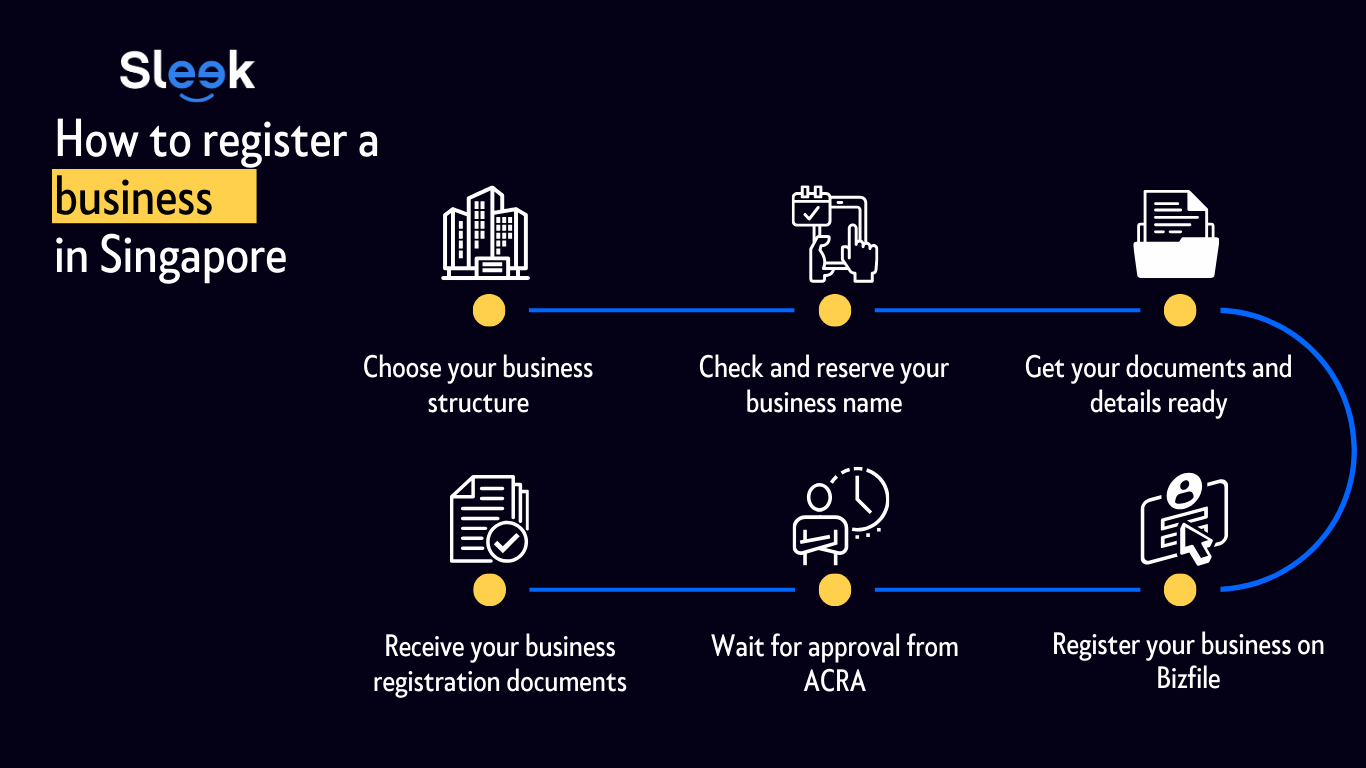
Steps on how to register a business in Singapore
How to start a business in Singapore – 6 steps

Starting a business in Singapore is simpler than it sounds if you know what to expect.

Here’s what to do:

1. Choose your business structure

First, decide what type of business you’re setting up. Are you freelancing on your own? Starting a team? Planning to raise funds later?

Your answer determines whether you register as a:

  • Sole Proprietorship (simplest, but no liability protection)
  • Private Limited Company (Pte Ltd) (most scalable and grant-eligible)
  • LLP/LP (only for specific cases)

2. Check and reserve company name

Go to Bizfile and run a name search. Your business name must be unique and avoid restricted terms. Once approved, your name is reserved for 120 days.

3. Get your documents and details ready

Before you start the actual application, have these on hand:

  • Business name (approved via Bizfile)
  • Local business address (physical or virtual — no P.O. boxes)
  • SSIC code (your business activity classification)
  • Identification documents (NRIC, FIN, or passport)
  • Consent to act (if you have directors or shareholders)
  • Company constitution (ACRA’s template works fine for most)

4. Register your business on Bizfile

Go back to Bizfile, select “Start a New Business”, and follow the prompts.

You’ll need to:

  • Enter company or sole prop details
  • Add key personnel (e.g., directors, shareholders, secretary)
  • Upload your supporting documents
  • Choose your registration period
  • Make payment

Latest fees:

  • S$115 – Sole Proprietorship (1 year)
  • S$175 – Sole Proprietorship (3 years)
  • S$315 – Private Limited Company

5. Wait for approval from ACRA

Most applications are approved within a few business days. It may take longer if your name includes sensitive terms or if additional approvals are needed (e.g., industry-specific activities).

6. Receive your business registration Singapore documents

Once approved, you’ll receive:

These are essential for opening a business bank account, applying for grants, and registering for GST (if applicable).

How long does it take to register a business in Singapore?

In most cases, it takes just 1–3 working days.
ACRA processes standard applications quickly, especially if your name is approved and all documents are in order. Using a professional service like Sleek can help avoid delays due to errors or missing details.

What to do after SG business incorporation?

Once you have your UEN and BizFile profile, take these steps to stay compliant and ready for growth:

  1. Open a business bank account
    Provide your ACRA Business Profile, UEN, and IDs. Some banks require in-person checks. Sleek Business Account simplifies banking, especially for foreign founders.
  2. Register for GST (if needed)
    Mandatory if revenue exceeds S$1M. Voluntary GST registration can help if you deal with GST vendors, want input tax credits, or serve corporate clients.
  3. Apply for business licences
    Certain sectors (F&B, education, finance, childcare, wellness) need approvals before operating.
  4. Appoint a company secretary
    For Pte Ltds, this is required within 6 months. They handle compliance, filings, and record-keeping. Sleek includes this service in all packages.
  5. Plan annual compliance
    Pte Ltds must hold AGMs (unless exempt), file Annual Returns with ACRA, and submit taxes to IRAS.
  6. Build your business
    Set up invoicing, grow your brand, track expenses, and explore grants now that you’re eligible.

DIY vs Sleek vs Traditional Firm: What’s the Difference?

Thinking of doing it all yourself on Bizfile? Here’s how that stacks up against using Sleek or going with a traditional firm.

FactorDIY on ACRA (Bizfile)SleekTraditional Firm
Admin timeHigh. You handle every form and documentLow. We manage the entire process for youMedium. Some hand-holding, some back-and-forth
Ease of useComplex. Requires understanding ACRA termsSimple. Online platform with expert helpMixed. Often offline and less transparent
Compliance accuracyRisky. Easy to miss legal or filing stepsHigh. Compliance is built into the serviceModerate. May charge extra for filings
Upfront costLow. S$115–S$315 depending on structureTransparent. Starts from S$650 (Including S$375 govt fees)High. Often S$800 or more
Hidden costsPossible. Errors can lead to late penaltiesNone. Clear package pricingLikely. May charge per document or add-on
Ongoing supportNone. You’re on your own after registrationYes. Real experts available when you need themLimited. Often business hours only
Best forFounders who are tech-savvy and confident navigating ACRA on their own, with time to spareEntrepreneurs who want a fast, compliant setup with expert support, modern tools, and no admin headachesBusiness owners who prefer in-person processes or have long-standing relationships with legacy providers

How Sleek helps you start a business in Singapore

Starting a business in Singapore shouldn’t feel like decoding a puzzle. Sleek removes the stress so you can launch with clarity and confidence.

What we do for you:

  • Prepare and file all your documents
  • Get your company name approved without hiccups
  • Ensure smooth, fast business registration
  • Provide everything in one place, be it a nominee director, secretary, or address
  • Support you with real experts, not automated replies

So, skip the paperwork and start your business right.

ACRA enables Singapore business registration. Sleek makes it effortless. Let our local team handle the details while you focus on growing your business.

Not sure which services are right for your business?

Answer a few quick questions and get a personalised recommendation.

Sleek is the preferred partner of entrepreneurs
Expertise in company incorporation, accounting, tax services, and compliance.
Trusted by over
450,000
businesses worldwide.
4.8/5
five stars icon
on Google
from 4,100+ reviews.
95%
satisfaction rate from
16,000 surveyed clients.

FAQs on how to register a business in Singapore

Do I really need to register my business if I’m just freelancing?

Yes, if you want to operate legally, invoice professionally, or open a business bank account. Even if you’re a solo freelancer, registering as a Sole Proprietor gives you a UEN, which most clients and platforms expect for payment processing, banking, and compliance.

What happens if I delay registering my business?

You risk running into issues with clients, banks, and the tax authority (IRAS). Without registration, you may not be able to open a business bank account, issue proper invoices, apply for grants or licences, or keep your income and taxes in order. Plus, operating informally may lead to penalties if your business exceeds S$1 million in annual revenue and you haven’t registered for GST.

Can I switch from a Sole Proprietorship to a Pte Ltd later?

Yes, but it’s a separate process, not an upgrade. You’ll need to:
  • Register a new Pte Ltd company
  • Close or transfer assets from your Sole Prop
  • Inform clients, banks, and IRAS of the change
That’s why many founders choose to start with a Pte Ltd if they plan to grow, hire, or raise funds.3a

What if my business name gets rejected?

You’ll need to pick another name and resubmit. Common reasons for rejection:
  • Too similar to an existing company
  • Contains restricted words without approval
  • Violates trademark guidelines

I’m overseas. Can I still register a business in Singapore?

Yes, you can register a business in Singapore even if you’re based overseas. The entire process is fully online through ACRA’s Bizfile portal, and no in-person visits are required. You’ll need a local director (a Singapore citizen, PR, or valid work pass holder) and a registered local address. If you don’t have either, Sleek can provide both, along with full incorporation support, so you can launch your business in Singapore remotely and stress-free.
View more

How to start a business in Singapore with no capital?

You can start a business in Singapore with no capital by choosing a low-cost structure such as a Sole Proprietorship, which requires no paid-up capital, or a Private Limited Company with a minimum of S$1 paid-up capital. You will still need to pay ACRA registration fees (S$115 to S$315), provide a registered address, and appoint a company secretary for a Pte Ltd. To keep costs low, start with service-based work, operate from home or a virtual office, use free digital tools, and apply for government grants for new businesses.

What is entity registration in Singapore?

Entity registration is the process of registering your business with ACRA to receive a Unique Entity Number (UEN). Fees start from S$100 for sole proprietorships and S$300 for private limited companies. Most applications are approved within minutes, but complex ones may take up to 15 working days.