You can start a business in Singapore as a foreigner without travelling to the country, and you can own 100% of a Singapore company. Most foreign founders choose a Private Limited Company (Pte Ltd), which requires at least one locally resident director and a registered Singapore address.
A registered filing agent can register a company in Singapore as a foreigner on your behalf. Incorporation completes within days when your name and business activity don’t need another agency’s approval.
A strong legal framework and pro-business regulations
A strategic location for expanding across Southeast Asia
A fast, digital incorporation process through ACRA’s Bizfile system
At a glance:Can foreigners start a business in Singapore? Yes. You can own 100% of a Singapore company and set it up remotely.
What do you need? A locally resident director, a Singapore registered address and a company secretary appointed within six months.
How do you register? Reserve a name, prepare your documents and submit the incorporation application through Bizfile or a registered filing agent, depending on your eligibility.
How much does registration cost? ACRA’s filing fees total S15 for name reservation and S$300 for incorporation.
How long does it take? Incorporation can be completed within days if no additional agency review is required. Banking may take weeks or longer.
Yes. Foreigners can start, register and fully own a Singapore company without living in Singapore. A private limited company needs at least one locally resident director (a nominee director or resident partner if you live overseas), a Singapore registered address, and a company secretary appointed within six months.
ACRA charges S$315 (S$15 for the name and S$300 for registration), and without Singpass you must file through a registered filing agent.
If you’re asking, “Do I need to live in Singapore to start a business?”, the answer is no. You do have to meet four legal requirements:
At least one locally resident director: This director must be a Singapore citizen, permanent resident, or someone holding a valid work pass. If you live overseas, you meet this through a nominee director or a resident partner.
A registered Singapore address: Your company must have a local physical address (P.O. boxes are not allowed). This is used for official correspondence and regulatory purposes.
A registered filing agent (if you don’t have Singpass): Without Singpass, you must file through a registered filing agent. Pass holders with Singpass, including EP and EntrePass holders, can file on Bizfile themselves.
Company secretary (within 6 months): ACRA requires every company to appoint a qualified company secretary within six months of incorporation to ensure ongoing compliance.
What are the key requirements for foreigners compared with locals?
The main difference is the local director obligation: residents can act as their own director, while overseas founders must appoint one. Otherwise, the incorporation requirements for foreigners and Singapore residents largely overlap.
Requirement
Singapore residents
Foreigners based overseas
Resident director
Can act as their own director
Must appoint a resident (nominee or partner)
Shareholding
100% ownership allowed
100% ownership allowed
Company secretary
Required within 6 months
Required within 6 months
Registered Singapore address
Required
Required (corporate service provider handles this)
Filing agent
Optional (can self-register via Bizfile)
Required unless you have Singpass
Can foreigners own a company in Singapore without a local shareholder? Yes, the shareholding row is identical for both groups.
Three ways to start a business in Singapore from overseas
There are three ways to start a business in Singapore from overseas: relocate, register remotely with a nominee director, or partner with a Singapore-based director. How can a foreigner start a business in Singapore without moving? The second and third routes cover that, while the first suits founders ready to relocate.
Option
Best for
Key requirement
Pros
Considerations
Relocate to Singapore
Founders planning to live in Singapore
Approved EntrePass or Employment Pass
Full control, can act as a director
Visa approval is required before acting as a director
Register from overseas
Remote founders, online businesses
Nominee director + service provider
No relocation needed, fast setup
Ongoing nominee director requirement
Partner with a local
Founders with trusted Singapore contacts
Local resident director (partner)
No need for nominee services
Requires trust and clear agreements
1. Relocate to Singapore and run the business yourself
Foreigners who want to be physically based in Singapore typically apply for:
An EntrePass (for innovative or venture-backed startups), or
An Employment Pass (EP) (if the company hires you as a director)
Once your pass is approved, you can act as the local resident director, fulfilling a key legal requirement.
2. Register a business in Singapore from overseas
If you prefer not to relocate, you can register a business in Singapore from overseas and manage it remotely.
In this case:
You retain full ownership and control
You appoint a nominee director through a licensed service provider to meet local requirements
3. Partner with a Singapore-based director
Some founders choose to work with a local partner or co-founder who can act as the resident director.
This approach may be suitable if:
You already have trusted contacts in Singapore
You want local market expertise or operational support
Which visa options are available if you plan to relocate?
If you plan to relocate, your two main options are the Employment Pass (EP) and the EntrePass, both issued by MOM. The right pass depends on your business model and background. For a detailed breakdown of eligibility criteria, see the guide to work passes for foreign business owners.
Pass
Who it is for
Key criteria
Employment Pass (EP)
Business owners hiring themselves as directors
Recognised degree, minimum qualifying salary, COMPASS score
EntrePass
Startup founders with innovative or venture-backed ideas
Must demonstrate innovation or funding; active business required
Note: You don’t need a work pass to own or direct a Singapore company from overseas; you need one only to work in Singapore. Once incorporated, your company can apply for an Employment Pass for you.
From 1 January 2027, MOM requires new EP applications to carry a monthly salary of at least S$6,000 (S$6,600 in financial services), and renewals follow from 1 January 2028. Dependant’s Pass holders need their own work pass to work in the business; MOM stopped issuing Letters of Consent to DP holders from 1 May 2021.
What are the steps to start a business in Singapore from abroad?
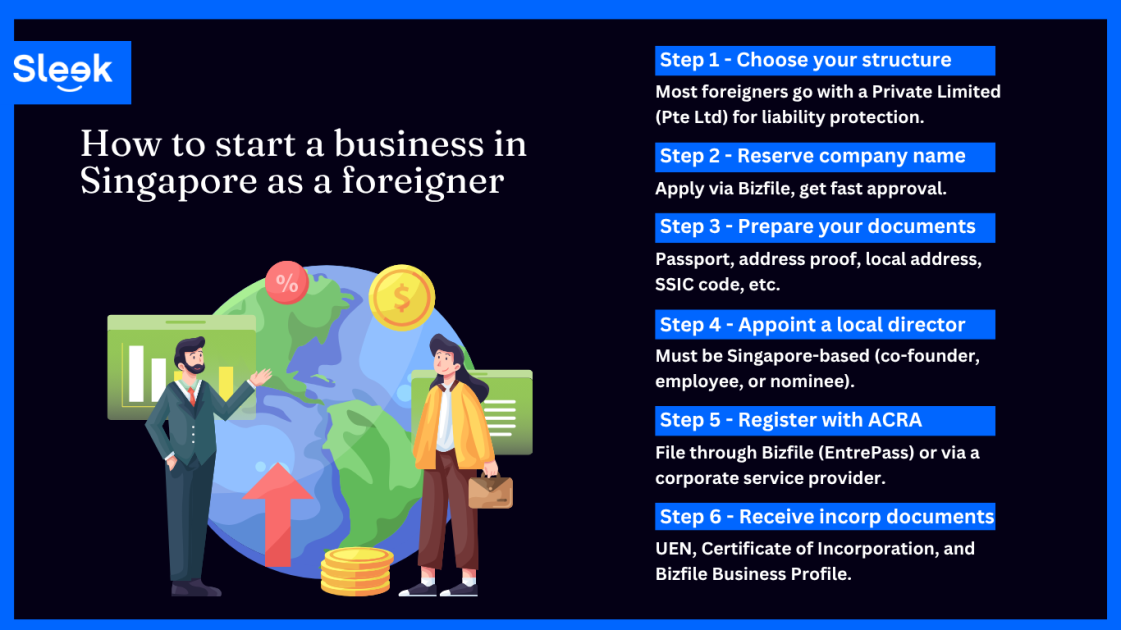
To start a business in Singapore from abroad, you choose a structure, reserve a name, prepare documents, appoint a local director, file with ACRA and receive your incorporation documents. Here is how to open a business in Singapore as a foreigner, step by step:
1. Choose your structure
A Pte Ltd is the structure that lets a foreign owner run the business from overseas without an authorised representative. Sole Proprietorships and Partnerships are possible, but only if you appoint at least one Singapore-based authorised representative (citizen, PR, or valid work pass holder) and engage a corporate service provider to file the application on your behalf.
2. Reserve your company name
File via Bizfile. ACRA approves names that don’t need another agency’s review shortly after you apply; names referred to another agency take longer. ACRA states that referred applications can take 14 days to 2 months.
Either a co-founder, a Singapore-based employee, or a nominee director from a service provider.
5. Register with ACRA
If you have Singpass, you can log in and submit the application through ACRA’s Bizfile yourself. Otherwise, foreigners must engage a registered corporate service provider to file on their behalf.
ACRA’s fees are fixed: S$15 for name reservation and S$300 for incorporation, for a total of S$315.
Ready to register? Here’s what Sleek handles for you
Register with Sleek: ACRA filing, nominee director, registered address, company secretary and business account, all handled remotely. You don’t need to travel or find local contacts, because Sleek provides your nominee director and address and files with ACRA. Packages to register a company in Singapore as a foreigner start from S$2,250, including ACRA fees.
Overseas founders face four main challenges: the local director requirement, bank account approval, ongoing compliance and choosing a reliable provider.
1. Local director requirement
Arrange your resident director before you reserve your company name; ACRA won’t register the company without one. If you’re not relocating, a nominee director for foreigners in Singapore covers this from day one.
2. Business bank account approval
Opening a corporate bank account is often the most time-consuming step for non-residents. A practical guide to opening a business bank account as a foreigner covers what banks require and which options are most accessible for non-residents. Incorporation completes in days; banking can take weeks to months depending on the bank and your business model.
3. Ongoing compliance obligations
As a foreigner doing business in Singapore, you must meet recurring obligations after incorporation: annual filings with ACRA, maintaining a company secretary, and tax filings with IRAS. These are not one-time tasks. Missing deadlines can result in financial penalties and, in serious cases, the company being struck off.
4. Choosing a service provider
Not all incorporation providers offer the same level of reliability or ongoing support. Fixing mistakes after incorporation is typically more expensive and time-consuming than getting the setup right from the start. Verify that any provider you engage holds an ACRA filing agent licence, and compare the best incorporation services for foreigners before you sign.
What happens after you register?
After you register, incorporation is only the first step, so take these actions right after setup. Starting a business in Singapore for foreigners doesn’t end with the certificate of incorporation:
Open a corporate bank account to receive payments and manage expenses
Set up accounting and bookkeeping to track income and stay compliant
Appoint a company secretary (if not already done during incorporation)
Ensure compliance systems are in place for annual filings and tax submissions
Which business structure is right for foreigners?
A Private Limited Company (Pte Ltd) is the right structure for most foreigners, because it allows 100% foreign ownership and limited liability. It’s also why the answer to “can foreigners own a company in Singapore?” is a clear yes.
If you’re comparing how to open a business in Singapore as a foreigner, the table below sets out the three options.
Structure
Best for
Key considerations
Private Limited Company (Pte Ltd)
Startups, SaaS, e-commerce, consulting, founders planning to scale or raise funding
100% foreign ownership. Limited liability. Recognised by investors and banks. Most flexible structure for long-term growth.
Branch Office
Existing foreign companies expanding into Singapore
Not a separate legal entity. Parent company remains liable for all branch obligations.
Representative Office
Market research only
Cannot generate revenue. Temporary setup with no pathway to a permanent commercial structure.
Private Limited Company (Pte Ltd): Recommended
Best for:
Startups, SaaS, e-commerce, consulting
Founders planning to scale or raise funding
Why:
Allows 100% foreign ownership
Provides limited liability protection
Recognised as a credible structure for investors and banks
Branch Office
Best for:
Existing foreign companies expanding into Singapore
Considerations:
Not a separate legal entity
Parent company remains liable
Representative Office
Best for:
Market research only
Limitations:
Cannot generate revenue
Temporary setup
Tip – Clear recommendation: Most foreign founders should choose a Private Limited Company, as it offers the flexibility and structure needed for long-term growth.
What are the ongoing costs to plan for?
Ongoing costs matter more than the one-off cost of registering a Singapore company, which ACRA fixes at S$315. As a foreigner doing business in Singapore, plan for them from the start.
These are recurring obligations, not one-time costs. Planning for them early helps you avoid unexpected expenses and stay compliant.
How Sleek helps with starting a business in Singapore as a foreigner
Sleek helps by handling your filings, nominee director, address, secretary and banking in one place, so starting a business in Singapore for foreigners takes no travel. The system is efficient, but handling everything from overseas can be challenging.
Managing ongoing compliance so you never miss a deadline
Whether you’re still asking how can a foreigner start a business in Singapore or you’re ready to file, Sleek gives you more than incorporation. You gain a partner who understands the challenges of running a company as a foreign founder. For more guides like this, browse the Sleek resources hub.
Ready to start your business in Singapore as a foreigner?
FAQs on start a business in singapore as a foreigner
Do I need to live in Singapore to start a business?
No. Incorporation, director appointments and document signing can all be done remotely through a registered filing agent, so you don’t need to be in Singapore to set up your company. You must still appoint at least one locally resident director to meet ACRA’s requirements and keep up with ongoing filing and reporting. Some banks may ask for a video call to verify your identity when you open a business account.
Can I open a Singapore business bank account as a foreigner?
Yes, foreigners can open a Singapore business bank account after incorporation. However, banks apply strict due diligence checks, especially for non-residents. You may be required to provide detailed business information and complete identity verification, sometimes through video calls or in-person visits, depending on the bank and your business profile.
What does a nominee director do, and for how long?
A nominee director for foreigners in Singapore is a non-executive, locally resident director who meets ACRA’s resident director requirement while you keep control of the business. They don’t run your day-to-day operations or make commercial decisions for you. The appointment lasts for the term in your service agreement; Sleek’s foreigner packages include 3, 6 or 12 months, and you can renew annually until you or another resident can take over the role.
Can my Singapore company apply for an Employment Pass for me?
Yes. Once your company is incorporated, it can apply to MOM for an Employment Pass for you, subject to MOM’s criteria. You need to meet MOM’s qualifying salary (currently S$5,600 a month, rising to S$6,000 for new applications from 1 January 2027) and pass the COMPASS framework with at least 40 points. MOM assesses each application on its own merits, so approval isn’t guaranteed.