Ismarina is the Head of Country at Sleek Singapore, where she leads strategic growth, operational excellence, and service delivery. With over 20 years of experience across finance, compliance, and business leadership, she oversees Sleek’s full range of services. These include CFO advisory, accounting, tax, GST, payroll, corporate secretarial, immigration, and client support.
She is known for her clarity in leadership and strength in execution. Ismarina has led large, cross-functional teams in both in-person and virtual settings. She has delivered strong P&L outcomes, scaled operations, and built trusted relationships across businesses of all sizes.
Ismarina combines practical insight with academic depth. She holds an MSc (Hons) in Management, is a Fellow CPA, an ASEAN CPA, and a CIMA-qualified Chartered Global Management Accountant. Her expertise covers project management, construction and nonprofit accounting, judicial management, and liquidation. Her experience running an accounting firm and offering CFO services gives her a sharp understanding of what clients need to grow and stay ahead.
She is also a committed mentor who supports her team’s growth with care and purpose. Before Sleek, she held senior roles at the Project Management Institute and the Football Association of Singapore. She played a key role in leading digital transformation and shaping regional strategy.
Outside of work, you’ll find her immersed in books, sewing projects, and knitting, or cheering on her family at sporting events. She brings the same passion for excellence to everything she does, both professionally and personally.
96% customer satisfaction from 16,000+ survey responses.
In this article
Share this post
Facebook
LinkedIn
WhatsApp
Copy to clipboard
Key takeaways
A shareholders’ agreement is a private contract between shareholders. It is not filed with ACRA and stays confidential.
Singapore law does not require one, but without it, minority shareholders have very limited contractual protection.
The most critical clauses for co-founders are voting rights, drag-along and tag-along rights, pre-emptive rights, deadlock resolution, and vesting schedules.
Sleek handles the ACRA statutory work (Constitution, share issuance, corporate secretary). A Singapore law firm drafts the SHA itself.
A shareholder agreement in Singapore is one of those documents nobody thinks twice about until the moment they desperately need one. If you are incorporating a Pte Ltd with a co-founder, or you have already signed equity and nothing is formally documented between you, you are more exposed than you realise.
The Singapore Companies Act (Cap. 50) does not require a shareholders agreement (SHA) for a Pte Ltd. But “not required” does not mean “not important.” Without one, disputes between shareholders default to your Constitution and the Act, both of which offer limited contractual protection, especially for minority shareholders.
This guide covers what a shareholders agreement is, how it differs from your Constitution, the key clauses every co-founder setup needs, and when you genuinely do not need one. If you are at the stage of registering a company in Singapore, this is the right time to read it.
Quick answer: Shareholders’ agreement in Singapore
S$1,500 to S$5,000 via a Singapore law firm (as of 2026)
Filed with ACRA
No. Private document, stays confidential
Is a shareholders agreement legally required in Singapore?
No. The Companies Act (Cap. 50) does not require a Pte Ltd to have a shareholders agreement. A company can be incorporated with nothing beyond the Constitution and still be fully compliant with ACRA.
The practical problem is that the Act sets default rules for companies, not for arrangements between individual shareholders. If a co-founder wants to sell their shares to a competitor, or if two equal shareholders cannot agree on a major decision, or if one founder stops contributing and the other wants to buy them out, the Act gives you limited tools to resolve any of this without going to court.
The oppression remedy under s. 216 of the Companies Act is available to minority shareholders being treated unfairly. But s. 216 claims are slow, expensive, and adversarial. A well-drafted SHA pre-empts this entirely by specifying in advance what happens in each scenario.
The question is not whether an SHA is required. It is whether you want to spend time in court arguing about what you and your co-founder meant when you shook hands.
Shareholders agreement vs. Company Constitution: What is the difference?
This is the question most founders ask first, and the answer comes down to audience and scope.
The short version: the Constitution tells the company how to run itself. The SHA tells the shareholders how to treat each other. You need both if you have more than one shareholder.
What should a Singapore shareholders agreement include?
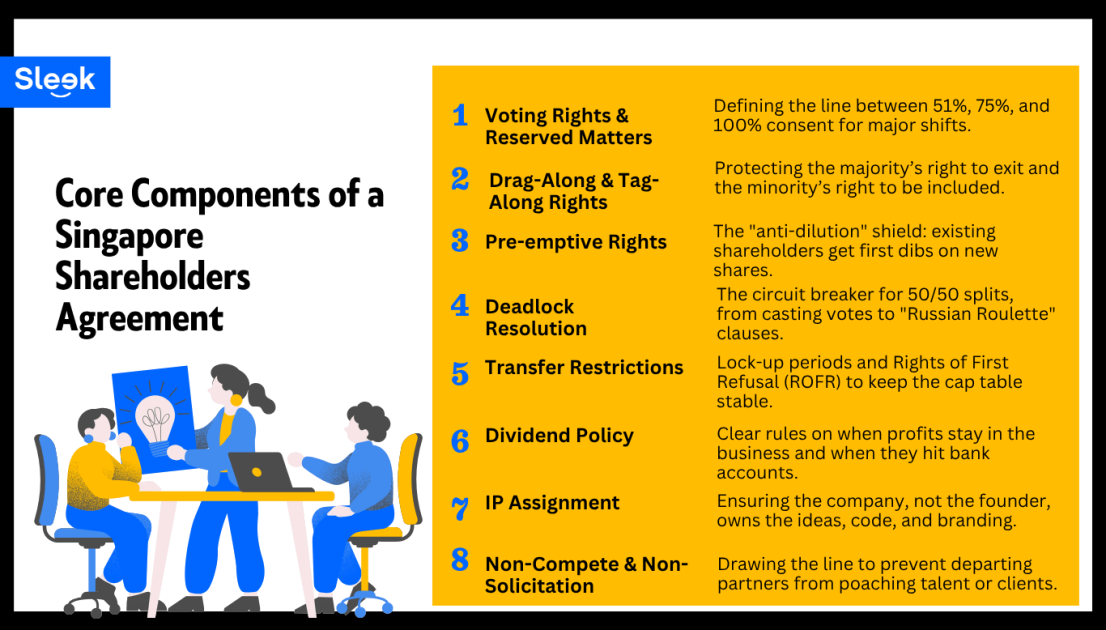
8 essential clauses every co-founder needs in their Shareholders Agreement.
There is no prescribed format under Singapore law. But the clauses below appear in almost every well-drafted SHA for a Pte Ltd with two or more co-founders.
Voting rights and reserved matters. Defines which decisions require a simple majority, a supermajority (typically 75%), or unanimous consent. Reserved matters usually include issuing new shares, taking on significant debt, or changing the core business model.
Drag-along and tag-along rights. A drag-along clause lets a majority shareholder compel minority shareholders to sell alongside them in an acquisition. A tag-along clause lets minority shareholders join a sale on the same terms if the majority sells. Both protect different parties, and both need to be explicit.
Pre-emptive rights on new shares. If the company issues new shares, existing shareholders have the right to buy them first in proportion to their current holding, before they are offered to outsiders. Without this clause, founders can be diluted without consent. Founders navigating how this interacts with their shareholding structure will find it useful to understand preference shares vs ordinary shares before finalising their SHA terms.
Deadlock resolution. What happens when two 50% shareholders cannot agree? Common mechanisms include a casting vote for the chairperson, a Russian Roulette clause where one party names a price and the other must buy or sell at that price, or a cooling-off period with escalation to mediation. Without one, a deadlock can paralyse a company indefinitely.
Transfer restrictions. Limits on when and to whom shares can be transferred. This typically includes a lock-up period after incorporation and a right of first refusal, meaning existing shareholders get the first opportunity to buy before any third party does. Founders who want to understand the mechanics of how this works should read up on share transfers in Singapore before their SHA is drafted.
Dividend policy. When profits are distributed, how, and at what threshold? This matters particularly for Pte Ltds where founder-shareholders are also directors drawing salaries — the SHA should make clear how surplus profit is handled and who decides.
IP assignment. Confirms that intellectual property created by founder-shareholders in connection with the business belongs to the company, not to the individual. This is a standard investor requirement and is frequently overlooked in early-stage setups.
Non-compete and non-solicitation. Restricts departing shareholders from competing directly or poaching clients and employees for a defined period after exit.
What are vesting schedules and why do Singapore co-founders need them?
This is the area that catches foreign founders most off-guard: Singapore company law does not include automatic vesting. If you give a co-founder 40% of your company at incorporation and they leave six months later, they keep 40%. There is no built-in mechanism to claw it back.
Vesting must be drafted explicitly, either in the SHA or in a separate founder vesting agreement. The common practice in Singapore startups as of 2026 is a four-year vesting schedule with a one-year cliff:
No shares vest in the first 12 months (the cliff)
25% vest at the 12-month mark
The remaining 75% vest monthly over the following 36 months
This structure protects all founders. If a co-founder exits before the cliff, they leave with no vested equity. If they leave after two years, they keep only the shares that have vested to that point.
For foreign co-founders who may be based in different jurisdictions, vesting is not just a fairness mechanism. It is a structural protection for the business if one party’s circumstances, visa status, or commitment changes.
When do you not need a shareholders agreement in Singapore?
Not every company needs one. There are three situations where an SHA is genuinely unnecessary.
Sole director, sole shareholder
If you are the only shareholder, there is no one else to govern arrangements with. The Constitution is sufficient.
Wholly-owned subsidiary
If your Singapore Pte Ltd is 100% owned by a parent company, the parent-level governance documents already handle shareholder arrangements. An SHA between the parent and a wholly-owned subsidiary adds no practical value.
Short-term SPV with a defined exit
If the company is a special-purpose vehicle set up for a single transaction with a clear, documented exit timeline and all parties have agreed to the mechanics in a separate transaction document, a full SHA may be disproportionate to the purpose.
Outside these three scenarios, if there are two or more shareholders with different equity stakes, different roles, or different expectations about the future of the business, an SHA is worth the cost of drafting.
When do you not need a shareholders agreement in Singapore?
Not every company needs one. There are three situations where an SHA is genuinely unnecessary.
Sole director, sole shareholder
If you are the only shareholder, there is no one else to govern arrangements with. The Constitution is sufficient.
Wholly-owned subsidiary
If your Singapore Pte Ltd is 100% owned by a parent company, the parent-level governance documents already handle shareholder arrangements. An SHA between the parent and a wholly-owned subsidiary adds no practical value.
Short-term SPV with a defined exit
If the company is a special-purpose vehicle set up for a single transaction with a clear, documented exit timeline and all parties have agreed to the mechanics in a separate transaction document, a full SHA may be disproportionate to the purpose.
Outside these three scenarios, if there are two or more shareholders with different equity stakes, different roles, or different expectations about the future of the business, an SHA is worth the cost of drafting.
How Sleek helps founders get incorporated and stay compliant
Sleek does not draft shareholders agreements that require a Singapore-qualified law firm, and you should use one. What Sleek handles is everything in the statutory and administrative layer that sits alongside your SHA:
Constitution drafting and ACRA filing
Share issuance and share certificate preparation
Nominee director services for foreign founders who need a locally resident director under the Companies Act s. 145
Understanding the rights and obligations of a shareholder in Singapore once shares are issued
With 77,579 new companies incorporated in Singapore in 2025 and foreign founder interest continuing to grow alongside the MAS fintech framework updates and EntrePass scheme expansion, getting the statutory layer right from day one matters more than most founders expect.
Your company name is just the first step. Let Sleek handle the rest.
No. The Singapore Companies Act (Cap. 50) does not require a Pte Ltd to have a shareholders agreement. Incorporation requires only a Constitution, filed with ACRA. Without an SHA, shareholder disputes default to the Act, which offers limited contractual protection, particularly for minority shareholders in a co-founded company.
What is the difference between a shareholders agreement and a company Constitution in Singapore?
The Constitution is a public document filed with ACRA that governs how the company operates: director appointments, share classes, voting at meetings. The SHA is a private contract between shareholders covering how they treat each other; equity transfers, vesting, deadlock, and exit terms. The SHA typically prevails on shareholder-level matters where the two conflict, but it does not bind shareholders who did not sign it.
Can a shareholders agreement override the company Constitution in Singapore?
Between the parties who signed it, yes. The SHA is a binding contract and its terms take precedence over the Constitution on matters it specifically addresses. It cannot override the Companies Act itself, and it does not bind shareholders who were not party to it. For this reason, all current shareholders should sign the SHA at or before incorporation.
How much does it cost to draft a shareholders agreement in Singapore?
Costs vary by complexity and the law firm engaged. For an early-stage Pte Ltd with two to four co-founders, a basic SHA typically ranges from S$1,500 to S$5,000 as of 2026. More complex arrangements involving multiple share classes or international parties cost more.
Do I need a shareholders agreement if I am the only shareholder?
No. If you are the sole shareholder, there are no other parties to govern arrangements with and the Constitution is sufficient. An SHA becomes necessary when there are two or more shareholders with different stakes, roles, or expectations, which is the typical co-founder situation this guide addresses.