Singapore intellectual property protection is a smart way to turn your original ideas into lasting business assets. From brand names and creative content to inventions and product designs, your IP reflects your hard work and vision.
This guide walks you through the different types of IP available in Singapore and how to protect what makes your business unique.
Intellectual property (IP) is a formal term for creations of the mind. These include things like your logo, a new app, a tagline, a product design, or even a unique process your business uses.
In Singapore, protecting intellectual property means securing the ideas and innovations that drive your business forward. Whether you’re building a startup, growing a creative brand, or launching a new product, IP protection helps you maintain ownership, create value, and stay ahead of the competition.
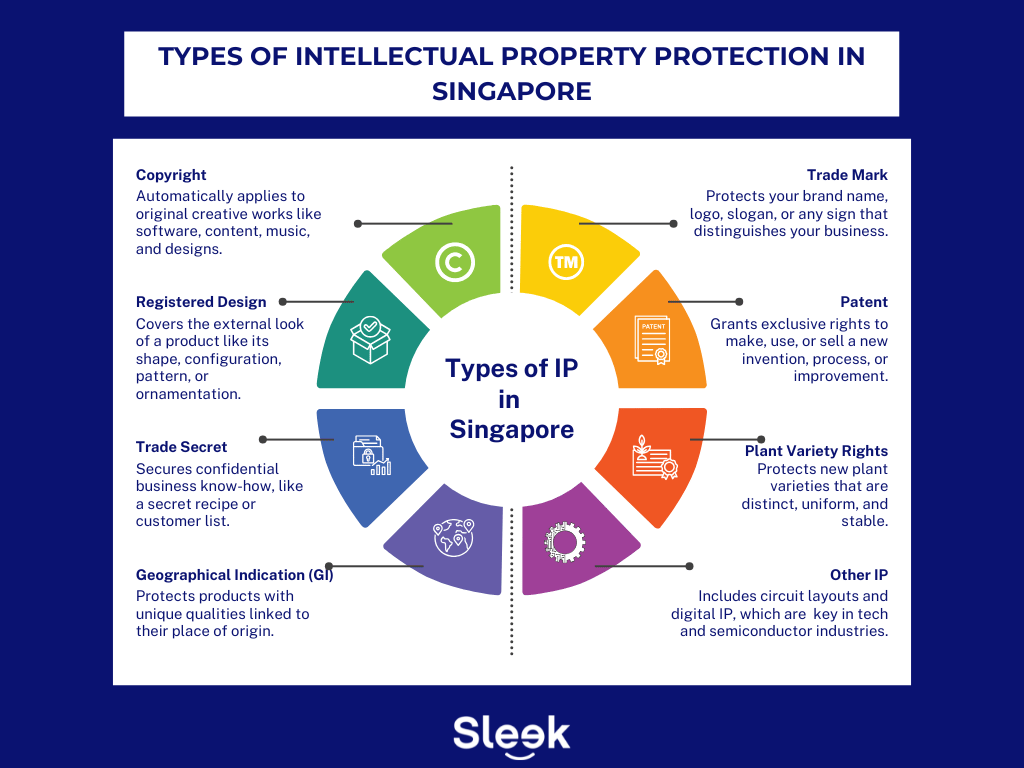
Managed by the Intellectual Property Office of Singapore (IPOS), the IP framework here is one of the most business-friendly in the world. It allows you to register and enforce rights over different types of IP, each tailored to a specific kind of asset:
Trademarks – for your brand name, logo, or tagline
Patents – for inventions, new processes, or improvements
Copyright – for original creative work like software, content, or designs
Registered designs – for the visual appearance of a product
Trade secrets – for confidential business knowledge
Geographical indications – for products linked to a specific region
Plant variety rights and circuit layouts – for specialised industries
Knowing which type applies to your business is the first step to building a strong IP foundation.
Types of intellectual property protection in Singapore
Types of Intellectual Property Protection in Singapore
Different ideas need different kinds of protection. Whether it’s your brand, product design, or a technical invention, Singapore offers specific IP rights to help you secure what matters.
Here’s a quick look at the main types and how they work for your business.
As the copyright owner, you have exclusive rights to:
Reproduce or copy the work
Publish, perform, or display it
Adapt it or license it to others
In most cases, this protection lasts for the life of the creator plus 70 years.
While you don’t need to file anything to claim copyright, it’s smart to keep clear records of your work, like timestamps, drafts, signed contracts, or emails, to make ownership easier to prove if a dispute ever arises.
Registered Design
A registered design protects the external appearance of a product. This includes its shape, configuration, pattern, or ornamentation. Think of the distinct shape of a beverage bottle or the pattern on a piece of fabric.
Unlike copyright, a registered design must be new and not previously published anywhere in the world. Registering a design with the government agency gives you the exclusive right to use it for an initial 5 years, renewable every 5 years for up to 15 years, with renewal fees increasing over time. This prevents competitors from making products that look like yours.
The application fee is S$200 per design. Renewal fees are:
S$220 for years 6–10
S$330 for years 11–15
S$440 for years 16–20
S$550 for years 21–25
Trade Secret
A trade secret is any confidential information that gives your business a competitive edge, like a secret recipe or a customer list. Trade secrets are protected through confidentiality measures like NDAs, access controls, and internal security protocols.
There is no time limit on trade secret protection, but enforcement relies on proving the information was confidential and improperly shared. Trade secrets cannot be registered like patents, but may be enforced under breach of confidence law.
Example: Think of Coca-Cola’s formula or Google’s search algorithm. Both are trade secrets that aren’t patented but are rigorously safeguarded.
Geographical Indication
A Geographical Indication (GI) is a sign used on a product that has a specific geographical origin. GIs are a formal part of the intellectual property protection landscape, especially for producers of wine, spirits, cheeses, and regional delicacies.
In Singapore, registering a GI costs S$1,500 and gives protection for 10 years, renewable for another 10 years at S$940 (before expiry) or S$1,240 (after expiry).
These products possess qualities or a reputation that are due to that origin. This type of IP helps protect the reputation of regional products.
Trade Mark
A trade mark is a sign you use to distinguish your products or services from your competitors. This sign can be a name, a logo, a slogan, or even a sound. Think about the most recognisable brands you know.
That iconic swoosh on a pair of sneakers or the golden arches you spot from the highway are powerful trademarks. They immediately communicate a standard of quality and a set of expectations without using a single word.
Patent
A patent is an intellectual property right granted by the government for an invention. The invention itself can be a physical product, a specific part of a product, a new process or device, or even an improvement on something that already exists.
Getting a patent gives you, the owner, the exclusive right to make, use, and sell your invention for a specific period. It effectively stops anyone else in the country of registration from copying, manufacturing, or profiting from your idea without your consent. This robust protection is a cornerstone of a solid IP strategy, including patents and other IP types.
Plant Variety Rights (PVRs)
These protect new plant varieties that are distinct, uniform, and stable. If your business involves agriculture or horticulture, PVRs give you exclusive control over the commercial use of your new variety.
PVRs are valid for up to 25 years from the date of grant, with annual renewal. You must register the variety with IPOS to enjoy protection
Other IP
This includes the layout designs of integrated circuits and digital intellectual assets. These are critical in industries like semiconductors and electronics. Singapore protects layout-designs of integrated circuits under a dedicated law.
No registration is required if the design is original and first used commercially within 5 years. Protection lasts 10 years from first use or 15 years from creation, whichever is earlier.
How to determine if an idea can be patented?
Not every new idea qualifies for a patent. Your invention must meet three specific criteria set by the IPOS to be considered patentable. You need to meet all three.
Novelty: Your invention must be new. This means it has never been seen before, not just in Singapore but anywhere in the world. This is why keeping your invention a secret until you file an application is so critical. If you talk about it publicly, demonstrate it, or try to sell it before filing, you risk losing its novelty. Once it is public knowledge, it is generally no longer patentable.
Inventive step: The idea must involve an inventive step. This means your invention has to be a genuine improvement over existing products or processes. The change cannot be obvious to someone with technical skill in that particular field.
Industrial applicability: Your invention needs to be useful and capable of being made or used in some kind of industry. It has to serve a practical purpose.
Some types of IP, such as copyright and trade secrets, are automatic or managed internally. Others, such as trademarks and patents, require formal registration through the Intellectual Property Office of Singapore (IPOS).
Here’s a quick look at how these work.
Trademarks (Brand Protection)
You can register a trademark to protect your business name, logo, or tagline. Once approved, it gives you exclusive rights in Singapore for 10 years, with the option to renew.
If you also want protection outside Singapore, you can apply through the Madrid Protocol via IPOS. This allows you to register your trade mark in multiple countries using a single application (Form MM2(E)), subject to additional fees.
If you need faster processing, IPOS also offers the SG Trade Marks Fast programme (from May 2025), which provides a first examination report or publication notice within 3–6 weeks. Additional acceleration fees apply (from S$200–S$250 per class). Acceleration must be requested during initial filing via Form TM4. It cannot be added later.
Patents (Invention Protection)
Patent protection must be formally registered through IPOS and can be filed locally or via international routes like the Patent Cooperation Treaty (PCT).
If your IP strategy includes innovation, patent protection is worth exploring early.
Why Singapore is a global IP hub
Singapore has established itself as a global IP hub, respected for its strong legal framework and efficient processes. The Singapore government actively promotes the country as a strategic location for managing intellectual property. This makes it an attractive destination for both local innovators and international companies.
The country’s focus on IP is a key part of its economic strategy, encouraging innovation and supporting foreign trade. IPOS offers various programs and services to help businesses protect and commercialize their intangible assets. You can use their online portal to manage IP globally through the IPOS IP Hub eServices.
It adds credibility and strength to your IP portfolio. The official government agency website for IPOS is a comprehensive resource for all IP matters.
Enforcing your IP and avoiding scams
Securing your IP rights is only half the battle; you must also be prepared to enforce them and be vigilant against scams. If you discover copyright infringement or someone using your trademark without permission, you can:
Sending a cease-and-desist letter
Take legal action through the courts
Claim damages
A growing threat to IP owners is impersonation scams. Scammers may create fake websites or send official-looking emails pretending to be from a government agency like IPOS. These communications often request payments for fake services or try to get you to share sensitive information.
It is crucial to be cautious. Government agencies communicate through official channels, and you should always verify any unexpected requests for money or data. Never transfer money or disclose bank login details based on an unsolicited email or phone call, even if they claim to be from a government agency.
Always identify official website links before clicking. A secure, official government website will typically use a ‘.gov.sg’ domain. Do not share sensitive personal data with unverified service providers or on non-secure websites.
What does it cost to protect IP in Singapore
Protecting your IP is an investment in your business’s future. The costs can vary quite a bit depending on what you are protecting and how complex it is.
S$280 for pre-approved descriptions; S$380 for custom ones. Valid for 10 years. See renewal breakdown below.
Patent
From S$2,200+
Includes filing (S$170), search & examination (from S$2,050). Agent fees may apply. Annual renewal begins Year 5.
Registered Design
S$200 (application)
Renewals every 5 years (S$220–S$550, up to 25 years total).
Geographical Indication
S$1,500 (registration)
Valid for 10 years. Renewal: S$940 (on time), S$1,240 (late).
Trademark renewal fees (After 10 years)
After 10 years, you must renew your trademark:
S$440 for on-time renewal
S$645 for late renewal
S$705 for restoration after expiry
These are one-time filing fees per class of goods or services. Your trademark is valid for 10 years, with unlimited renewals in 10-year blocks.
A note on patent costs
Patents require a much bigger financial commitment, which makes sense given the powerful protection they offer. The official government fees for filing a patent application in Singapore start around S$2,200. But, this does not include fees for a patent agent, which are highly recommended.
With agent fees and potential complexities, the total cost for getting a patent can often exceed S$10,000–S$15,000. Once granted, remember that annual renewal fees are needed to keep the patent in force.
How Sleek helps with Singapore Intellectual Property Protection
Your ideas and creations are the foundation of your business, and they deserve to be protected. Taking the time to understand your options for Singapore intellectual property protection is not just a legal task. It is a fundamental business strategy.
At Sleek, we help founders, entrepreneurs, and growing businesses in Singapore protect what matters most. Here’s how:
Guidance on what to protect: Not sure if it’s a trademark, patent, or design? We help you identify the right IP strategy for your business.
End-to-end IP protection support: From trademark class selection to patent design and filing assistance, we simplify every step.
Business-first advice: We tailor recommendations based on your goals, whether it’s brand expansion, investor-readiness, or licensing opportunities.
With Sleek, you get not just compliance but also clarity, confidence, and a partner who cares about protecting your ideas as much as you do.
Not always. Some types of IP, like copyright and trade secrets, are automatically protected once created or properly safeguarded. However, trademarks, patents, and registered designs must be formally registered through IPOS to give you full legal rights and easier enforcement.
A trademark protects your brand, like your name, logo, or slogan, while a patent protects an invention or technical solution. Trademarks are about identity; patents are about innovation.
Only if your idea includes a specific invention or process that can be patented. General business ideas or concepts (like “an app that connects pet owners”) can’t be patented unless there’s a technical innovation behind them. You might protect parts of it as trade secrets or via copyright (for written content or software).
Yes, especially for patents or trademarks. IP filings involve technical requirements, and mistakes can lead to rejections or limited protection. Sleek can guide you through the process or connect you with trusted agents, saving time and avoiding costly errors.