Ismarina is the Head of Country at Sleek Singapore, where she leads strategic growth, operational excellence, and service delivery. With over 20 years of experience across finance, compliance, and business leadership, she oversees Sleek’s full range of services. These include CFO advisory, accounting, tax, GST, payroll, corporate secretarial, immigration, and client support.
She is known for her clarity in leadership and strength in execution. Ismarina has led large, cross-functional teams in both in-person and virtual settings. She has delivered strong P&L outcomes, scaled operations, and built trusted relationships across businesses of all sizes.
Ismarina combines practical insight with academic depth. She holds an MSc (Hons) in Management, is a Fellow CPA, an ASEAN CPA, and a CIMA-qualified Chartered Global Management Accountant. Her expertise covers project management, construction and nonprofit accounting, judicial management, and liquidation. Her experience running an accounting firm and offering CFO services gives her a sharp understanding of what clients need to grow and stay ahead.
She is also a committed mentor who supports her team’s growth with care and purpose. Before Sleek, she held senior roles at the Project Management Institute and the Football Association of Singapore. She played a key role in leading digital transformation and shaping regional strategy.
Outside of work, you’ll find her immersed in books, sewing projects, and knitting, or cheering on her family at sporting events. She brings the same passion for excellence to everything she does, both professionally and personally.
96% customer satisfaction from 16,000+ survey responses.
In this article
Share this post
Facebook
LinkedIn
WhatsApp
Copy to clipboard
Key takeaways
Voluntary registration suits businesses below S$1 million that pay a lot of GST on local costs or sell to GST-registered clients, because input-tax recovery and credibility can outweigh the admin.
It is a two-year commitment with quarterly GST F5 filing, GIRO, and mandatory InvoiceNow e-invoicing for all new voluntary registrants since 1 April 2026.
For price-sensitive B2C customers who cannot reclaim GST, charging 9% can erode your competitiveness, so weigh the trade-off before you commit.
Voluntary GST registration in Singapore allows a business with a turnover below the S$1 million threshold to register for Goods and Services Tax (GST), primarily to reclaim the 9% input tax on its costs and appear more established to B2B clients. It also brings quarterly filing, a two-year commitment, and InvoiceNow e-invoicing.
The real decision is simple: does what you reclaim outweigh what you take on? In this guide, we break down the real numbers, the risks, and the benefits to help you make an informed decision.
In short, Voluntary GST registration lets a Singapore business below the S$1 million threshold register anyway, mainly to reclaim the 9% input tax on business costs and to look more established to B2B clients. It tends to pay off for B2B businesses with meaningful GST-bearing expenses, but it adds quarterly filing, a two-year commitment, mandatory InvoiceNow e-invoicing for all new voluntary registrants, and a price rise for B2C customers who cannot reclaim the tax.
What is voluntary GST registration in Singapore?
Voluntary GST registration is when a business chooses to register for GST even though its annual taxable turnover is below the S$1 million compulsory threshold. Once registered, you charge the prevailing 9% rate on taxable sales, file GST returns each quarter, and meet the same IRAS obligations as a compulsorily registered business.
To register voluntarily, IRAS expects you to be carrying on a business in Singapore and to make, or firmly intend to make, taxable supplies. You also need to be ready to meet GST responsibilities, which is why eligibility for zero-rated exports differs from zero-rated and exempt supplies you cannot reclaim against. The commitment lasts a minimum of two years.
When does voluntary GST registration make sense?
Voluntary registration usually pays off when you reclaim more GST than the admin costs you, and when charging GST will not scare off your customers. A few patterns make the case clearly.
You buy locally but sell overseas. Exports are zero-rated, so you charge no GST on sales yet still reclaim the GST on local rent, software, and services.
Your costs carry a lot of GST. If rent, inventory, equipment, or professional fees come with 9% attached, registration lets you recover that input tax.
Your clients are GST-registered. B2B customers reclaim the GST you charge, so your price stays competitive while you gain the input-tax benefit.
You are scaling toward S$1 million. Registering early lets you set pricing, systems, and invoicing before registration becomes compulsory.
Sleek models whether voluntary GST pays off and handles the filing if it does.
In 2026, the GST rate in Singapore is 9%. Voluntarily registered businesses must follow the same rules as compulsory ones, like charging GST, filing quarterly, and meeting IRAS requirements.
To register voluntarily, your business must:
Be actively operating in Singapore
Intend to make taxable supplies (now or in the near future)
Be able to comply with GST responsibilities, including record-keeping and return filing
Have a GIRO arrangement in place
Complete the GST e-learning course
Be prepared for a 2-year minimum commitment
Voluntary GST registration vs. Not registering: Quick comparison
Not sure if it’s really worth the effort for your business? Here’s a side-by-side comparison of the key differences to help you decide faster:
Feature / Obligation
Voluntarily Registered Business
Not Registered Business
Can claim input GST
Yes
No
Must charge 9% GST
Yes
No
Quarterly GST filings
Yes
No
InvoiceNow compliance (2025–26)
Required
Not required
Minimum 2-year commitment
Yes
No
Best for B2B
Often
Depends
Best for B2C
Risky
Often
Admin & paperwork
More
Less
Cost-benefit analysis
Wondering how much you can actually save with voluntary GST registration? Well, it can unlock serious cash flow if your business spends enough on GST-inclusive items.
That’s over S$14,800 across the 2-year commitment, back into your business, not buried in admin.
This kind of ROI makes voluntary GST registration a smart move for many businesses, especially those with GST-registered clients.
Tip
Model the decision across the full two years, not one strong month. Because voluntary registration locks you in for two years, compare two years of input-tax recovery against two years of filing and any B2C pricing impact before you apply.
How does input-tax recovery work?
Input-tax recovery means reclaiming the 9% GST you pay on business purchases once you are registered. When you are not registered, that GST is a sunk cost. After registration, you offset it against the GST you collect, or claim a refund if you collect less than you pay.
Here is a simple illustration for a business with high local costs:
Item
Amount
Local GST-bearing costs
S$8,000 per month
Input tax reclaimed at 9%
S$720 per month (S$8,640 per year)
Sleek GST quarterly filing (list price)
S$300 per year
Net annual benefit (before your own time)
About S$8,340
Over the two-year commitment
Roughly S$16,680
The maths only works if you make taxable or zero-rated supplies, so you are entitled to reclaim, and if your costs genuinely carry GST. A business with low GST-bearing expenses reclaims little.
Do you need InvoiceNow if you register for GST voluntarily?
InvoiceNow is now a condition of voluntary GST registration, not an optional extra. Since 1 April 2026, every new voluntary registrant must transmit invoice data to IRAS through the InvoiceNow (Peppol) network, regardless of when the business was incorporated.
The rule arrived in phases. From 1 November 2025, it applied to newly incorporated companies registering voluntarily within six months of incorporation, then widened to all new voluntary registrants from 1 April 2026.
In practice, you need a Peppol ID and an InvoiceNow-ready accounting system before you apply, and IRAS can reject an application that does not meet the requirements. The full setup is covered in our guide to InvoiceNow setup.
What are the pros and cons of registering voluntarily for GST in Singapore?
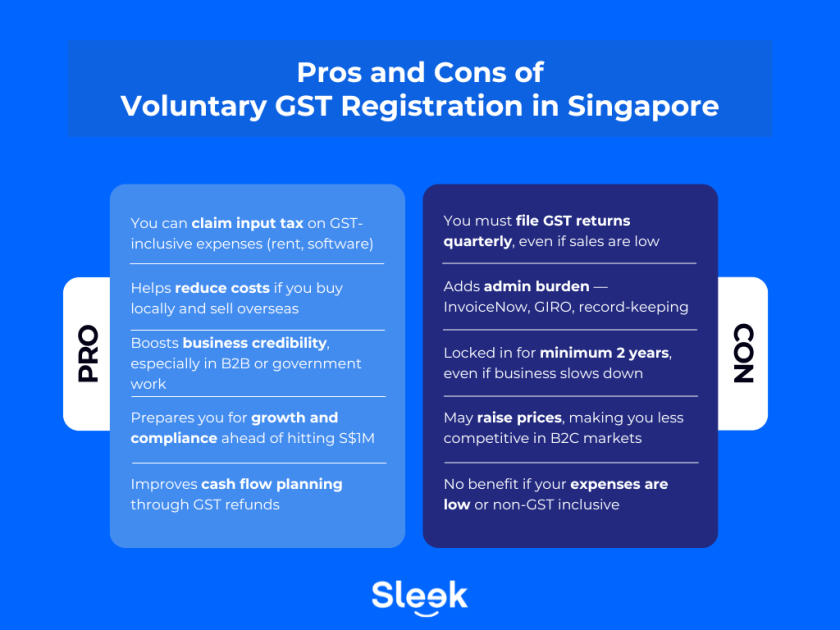
Pros and cons of Voluntary GST registration
If you’re still on the fence regarding registering for GST voluntarily, here’s a quick side-by-side look at the upsides and trade-offs to help you decide faster.
Pros
Reclaim input tax on GST-inclusive business costs such as rent and software
Reduce costs if you buy locally but sell overseas on zero-rated terms
Signal credibility to B2B clients and government-linked entities
Get your systems ready before crossing the S$1M compulsory threshold
Improve cash flow planning through quarterly GST refunds
Cons
Quarterly F5 filing required even during low-sales periods
Real admin burden: InvoiceNow setup, GIRO arrangement, and ongoing record-keeping
Locked in for a minimum two years with no early exit if business slows
Charging 9% GST can raise your prices and hurt competitiveness in B2C markets
No meaningful benefit if your expenses are low or not GST-inclusive
How to register for GST voluntarily in Singapore
Going in for voluntary GST registration ? Here’s how to do it:
1. Complete the GST e-Learning course
Before IRAS lets you register voluntarily, you’ll need to take their short online course. It covers your responsibilities as a GST-registered business and helps ensure you know what you’re signing up for.
2. Make sure you’ve a GIRO-enabled business account
IRAS requires all voluntarily registered businesses to use GIRO for both GST payments and refunds. If you haven’t already, set up a GIRO arrangement through your corporate bank account.
3. Register for GST via IRAS’ myTax portal
Once you’re ready, head to the myTax Portal and submit your application online under “GST Registration.” Make sure you have your Corppass login ready. You’ll need to upload basic business info and supporting documents.
4. Set up InvoiceNow and maintain proper records
From 1 November 2025, InvoiceNow is mandatory if you’re a newly incorporated company applying for GST. From 1 April 2026, it applies to all new voluntary GST registrants. If that’s you, you’ll need to sign up for InvoiceNow, get a Peppol ID, and use an InvoiceNow-ready system before applying.
Once registered, you’ll send invoice data to IRAS for most sales and purchases. It makes compliance easier, speeds up refunds, and lowers audit risk.
5. Wait for IRAS approval (Usually 10–30 days)
IRAS typically processes voluntary GST registrations within 2–4 weeks. Once approved, your effective date will be stated in your approval letter. Don’t start charging GST before that.
How Sleek helps you decide and file with confidence
Voluntary GST registration is a numbers question first and an admin question second, and Sleek handles both. We model whether registering pays off for how your business actually spends and sells, then set up GIRO, InvoiceNow, and your quarterly filing, so the decision does not turn into a compliance headache.
Our in-house experts helps make the process easier to manage, from start to finish.
Figuring out if it’s right for you: Not sure if registering makes sense? We help you weigh the pros and cons based on how your business runs and what you’re spending.
Getting registered (without the guesswork): From completing the IRAS e-learning to setting up GIRO and InvoiceNow, we guide you through what’s needed so you don’t miss a step.
Handling quarterly filings: Once you’re registered, we help keep your filings on track, accurate, and on time.
Staying compliant: We help you stay on top of your records and GST claims so you’re always audit-ready (just in case IRAS ever asks).
Being there if questions come up: If IRAS needs more info or sends a letter your way, we’re around to help you respond confidently.
If IRAS ever asks a question, our team has your GST filings, records, and claims already in order, which keeps you audit-ready without the scramble.
Find out whether voluntary GST registration pays off for your business.
Should I register for GST voluntarily in Singapore?
It usually makes sense for B2B businesses with meaningful GST-bearing costs, as input tax recovery can outweigh the admin costs. For B2C businesses, it can raise your effective prices, since consumers cannot reclaim the 9%. Assess the costs and benefits over the full two-year commitment, not a single quarter, before you decide.
Can I deregister before the two-year period ends?
No. Businesses that register voluntarily must stay registered for at least two years, even if revenue dips or operations pause. After two years, you can apply to cancel only if your taxable turnover has fallen below S$1 million and is not expected to exceed it in the next 12 months.
Can I claim GST on expenses from before I registered?
Often, yes. IRAS allows pre-registration input tax claims on certain goods still held and services received before your effective date, subject to conditions and time limits. Keep the original tax invoices, because you cannot make these claims without them. It is worth reviewing eligible purchases as part of your first return.
Do I still need to file GST returns if I have no sales?
Yes. A GST F5 return is due every quarter once you are registered, even when there are no sales to report, and you simply file a nil return. Missing a filing deadline attracts IRAS penalties regardless of turnover, so the quarterly cadence applies for the whole two-year period.
What happens if my turnover later crosses S$1 million?
Nothing restarts. Your existing GST registration continues, and it simply becomes compulsory rather than voluntary, so there is no second application to make. The practical change is that you can no longer choose to deregister on turnover grounds while you remain above the threshold.