












How to start a digital marketing agency in Singapore in 10 steps
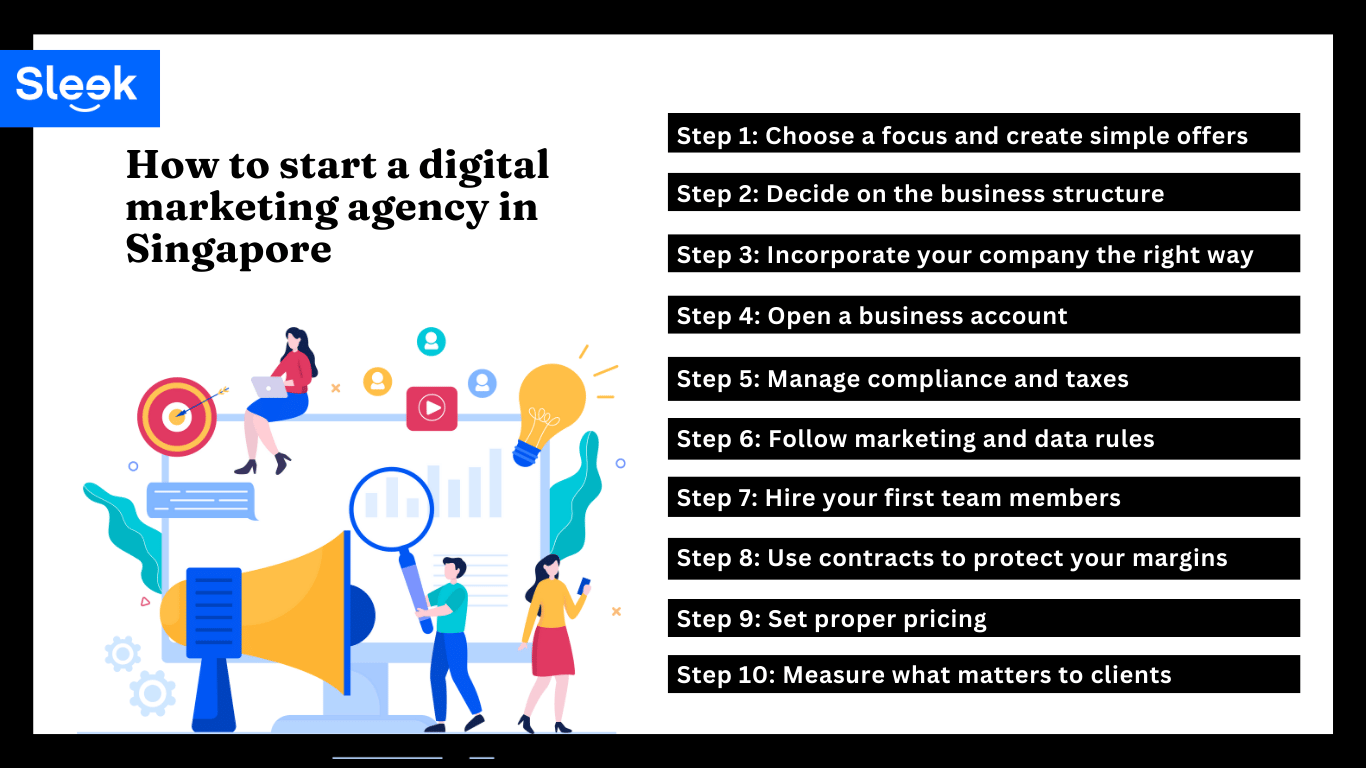
Know your marketing but not the paperwork? These 10 steps show you how to set up properly.
Step 1: Choose a focus and create simple offers
Clients hire you faster when you are clear about what you do. Pick one focus area:
- Industry: Clinics, F&B, education
- Outcome: More leads, more online sales
- Channel: SEO and content, paid social
Then turn that focus into two easy offers:
- Launch Sprint (6–8 weeks): Set up messaging, tracking, and first campaigns for quick results
- Lead Gen Retainer (3–6 months): Run ads, landing pages, and CRM with regular reporting
Tip: Always describe the result, not the tasks. For example, say “20 to 40 new enquiries each month” instead of “ad management and landing pages.”
Step 2: Decide on the business structure
Pick the right structure before you register your agency. It changes your liability, tax duties, and credibility.
- Sole Proprietorship: Fast and cheap to set up, but you are personally responsible for all debts and risks. Bigger clients may also see it as less professional.
- Limited Liability Partnership (LLP): Useful if you are starting with a partner, but you still carry personal risks if something goes wrong.
- Private Limited Company (Pte. Ltd.): This is the most common choice for agencies. It gives you limited liability (your personal assets are separate from the business), looks more credible to clients, and gives access to corporate tax reliefs.
If you choose a Pte. Ltd., you will need:
- At least 1 shareholder (this can be you)
- At least 1 local resident director (Singapore citizen, PR, or eligible pass holder)
- A company secretary (must be appointed within 6 months of incorporation)
- A registered office address (must be open and accessible at least 3 hours on business days)
- An SSIC code that matches your business activity (e.g., advertising or market research)
- Paid-up capital of at least S$1 (you can add more later as your agency grows)
Step 3: Incorporate your company the right way
Once you know your structure, the next step is to officially register your agency. This process is called incorporation, and it is done online through Bizfile. If all documents are ready, it usually takes 1 to 3 working days.
Steps on Bizfile:
- Reserve your company name – Make sure it is not misleading, restricted, or already taken.
- Prepare officer details – Include your shareholder(s), local director, and company secretary.
- Choose your SSIC code – This code tells ACRA what your main business activity is (e.g., advertising, marketing, or research).
- Upload your constitution – Most new companies use the standard model company constitution unless you need custom rules.
- Pay the fees – You will need to pay for the name application and the incorporation filing.
After approval, you will receive:
- UEN (Unique Entity Number): This is your official business ID and will be used on invoices, contracts, and tax filings.
- Business Profile: A document that proves your company is registered. You’ll need it to open a bank account, work with vendors, and apply for grants.
Step 4: Open a business account & set up your finance stack
Keep your business money separate from your personal money. Clients and auditors expect this, and it makes life much easier. To open a business account, you’ll need your ACRA business profile, company constitution, IDs and addresses for directors or owners, and answers to some basic KYC questions.
Once your account is open, set up the basics:
- Invoicing and payments: Recurring invoices, reminders for late payments
- Bookkeeping: Close your books monthly so there’s no year-end panic
- Expense tracking: Use virtual cards or tools to capture receipts
- Budget and cash flow view: Know how much runway you have and what to set aside for taxes
Account opening takes time, so get your finances sorted before agreeing to start with clients.
Step 5: Manage compliance and taxes for your digital agency in Singapore
Sorting out your legal and tax duties early can save you time and fines later. Here are the basics every agency owner should know.
Corporate income tax
- Standard rate is 17 percent on chargeable income
- New start-ups may enjoy exemptions on the first S$200,000 if conditions are met
Estimated Chargeable Income (ECI)
- File within three months of your financial year end
Annual return and AGM
- Many small companies can skip holding an AGM if they send financials to members within five months, and no one requests a meeting
- The annual return must still be filed within seven months of the financial year end
GST (Goods and Services Tax)
- GST is 9 percent in Singapore
- You must register if turnover is above S$1 million in the past 12 months, or if you expect to cross that in the next 12 months
Company secretary and registers
- Your company secretary keeps statutory registers updated, records decisions, and files documents on time
- Forgetting this is one of the most common reasons small agencies get fined
Step 6: Follow marketing and data rules in Singapore
When you run campaigns, you need to follow Singapore’s data and marketing laws to avoid fines or blocked messages. Here are the key ones:
PDPA (Personal Data Protection Act)
- Appoint a Data Protection Officer and publish their contact details
- Have a privacy policy and clear processes for data access, correction, and data breach handling
DNC and Spam rules
- Check the Do Not Call (DNC) Registry before sending calls, SMS, or faxes to Singapore numbers
- For bulk emails or messages, label them properly and always include a working unsubscribe link
- If you use an alphanumeric sender ID (like “YourBrand”), register it under SSIR
- Unregistered IDs may be blocked or flagged as “Likely-SCAM”
Quick tip: Add a Data Processing Addendum (DPA) to client contracts if you handle customer data such as CRM, analytics, or email lists.
Step 7: Hire team members or work with freelancers
When learning about how to start a digital marketing agency, remember that if you hire Singapore Citizens or PRs, you need to:
- Give them Key Employment Terms (KETs) in writing
- Set up payroll, pay CPF, and issue itemised payslips
If you use freelancers, protect yourself with a simple contract that covers IP ownership, confidentiality, deliverables, and payment milestones.
Good first hires for an agency are an Account Manager (to manage clients), a Performance Marketer or SEO Lead (to run campaigns), and a Creative or Video person (to keep content moving).
Step 8: Use contracts to protect your margins
Always start with a basic Master Service Agreement and add a Statement of Work for each project. Key things to cover:
- Scope and changes: Charge for work that is out of scope
- Ownership: State who owns raw files and final deliverables
- Payment terms: For example, 50% upfront, or a deposit for retainers
- Termination: Include fees to cover time already spent
- Approvals and client duties: Set expectations for feedback, access, and brand guidelines
Step 9: Determine pricing that works for cash flow and growth
The way you set your prices will decide how stable your agency is and how fast it can grow. The goal is to balance steady income with room to scale.
Retainers for stability
- Retainers give you predictable monthly revenue.
- They work well for ongoing tasks like running ads, CRO, or reporting.
Sprints for quick wins
- Short projects like audits, tracking setup, landing pages, or creative work.
- Great for new clients who want to test you before committing to a retainer.
Performance-linked models
- Only consider this if you control the full funnel and budget.
- Otherwise, you’ll take on too much risk for results you cannot fully manage.
Know your minimums
- Work out your real cost to deliver plus your margin.
- This helps you avoid underpricing and protects your cash flow as you grow.
Step 10: Measure what matters to clients
Clients are interested in business outcomes, not surface numbers like clicks or followers. Always connect your work back to the growth results they truly value.
The most useful metrics include:
- Customer Acquisition Cost (CAC): How much it costs to bring in a new customer
- Return on Ad Spend (ROAS) or Marketing Efficiency Ratio (MER): How much revenue comes from every dollar spent
- Lead quality: Make sure you and your client agree on what counts as a marketing qualified lead (MQL) or sales qualified lead (SQL)
- Attribution: Use simple, defensible methods so you can explain where results are coming from
When you report, keep it short and practical. A clear summary with key numbers, what they mean, and your next steps is worth more to a busy founder than a long, complex dashboard.