Ismarina is the Head of Country at Sleek Singapore, where she leads strategic growth, operational excellence, and service delivery. With over 20 years of experience across finance, compliance, and business leadership, she oversees Sleek’s full range of services. These include CFO advisory, accounting, tax, GST, payroll, corporate secretarial, immigration, and client support.
She is known for her clarity in leadership and strength in execution. Ismarina has led large, cross-functional teams in both in-person and virtual settings. She has delivered strong P&L outcomes, scaled operations, and built trusted relationships across businesses of all sizes.
Ismarina combines practical insight with academic depth. She holds an MSc (Hons) in Management, is a Fellow CPA, an ASEAN CPA, and a CIMA-qualified Chartered Global Management Accountant. Her expertise covers project management, construction and nonprofit accounting, judicial management, and liquidation. Her experience running an accounting firm and offering CFO services gives her a sharp understanding of what clients need to grow and stay ahead.
She is also a committed mentor who supports her team’s growth with care and purpose. Before Sleek, she held senior roles at the Project Management Institute and the Football Association of Singapore. She played a key role in leading digital transformation and shaping regional strategy.
Outside of work, you’ll find her immersed in books, sewing projects, and knitting, or cheering on her family at sporting events. She brings the same passion for excellence to everything she does, both professionally and personally.
ECI filing in Singapore trips up more directors than almost any other tax deadline, mostly because it lands so soon after the books close. Estimated Chargeable Income (ECI) is your company’s early estimate of taxable profit, and it’s due within three months of your financial year-end. File on time and you unlock instalment payments. Miss it, and IRAS can issue its own estimate, which you still have to pay. Sleek files ECI for hundreds of Singapore companies each season, so the deadline never sneaks up.
In short: Estimated Chargeable Income is your company’s forecast of taxable income for a financial year, and it must be filed with IRAS within three months of the financial year end. A company is waived from filing if its annual revenue is S$5 million or below and its ECI is nil. Miss the deadline, and IRAS can issue an estimated assessment that you must pay even if you later disagree.
What is Estimated Chargeable Income (ECI)?
What is Estimated Chargeable Income (ECI)
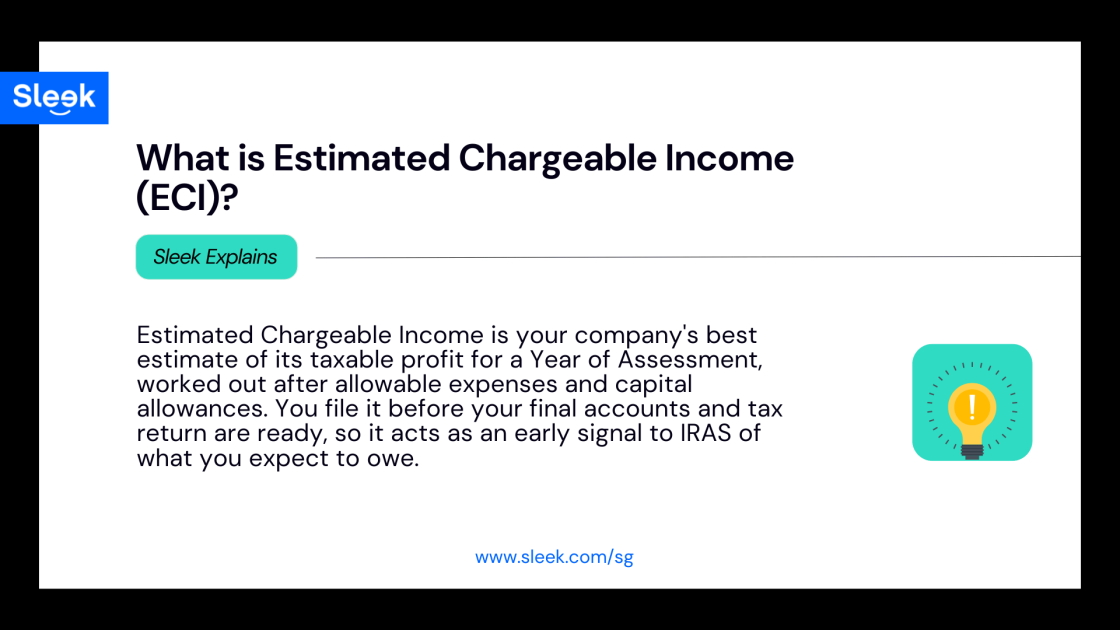
Estimated Chargeable Income is your company’s best estimate of its taxable profit for a Year of Assessment, worked out after allowable expenses and capital allowances. You file it before your final accounts and tax return are ready, so it acts as an early signal to IRAS of what you expect to owe.
ECI is not your final tax bill. It’s an estimate; the actual figure is confirmed later through the Form C-S or Form C return. If you want the plain-English version of what ECI is, that’s a good starting point before you tackle the filing itself.
The figure is taxed at Singapore’s flat corporate rate, and your company tax residency affects the reliefs you can claim. Either way, every active company with a Singapore financial year-end has an ECI obligation unless a waiver applies.
Feature
ECI
Form C-S / Form C
What it is
Early estimate of taxable income
Final corporate income tax return
When it’s due
Within three months of FYE
By 30 November each year
Based on
Management accounts
Final or audited accounts
Filed via
myTax Portal
myTax Portal
When is the ECI filing deadline in Singapore?
Your ECI is due within three months of your company’s financial year end. The deadline is driven entirely by your financial year end, not the calendar year, so two companies can have very different ECI dates.
Take a few common examples. A 31 December year end means filing by 31 March. A 30 June year end pushes the deadline to 30 September.
Financial year end
ECI filing deadline
31 December
31 March
31 March
30 June
30 June
30 September
30 September
31 December
IRAS sends a filing notification in the last month of your financial year. If you don’t receive one and you don’t qualify for the waiver, you still have to file within the three-month window.
Not sure whether you even need to file ECI this year, or what happens if you let the clock run out?
You qualify for the ECI filing waiver only if you meet both conditions: your annual revenue is S$5 million or below for the financial year, and your ECI is nil for the Year of Assessment. Meet just one, and you still have to file. This is set out directly by IRAS.
A nil ECI means no estimated taxable income after allowable deductions, measured before any startup or partial exemption is applied. There’s one catch worth knowing: if your revenue is above S$5 million, but your ECI is nil, you still file. You simply enter the ECI as zero.
Use this quick check to see where you land:
Your situation
Do you file ECI?
Revenue ≤ S$5M and ECI is nil
No, the waiver applies
Revenue ≤ S$5M but ECI is above zero
Yes
Revenue above S$5M and ECI is nil
Yes, enter zero
Revenue above S$5M and ECI above zero
Yes
How do you file ECI through myTax Portal?
You file ECI online through the IRAS myTax Portal; paper submissions are no longer accepted. You’ll need a Corppass account with the right authorisation, your company’s Unique Entity Number, and your management accounts to hand.
The steps are straightforward. Log in with Corppass, open the File ECI service, declare your revenue and estimated chargeable income, then submit. IRAS issues a Notice of Assessment with the tax payable.
Filing early pays off, literally. Companies on GIRO that file by the 26th of a qualifying month get the maximum number of instalments. It helps to estimate your liability first with a corporate tax calculator so there are no surprises when the assessment arrives.
Tip
Sign up for GIRO at least three weeks before you file ECI. IRAS only offers instalment payments to companies with an approved GIRO arrangement, and the earlier you file, the more instalments you get.
How do startup tax exemptions affect your ECI?
Startup tax exemptions lower the tax you eventually pay, but they don’t change the ECI figure you file. You report ECI before exemptions, and IRAS applies the relief automatically when it raises your assessment.
The startup tax exemption scheme gives qualifying new companies 75% off the first S$100,000 of normal chargeable income for their first three Years of Assessment, with a partial exemption on a further slice. So a new company can show chargeable income in its ECI yet pay well below the headline corporate tax rate of 17% once the relief flows through.
This is also why owners sometimes confuse a profitable year with a nil ECI position. The exemption is applied after you file, not before, so your ECI is reported on the pre-relief figure.
What happens if you miss the ECI filing deadline?
If you miss the deadline, IRAS can raise an estimated Notice of Assessment based on its own judgement, often higher than what you actually owe. You must pay it in full within one month, and you lose the option to pay by instalments.
You can object, but the window is tight. An objection has to be filed within two months of the assessment date, and payment is still due in the meantime. Any overpayment is refunded once the figure is corrected.
Repeated late or non-filing also raises your compliance risk and sits awkwardly next to your other obligations, such as the ACRA annual return. For the enforcement detail on overdue tax, see the IRAS guidance on late payment.
“Year-end accounting was handled professionally, and everything ran smoothly. Response was prompt and informative. Highly recommend.”
Torina Tan, Sleek client
How Sleek helps you file ECI on time, every year
Missing the ECI deadline is rarely about not knowing the rules. It’s about the date arriving while you’re buried in everything else. Sleek tracks your financial year-end, prepares the estimate from your books, and files ECI with IRAS so the three-month window never catches you out. Your accounting, tax return, and ECI all sit with one team.
Sleek files ECI for hundreds of Singapore companies each season, so the deadline never sneaks up.
Ready to take ECI off your plate?
Let Sleek handle your ECI and corporate tax filing.
ECI must be filed within three months of your company’s financial year-end, unless you qualify for the filing waiver. If you change your financial year-end, the deadline shifts with it, and IRAS may apportion the period across two Years of Assessment, so notify IRAS through myTax Portal before any change.
Who is exempt from filing ECI?
A company is exempt if its annual revenue is S$5 million or below and its ECI is nil; both must be true. Here, revenue means your main trading income, not separate items such as interest, dividends, or rentals. The nil test is also measured before any startup or partial exemption.
What happens if I miss the ECI deadline?
IRAS can issue an estimated Notice of Assessment based on your past years’ income or other data it holds, which is often higher than your real liability. You pay within one month and lose the instalment option. You may object within two months, but payment is still due while the objection is reviewed.
Is ECI the same as Form C-S?
No. ECI is an early estimate of taxable income filed within three months of your year-end; Form C-S, Form C-S (Lite), or Form C is the final corporate tax return due by 30 November. ECI is usually prepared from management accounts, and you don’t need audited accounts to file it.
Can I pay my ECI tax in instalments?
Yes, but only Singapore-registered companies on a GIRO arrangement can pay by instalments. The number of instalments you get depends on how early you file: the earlier the submission, the more instalments are offered, which is why filing soon after your year-end helps your cash flow.