







- Hong Kong has no sales tax, VAT or GST. You don’t register for or collect a Hong Kong consumption tax on online sales.
- E-commerce profits can still face Profits Tax. The rate depends on whether you trade through a company or an unincorporated business.
- Foreign customers don’t make profits offshore by themselves. The IRD looks at what you did to earn the profit and where those operations happened.
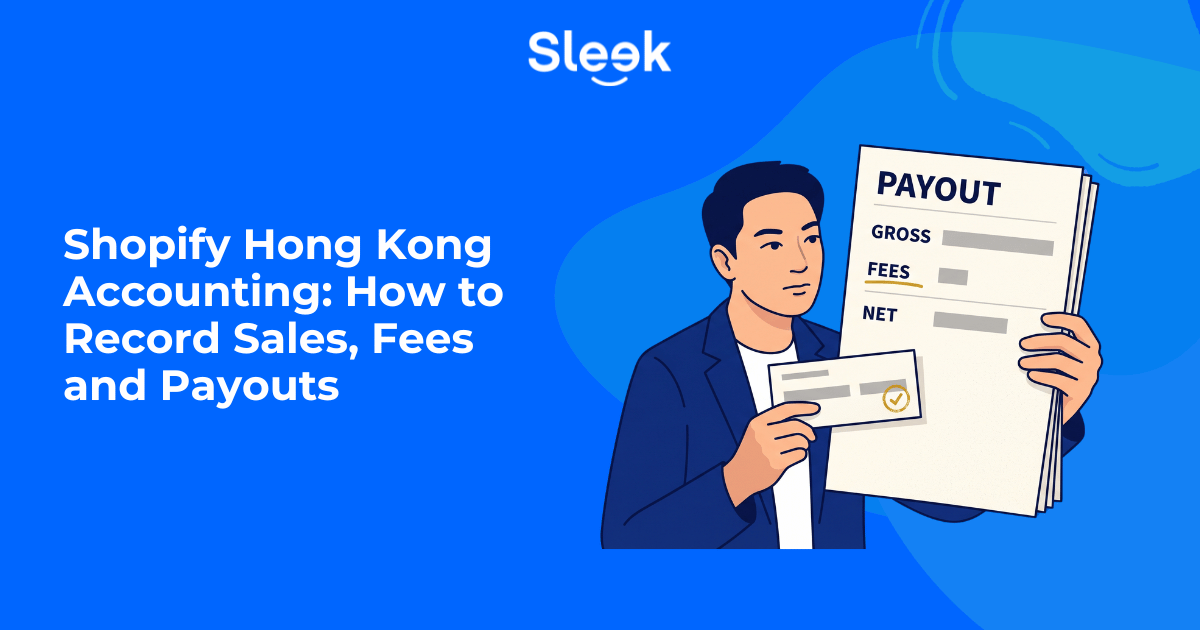
- A platform payout isn’t your sales figure. Reconcile gross orders, refunds, fees, reserves and net cash separately.
- Keep ecommerce records for at least seven years. Platform reports, processor statements, invoices and inventory records all support the tax return.




- Local consumption tax: none; Hong Kong has no sales tax, VAT or GST
- Business tax: Profits Tax applies to assessable profits sourced in Hong Kong
- Cross-border sales: an offshore claim depends on operations, not customer or bank location alone
- Seller records: reconcile platform sales to processor payouts and retain evidence for seven years
E-commerce taxes in Hong Kong start with good news: there is no Hong Kong sales tax, VAT or GST. The trap is stopping there. Online sellers still need to account for Profits Tax, platform income, deductible costs and possible tax in customer or warehouse markets.
This guide focuses on the tax side. If you’re still choosing a structure, platform or payment provider, start with setting up an e-commerce business in Hong Kong.
In this guide, you’ll learn:
- Which Hong Kong tax applies to online sellers
- How ecommerce profit sourcing works
- How to record marketplace and processor payouts
- Which costs may be deductible
- What to retain and file
What taxes do e-commerce sellers pay in Hong Kong?
Online sellers pay Profits Tax on Hong Kong-sourced assessable profits, just like other businesses.
Hong Kong doesn’t impose a separate ecommerce tax. Your business structure, profit source and allowable costs determine the result.
|
Tax question |
Hong Kong treatment |
|
Sales tax / VAT / GST |
None in Hong Kong |
|
Profits Tax |
Applies to assessable profits arising in or derived from Hong Kong |
|
Customs duty |
No general tariff, but duty applies to specified excisable goods |
|
Overseas consumption tax |
May apply under the customer’s, warehouse’s or marketplace’s jurisdiction |
No Hong Kong sales tax means you don’t collect a Hong Kong VAT or GST amount at checkout. It doesn’t remove business registration, accounting, audit or Profits Tax obligations.

Does Hong Kong charge sales tax, VAT or GST on online sales?
Hong Kong doesn’t charge sales tax, VAT or GST, including on ecommerce sales.
The Financial Services and the Treasury Bureau confirms that Hong Kong has no value-added or sales tax. There is no Hong Kong consumption-tax registration threshold, return or output tax for an online seller.
That answer covers Hong Kong only. If you sell to consumers overseas, another jurisdiction may require VAT, GST or sales-tax registration based on sales, customer location, inventory storage or marketplace rules.
How much Profits Tax does an ecommerce business pay?
Profits Tax is charged on assessable profit, not revenue or platform payouts.
Assessable profit starts with sales income, then adjusts for cost of goods sold and allowable business expenses. For eligible businesses under the two-tier regime:
|
Seller structure |
First HK$2 million of assessable profits |
Profits above HK$2 million |
|
Hong Kong corporation |
8.25% |
16.5% |
|
Sole proprietorship / partnership |
7.5% |
15% |
In simple terms:
Assessable profit = sales − refunds − cost of goods sold − allowable expenses ± tax adjustments
Only one connected entity can generally elect for the two-tier rates.
For example, an eligible corporation with HK$1 million of assessable profit pays HK$82,500 before tax credits or other adjustments. HK$1 million of sales is not the same thing as HK$1 million of assessable profit.
Can cross-border ecommerce profits be offshore?
Cross-border ecommerce profits may be offshore, but overseas customers, processors or warehouses don’t settle the question.
Hong Kong applies an operations test. The IRD asks what the business did to earn the profit and where those profit-producing activities took place. Depending on the model, relevant facts may include:
- Contracts: where purchase and sale contracts were effected
- Negotiations: where supplier terms and prices were agreed
- Store operations: where marketing, website and customer work was managed
- Commercial control: who accepted orders and made the key decisions
- Delivery: where the product or service was performed or fulfilled
The IRD’s ecommerce guidance in DIPN 39 applies ordinary Profits Tax principles to internet transactions. A Hong Kong company, bank account or Shopify store doesn’t decide source on its own.
An offshore position is a claim supported by evidence, not an automatic 0% rate.

Server location alone doesn't decide where ecommerce profit is sourced. An overseas server can automate a transaction while the commercial work still happens in Hong Kong. The IRD looks at the business's core operations as a whole.
How should Shopify, Amazon and App Store income be recorded?
Record platform income using the underlying sales and contract terms, not the amount that reaches the bank.
|
Channel |
What to capture |
Common accounting issue |
|
Shopify + Stripe / PayPal |
Orders, refunds, discounts, processor fees and payouts |
Treating the net payout as total revenue |
|
Amazon / marketplace |
Gross orders, returns, marketplace fees, fulfilment and advertising |
Missing fees deducted inside the settlement |
|
App Store / Google Play |
Sales reports, commission, refunds, tax handled by the platform |
Assuming gross or net presentation without checking principal-agent terms |
|
Dropshipping store |
Customer sales and supplier product/fulfilment costs |
Recording only the margin rather than sales and cost of goods |
Shopify is a storefront and Stripe or PayPal is usually a payment processor. Neither changes the source of the sale by itself.
For an app marketplace or reseller model, the contract determines whether your accounts show gross customer billings with commission expense or net revenue. Your accountant should apply the relevant accounting standard consistently.

A rolling reserve is usually not a sales discount. It is cash the processor retains temporarily and may remain a receivable in your books. Track it separately so revenue doesn't rise or fall when the reserve is released.
Which ecommerce costs are tax-deductible?

Costs are generally deductible when incurred in producing assessable profits and not private, capital or otherwise disallowed.
Common ecommerce costs include:
- Products: inventory cost attached to goods sold
- Selling: marketplace fees, payment processing, advertising, affiliates and creators
- Fulfilment: shipping, warehousing, packaging and order handling
- Operations: store software, apps, subscriptions and professional fees
- People: salaries, contractor fees and employer costs
- Customer losses: bad debts and refunds where the tax rules are met
Buying inventory doesn’t always create an immediate deduction. Unsold stock remains inventory, while the cost attached to goods sold flows into cost of goods sold. Keep supplier invoices and stock records.
What ecommerce records must you keep?
Keep enough records to trace every order from the platform to the processor, bank and accounts for at least seven years.
Save:
- Sales: platform orders, settlements, invoices, credit notes, refunds and chargebacks
- Payments: Stripe, PayPal and other processor statements
- Stock: supplier invoices, inventory movement and cost-of-goods-sold schedules
- Fulfilment: shipping, customs, warehouse and packaging records
- Operating costs: advertising, software and contractor invoices
- Cash: business bank and multi-currency account statements
- Contracts: platform, reseller and marketplace terms
Download reports regularly. Some platforms limit historical access after you close or change a plan. Electronic records are acceptable when they remain complete, legible and accessible.
How do ecommerce sellers file Profits Tax?
Ecommerce sellers use the normal Hong Kong Profits Tax process. There is no separate return for an online store.
Use the return that matches the business structure:
|
Business structure |
Tax return |
|
Hong Kong corporation |
BIR51 |
|
Partnership |
BIR52 |
|
Sole proprietorship |
Part 5 of BIR60 |
Step 1: Close and reconcile the books
Match gross platform sales to refunds, fees, reserves and bank payouts. Reconcile inventory, payment processors, multi-currency balances and business expenses for the accounting period.
Step 2: Prepare the accounts and tax computation
Turn the reconciled books into financial statements and a Profits Tax computation. A limited company also completes its annual statutory audit unless it is formally dormant. The computation adjusts the accounting profit for deductible, disallowed, capital and offshore items.
Step 3: Complete the correct return
Enter the business figures on BIR51, BIR52 or Part 5 of BIR60. Report a loss and any offshore claim rather than leaving the return unfiled. Complete any supplementary forms required by the facts.
Step 4: Attach and submit the required documents
Follow the filing instructions printed on the return. Filing routes by structure:
- Corporations and partnerships: the Business Tax Portal (BTP), or the Tax Representative Portal if you use an authorised tax representative
- Sole proprietors: BIR60 through the Individual Tax Portal (ITP), or return the original paper form
For fully electronic BIR51 and BIR52 filing, supplementary forms use XML, and supporting financial statements and tax computations use iXBRL.
Step 5: Keep the receipt and review the assessment
Submit by the deadline shown on the return or an approved extension, then save the filing confirmation and final documents. Check the IRD assessment against the return and pay by the stated date. If the assessment is wrong, the objection normally must reach the IRD within one month after the date of the notice.
The Profits Tax Return guide covers issue dates, extension arrangements and supporting-document rules in more detail.
What overseas taxes should online sellers watch?
Overseas VAT, GST, sales tax, customs and income tax can apply even though Hong Kong has no consumption tax.
Common triggers include:
- Foreign inventory: holding stock in an overseas fulfilment warehouse
- Sales thresholds: exceeding a destination’s registration limit
- Digital sales: supplying apps, subscriptions or other digital services to consumers
- Local presence: having staff, agents or a fixed business presence overseas
- Marketplace gaps: using a platform that collects one tax but leaves other duties with the seller
Marketplace collection doesn’t always close the issue. Confirm registration, invoicing and return obligations in each material market.
What ecommerce tax mistakes should sellers avoid?
The most common mistake is treating “no sales tax” as “no tax”.
Also avoid:
- Net-payout accounting: recording Stripe or Amazon settlements as total revenue
- Early inventory deductions: claiming stock before the goods are sold
- Weak offshore claims: relying only on overseas customers or servers
- Missing evidence: losing platform reports after changing accounts
- Mixed spending: putting personal purchases through the store
- Foreign-tax blind spots: ignoring VAT or sales-tax rules overseas
- Late reconciliation: waiting until year-end to sort out several currencies
Monthly reconciliation makes the tax return easier. It also catches missing payouts, duplicate refunds and platform fees while the supporting reports are still available.
How Sleek handles ecommerce accounting and Hong Kong tax
Sleek keeps platform activity, business accounts and Hong Kong tax records in one accounting cycle.
With Sleek, you can:
- Reconcile ecommerce sales: match platform exports, refunds, fees and processor payouts to the bank records you provide
- Keep seller costs organised: record inventory, advertising, software, fulfilment and multi-currency expenses
- Prepare annual compliance: coordinate accounts, audit support and Profits Tax filing for your Hong Kong company
- Assess an offshore claim: review where the profit-producing operations happened and prepare the claim when the evidence supports it



450,000
businesses worldwide.


from 4,100+ reviews.

satisfaction rate from
16,000 surveyed clients.
FAQs about ecommerce taxes in Hong Kong
Record the gross income and tax withheld using the platform statement. Don’t assume the withholding ends every foreign filing obligation or is automatically creditable in Hong Kong. The answer depends on the tax, jurisdiction and treaty. Keep the certificate or statement and have advisers on both sides test relief.
Helpful read: Withholding Tax in Hong Kong
View more
Get help before the first return if you sell in several currencies, use multiple platforms, hold overseas inventory or plan an offshore claim. Early setup prevents net payouts, reserves and inventory from being recorded incorrectly for a full year. Sleek can handle the Hong Kong books and tax; overseas registrations need local specialists.