With 12 years of industry experience, including a tenure at a Big 4 firm, Yuk Ming is a seasoned professional specializing in accounting, audit, tax, and project management. A member of both HKICPA and ICAEW, he brings a wealth of expertise to Sleek, particularly in advising and supporting SMEs.
Outside work, Yuk Ming enjoys staying active through tennis and badminton. He also likes watching movies and playing video games in his free time.
97% customer satisfaction from 16,000+ survey responses.
In this article
Share this post
Facebook
LinkedIn
WhatsApp
Copy to clipboard
Key takeaways
Almost every Hong Kong company must be audited every year. There’s no turnover or size threshold. Even a company with HK$1 of revenue needs audited financial statements.
The audit must be done by a Hong Kong-registered CPA (Practising). You can’t audit your own company, and an overseas or in-house accountant can’t sign it.
Audited financial statements are your annual financial statements plus an independent auditor’s report on them.
The audited accounts and auditor’s report must be filed with your Profits Tax Return (Form BIR51) to the Inland Revenue Department (IRD).
The only general exemption is a company formally registered as dormant under the Companies Ordinance. The small-company reporting exemption reduces disclosure but doesn’t remove the audit.
Do I need one? Yes, unless your company is formally dormant. There's no turnover threshold.
Who signs it? A Hong Kong-registered CPA (Practising) only.
What is it? Your financial statements plus an independent auditor's report and opinion.
Where does it go? Filed with your Profits Tax Return (BIR51) to the IRD.
If you run a company, audited financial statements in Hong Kong aren’t optional paperwork. They’re a yearly statutory requirement, and unlike many countries, Hong Kong applies them to almost every company regardless of size. First-time founders are often surprised that even a tiny or barely-trading company still needs a full audit.
In this guide, you’ll learn:
Whether your Hong Kong company actually needs an audit
What audited financial statements contain
Who is allowed to audit and sign them
The audit process and how early to start
How audited accounts connect to your Profits Tax Return
Does my Hong Kong company need audited financial statements?
Yes. Almost every company incorporated in Hong Kong must have its financial statements audited every year by a Hong Kong-registered CPA, under Part 9 of the Companies Ordinance (Cap. 622). There’s no exemption based on turnover, profit, or company size.
That’s what catches most founders out. In the UK, Singapore, or Australia, a small company can often skip the audit if it stays under a revenue threshold. Hong Kong has no such threshold. A company with HK$1 of income and one with HK$100 million are both audited annually. The requirement applies whether you’re profitable, loss-making, or barely trading.
The Companies Registry confirms that audit is required for all companies, including those within the reporting exemption, except dormant companies (section 447).
Audited financial statements are your company’s annual accounts plus an independent auditor’s opinion on them. Your accountant prepares the financial statements under Hong Kong Financial Reporting Standards (HKFRS). A practising CPA then audits them and issues a signed auditor’s report. That report is what makes the package “audited.”
A full set for a Hong Kong SME usually contains:
Statement of financial position (balance sheet)
Statement of profit or loss and other comprehensive income
Statement of changes in equity
Statement of cash flows
Notes to the financial statements (accounting policies and detail)
Directors’ report
Independent auditor’s report (the opinion that makes them audited)
Who can audit my Hong Kong company’s financial statements?
Only a Hong Kong-registered CPA holding a practising certificate, a CPA (Practising), can audit and sign a Hong Kong company’s statutory financial statements. This is set under the Professional Accountants Ordinance (Cap. 50) and administered by the Hong Kong Institute of Certified Public Accountants (HKICPA).
That rules out three things founders sometimes assume they can do:
Audit your own company. A director can’t audit their own company’s accounts. The auditor must be independent.
Use your overseas accountant. An accountant qualified abroad can’t sign a Hong Kong statutory audit unless they hold a Hong Kong practising certificate.
Use an in-house bookkeeper. Preparing the books is fine. The audit opinion has to come from an independent, HK-registered practising CPA.
How does the Hong Kong audit process work?
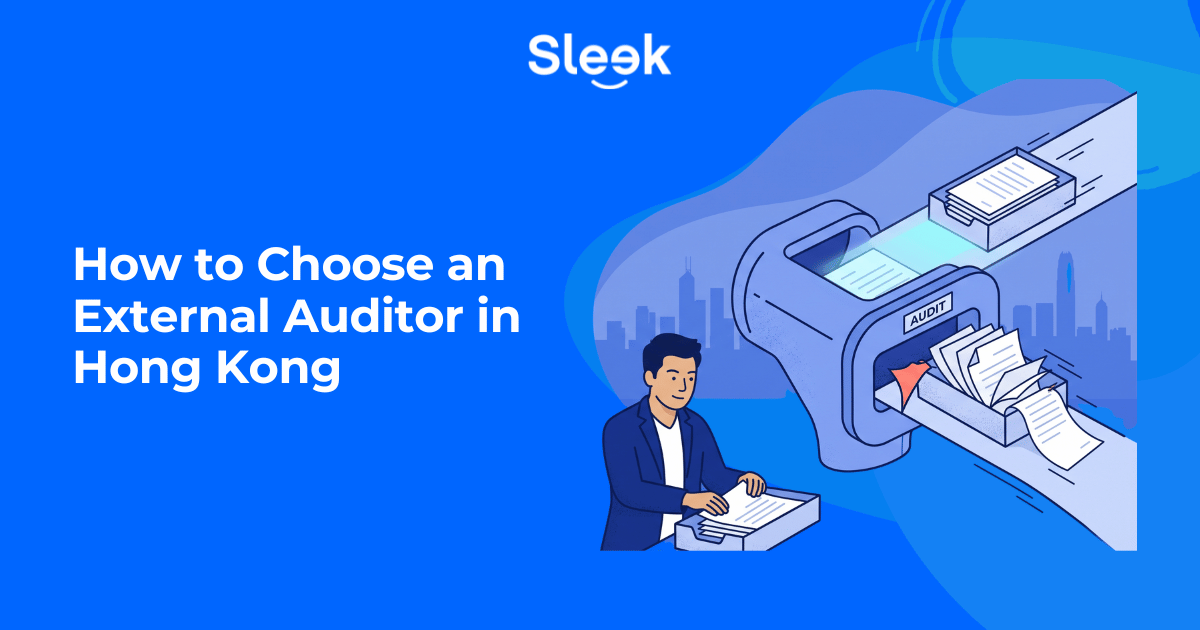
Every Hong Kong audit follows the same five-step path, from record-keeping to the Profits Tax Return.
A Hong Kong audit runs from year-round bookkeeping through to a signed auditor’s report filed with your tax return. The cleaner your records, the faster and cheaper it goes.
Keep proper books all year. Invoices, bank statements, contracts, and ledgers. Hong Kong companies must retain accounting records for at least seven years (section 373, Cap. 622).
Prepare draft financial statements. Your accountant turns the year’s bookkeeping into financial statements under HKFRS.
Appoint a CPA (Practising) and start the audit. The auditor tests transactions, confirms balances, and reviews the draft statements against the evidence.
Receive the signed auditor’s report. The auditor issues their opinion (see opinion types below).
File with the Profits Tax Return. The audited accounts and auditor’s report go to the IRD with Form BIR51.
Tip
Start the audit well before your Profits Tax Return is due, not after the IRD issues it. The bottleneck is almost always incomplete bookkeeping. Chasing a year of missing invoices under deadline pressure is what turns a routine audit into a stressful one.
How do audited accounts connect to my Profits Tax Return?
The audited financial statements must be submitted with your company’s Profits Tax Return (BIR51). They’re not a standalone exercise. The auditor’s report and audited accounts are the supporting evidence for the profits you declare to the IRD.
That’s why audit and tax filing are usually handled together, and why timing matters. The audit has to be finished before the return can be filed properly.
What do the different audit opinion types mean?
The auditor’s report ends with an opinion. The type tells you how clean the accounts are. There are four:
Unqualified (clean) opinion: the financial statements give a true and fair view. This is what a well-run company gets, and what banks and investors want to see.
Qualified opinion: the accounts are reliable except for one specific issue the auditor flags.
Adverse opinion: the financial statements don’t give a true and fair view. A serious signal.
Disclaimer of opinion: the auditor couldn’t get enough evidence to form any opinion, often due to poor records or scope limits.
For most SMEs with tidy books, an unqualified opinion is the routine outcome.
Do I need audited accounts for an offshore profits tax claim?
Yes. If you plan to claim that some or all of your profits are offshore-sourced and outside Hong Kong profits tax, audited financial statements are the foundation of that claim. The IRD assesses an offshore claim against your audited accounts. You can’t make a credible claim without them.
The audit doesn’t decide the offshore question. It produces the numbers the IRD works from.
When is a Hong Kong audit definitely required?
Assume you need audited financial statements if:
Your company is incorporated in Hong Kong and not formally dormant.
You had any revenue, expenses, or bank activity in the financial year, however small.
You’re filing a Profits Tax Return for the year (the IRD expects audited accounts with it).
You’re claiming offshore profits exemption or need accounts for a bank loan or investor.
If you’re unsure about dormant status, check before assuming you’re exempt.
How Sleek handles your accounting and audit
Sleek runs bookkeeping, financial statement preparation, and the statutory audit under one roof, so the year-end sequence is handled end to end rather than split across providers.
With Sleek, you can:
Keep audit-ready books year-round: Our accounting and bookkeeping team maintains your records to HKFRS, so nothing is reconstructed under deadline pressure.
Get audited by an in-house CPA team: Our Hong Kong CPA audit team prepares and signs your audited financial statements without you sourcing a separate audit firm.
File the audit with your tax return in one step: We submit the audited accounts and auditor’s report with your Profits Tax Return, on time.
Support an offshore claim if it applies: Where you’re claiming offshore profits, we prepare the audited accounts the IRD assesses the claim against.
Bookkeeping, audit, and tax filing move as one process. That’s what most founders want when they say they just want to be above board.
Ready to get your Hong Kong audit sorted?
Get your audit handled by Sleek. Audit and accounting from HK$5,500/year.
FAQs about audited financial statements in Hong Kong
Does a newly incorporated company need an audit in its first year?
Yes, though the timing is generous at the start. Your first set of audited accounts covers the period from incorporation to your first financial year-end. It typically lines up with your first Profits Tax Return, which the IRD usually issues around 18 months after incorporation. Keep proper records from day one so the first audit is straightforward.
How long does a Hong Kong audit take?
A few weeks with clean records; months if books are incomplete. A straightforward SME audit moves quickly when invoices, bank statements, and reconciliations are already in order. Missing documentation is what stretches the timeline. Start well before your Profits Tax Return deadline, not when the IRD issues the return.
What happens if I don’t get my accounts audited?
You can’t properly file your Profits Tax Return without audited accounts. That exposes you to IRD estimated assessments, penalties for late or incorrect filing, and offences under the Companies Ordinance for failing to meet accounts and audit obligations. Directors are personally responsible for the company meeting these duties.
Does the reporting exemption mean I can skip the audit?
No. The reporting exemption simplifies what a small private company discloses in its financial statements. The Companies Registry states that companies within the reporting exemption still need an audit. The only general exemption is dormant status under section 447.
Can Sleek prepare and audit my financial statements?
Yes. Sleek’s in-house CPA team handles bookkeeping, financial statement preparation, and the statutory audit, then files the audited accounts with your Profits Tax Return. Because it’s one team, you avoid hand-offs between a separate bookkeeper, auditor, and tax agent. Talk to our audit team.