Ismarina is the Head of Country at Sleek Singapore, where she leads strategic growth, operational excellence, and service delivery. With over 20 years of experience across finance, compliance, and business leadership, she oversees Sleek’s full range of services. These include CFO advisory, accounting, tax, GST, payroll, corporate secretarial, immigration, and client support.
She is known for her clarity in leadership and strength in execution. Ismarina has led large, cross-functional teams in both in-person and virtual settings. She has delivered strong P&L outcomes, scaled operations, and built trusted relationships across businesses of all sizes.
Ismarina combines practical insight with academic depth. She holds an MSc (Hons) in Management, is a Fellow CPA, an ASEAN CPA, and a CIMA-qualified Chartered Global Management Accountant. Her expertise covers project management, construction and nonprofit accounting, judicial management, and liquidation. Her experience running an accounting firm and offering CFO services gives her a sharp understanding of what clients need to grow and stay ahead.
She is also a committed mentor who supports her team’s growth with care and purpose. Before Sleek, she held senior roles at the Project Management Institute and the Football Association of Singapore. She played a key role in leading digital transformation and shaping regional strategy.
Outside of work, you’ll find her immersed in books, sewing projects, and knitting, or cheering on her family at sporting events. She brings the same passion for excellence to everything she does, both professionally and personally.
Payroll tax and CPF in Singapore aren’t quite what many first-time employers expect. There’s no single “payroll tax” and, unlike a lot of countries, you don’t withhold income tax from your staff at all. What you do owe is a set of statutory contributions: CPF, the Skills Development Levy, Self-Help Group funds and, for certain workers, the Foreign Worker Levy, plus an annual duty to report what you paid each person. Handled together, getting payroll and statutory filings right is mostly about knowing who pays what, how much, and when. This guide walks through each one for 2026.
What counts as payroll tax in Singapore?
Here’s the first thing to unlearn: employers in Singapore don’t deduct income tax from salaries. Your employees file and pay their own income tax directly to IRAS. Your job at year-end is to report what you paid them, not to withhold it. That single fact changes how you should think about payroll here.
So when people say “payroll taxes”, what they really mean is the bundle of statutory contributions and levies an employer is responsible for. The main ones are CPF, the Skills Development Levy, Self-Help Group fund contributions, and, if you hire Work Permit or S Pass holders, the Foreign Worker Levy. On top of those sits your annual reporting duty through IR8A. The rest of this guide takes them one at a time, with a “who pays, how much, and when” for each.
How much are CPF contributions for employers?
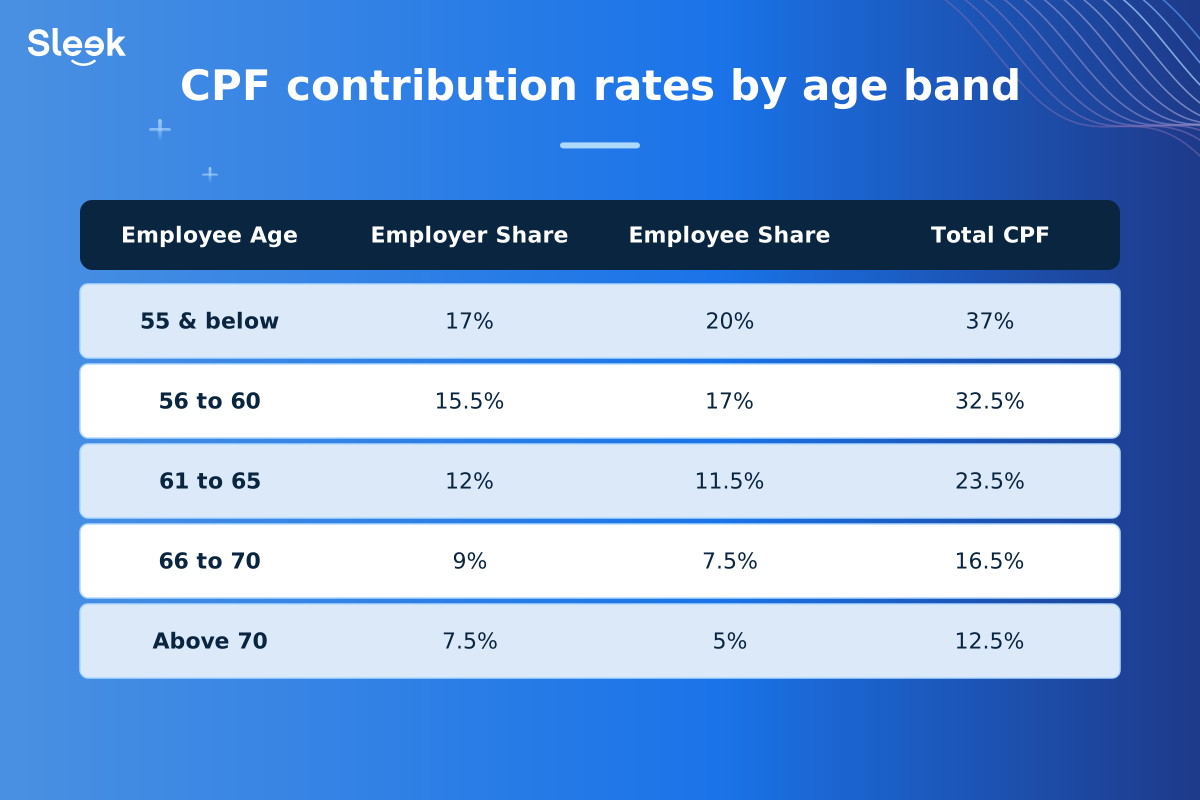
CPF is the big one. For employees who are Singapore Citizens or Permanent Residents aged 55 and below, the total contribution is 37% of wages: 17% from the employer and 20% from the employee. You pay your 17% on top of salary, deduct the employee’s 20% from their pay, and remit both together.
The wage ceiling matters
CPF isn’t charged on unlimited earnings. From 1 January 2026, the Ordinary Wage ceiling is S$8,000 per month, the maximum monthly salary that attracts CPF. Earnings above that don’t draw further Ordinary Wage CPF. Rates also step down as employees get older, so staff above 55 attract lower percentages on both sides. Because the ceiling and the age bands change over time, it’s worth confirming the current figures rather than relying on last year’s numbers.
What are Employer payroll contributions?
You’re also required to make your own contributions, calculated separately from the employee’s share.
1. CPF (Employer Share)
Rate: Up to 17% of monthly wages
Wage cap: SGD 7,400
Max contribution: SGD 1,258/month
You submit both employer and employee CPF contributions together.
CPF contribution rates by age
2. Skill Development Levy (SDL)
SDL funds government-supported training for employees.
Rate: 0.25% of total monthly wages
Minimum: SGD 2 per month per employee
Maximum: SGD 11.25 per month per employee
Applies to all employees, including foreign workers.
3. Foreign Worker Levy (FWL)
If you employ Work Permit or S Pass holders, you must also pay the FWL.
Rate: Varies by industry, employee qualification, and quota
Collected by: Ministry of Manpower
Usually paid through the same CPF submission portal
How to file and pay payroll taxes in Singapore
Calculate all contributions (CPF, SDL, FWL)
Submit CPF details through CPF EZPay (web or mobile), or directly from approved payroll software
Self-Help Group, or SHG, funds are monthly contributions that support community programmes, and they’re tied to your employees’ backgrounds. There are four: CDAC for the Chinese community, MBMF for Muslim employees, SINDA for the Indian community, and the ECF for the Eurasian community.
These are employee contributions, not an employer cost. You deduct a small monthly amount from the relevant employee’s wages and remit it along with CPF. Employees can opt out if they choose, but the default is that the contribution applies, so your payroll needs to assign the right fund to each person. The sums are modest and banded by wage level, but like everything else here, they run through the same monthly CPF submission. Getting your core employment obligations right from day one keeps these deductions clean.
How do you report payroll through IR8A?
This is the reporting duty that replaces income-tax withholding. Each year, you have to report every employee’s earnings for the previous calendar year to IRAS using Form IR8A, along with any relevant appendices. It tells IRAS what each person earned so they can be taxed correctly on their own return.
Most employers now do this through the Auto-Inclusion Scheme, which is mandatory once you have five or more employees. Under it, you submit the income information electronically, and it flows straight into your employees’ tax returns, so they don’t re-enter it. The submission is due by 1 March each year. Miss it, and penalties can follow, so it’s worth locking the date into your payroll calendar.
When is professional payroll worth it?
For a founder with one or two staff, running payroll yourself is doable. The tipping point usually comes with headcount and complexity: a mix of local and foreign workers, variable pay, SHG funds to assign, FWL to track, and IR8A to file all at once. That’s when the monthly admin starts to cost real hours, and small mistakes get expensive.
A couple of signals that it’s time to hand it over: you’re spending more than an afternoon a month on payroll, or you’ve had a near-miss on a deadline. Good payroll software solves part of the problem, and a full payroll service solves the rest by taking the filing off your plate entirely. If you’re raising pay for lower-wage staff, it’s also worth checking the Progressive Wage Credit Scheme, which can co-fund those increases, and Absentee Payroll funding if you send people for training.
How Sleek helps with your payroll and statutory filings
Payroll in Singapore isn’t hard so much as fiddly: several contributions, one monthly deadline, one annual return, and no room to be wrong. Sleek runs the whole cycle for you, from monthly payslips to CPF, SDL, Self-Help Group funds and IR8A reporting, all computed and submitted on time. You get one provider and one point of contact for every statutory payment, instead of juggling deadlines across MOM, IRAS and the CPF Board.
Stop guessing what you owe on payroll and let one team handle it.
Talk to a Sleek payroll specialist about running your monthly payroll and filings.
FAQs: Payroll Taxes in Singapore: Your Clear Guide
Do employers in Singapore withhold income tax from salaries?
No. Singapore employers don’t deduct income tax from employee wages. Employees file and pay their own income tax to IRAS. Your obligation is to report each employee’s earnings annually through Form IR8A, usually via the Auto-Inclusion Scheme, so IRAS can tax them correctly.
What are the employer CPF contribution rates for 2026?
For employees aged 55 and below who are Citizens or Permanent Residents, the employer contributes 17% and the employee 20%, for a total of 37% of wages. From 1 January 2026, the Ordinary Wage ceiling is S$8,000 a month. Rates step down for older employees, so confirm the current band for each person.
What's the difference between SDL and the Foreign Worker Levy?
SDL is 0.25% of wages and applies to almost all employees, local and foreign. The Foreign Worker Levy applies only to Work Permit and S Pass holders and varies by sector, pass type and your dependency ratio. You can owe both for the same Work Permit holder, but only SDL for a local or Employment Pass employee.
What are Self-Help Group fund contributions?
SHG funds (CDAC, MBMF, SINDA and the ECF) are small monthly contributions deducted from an employee’s wages based on their community, then remitted with CPF. They’re an employee cost, not an employer one. Employees can opt out, but by default the contribution applies, so payroll assigns the right fund to each person.
When do I submit IR8A?
IR8A income information for the previous calendar year is due by 1 March. If you have five or more employees, you must submit electronically under the Auto-Inclusion Scheme, and the figures flow directly into your employees’ tax returns. Late or missing submissions can attract penalties.
How often do I pay CPF and the other contributions?
Monthly. CPF, SDL and SHG funds are all paid to the CPF Board in a single e-Submission, due by the 14th of the following month. The Foreign Worker Levy is billed separately by MOM. Keeping to the 14th each month covers most of your statutory payroll obligations in one go.
Which payroll costs are the employer's and which are the employee's?
The employer pays its 17% CPF share, the full SDL, and the Foreign Worker Levy where it applies. The employee’s 20% CPF share and their SHG contribution are deducted from their wages, so you collect and remit them, but they aren’t your cost. Income tax is entirely the employee’s responsibility.