










- The Progressive Wage Credit Scheme co-funds pay rises you give to lower-wage Singaporean employees.
- Payouts are worked out automatically from your CPF records and paid by IRAS, with no application to submit.
- PWCS is government support, not a legal wage requirement, which is what sets it apart from the Progressive Wage Model.



The Progressive Wage Credit Scheme in Singapore is a government scheme that co-funds the pay rises you give to lower-wage workers, so raising wages costs your business less than the full increase. If you’re a smaller employer with local staff on modest salaries, it’s real money you can claim, and the best part is you don’t apply for it.
Payouts are worked out automatically from your CPF contribution records and paid by IRAS. Keeping accurate payroll and CPF records is really all it takes to benefit.
At a glance
The PWCS is a transitional Singaporean government scheme that co-funds wage increases given to eligible lower-wage resident workers, helping employers absorb the cost of raising salaries.
- Enhanced co-funding: the government raised the 2026 co-funding rate from 20% to 30%.
- Wage ceiling: the 2026 support applies to resident employees with a gross monthly wage of up to S$3,000.
- Minimum increase: to qualify, the average gross monthly wage increase must be at least S$100 (rising to S$200 in 2027).
- Extension: the scheme has been officially extended through 2028.

What is the Progressive Wage Credit Scheme?
The Progressive Wage Credit Scheme, usually shortened to PWCS, is a co-funding scheme. When you raise the wages of eligible lower-wage employees, the government pays a share of that increase back to you. It was introduced to encourage employers to lift pay for workers at the lower end of the salary range, and to share the cost of doing so rather than leaving it entirely on the employer.
Think of it as a partnership. You decide to pay someone more, and PWCS softens the impact on your payroll by covering part of the rise for a period. It’s administered by IRAS, and it works off the CPF contributions you already make, which is why it can be calculated and paid without you filling anything in.
Who qualifies for PWCS?
Two sides have to line up: the employee and the wage increase. On the employee side, the scheme is aimed at lower-wage resident workers, and eligibility is tied to a gross monthly wage that sits within the scheme’s qualifying range. On the employer side, you qualify by actually giving a qualifying wage increase to those employees and by making the CPF contributions that evidence it.
Because the exact wage ceiling and the qualifying conditions are set by the scheme and have been adjusted over its life, the sensible move is to confirm the current-year thresholds against IRAS before you count on a payout. What doesn’t change is the shape of it: you employ lower-wage residents, you raise their pay, and your CPF records do the talking. Keeping your core employment records and CPF submissions accurate is what makes you eligible in practice.
How does the scheme work?
The following are the key features of the PWCS as of 2026:
- Targeted support: the scheme primarily targets lower-wage resident employees. For the qualifying years 2025 and 2026, the gross monthly wage ceiling for co-funding is S$3,000. (The previous two-tier system for wages up to S$2,500 and between S$2,500 and S$3,000 has been consolidated into this single ceiling.)
- Funding extension: the scheme, originally intended to run from 2022 to 2026, has been officially extended to 2028 to provide continued transitional support for employers.
- Minimum wage increase: to qualify for the PWCS payout in the 2022 to 2026 qualifying years, the average gross monthly wage increase must be a minimum of S$100. (This minimum requirement increases to S$200 for the qualifying years 2027 and 2028.)
- Two-year compounding support: the government co-funds eligible wage increases for two years. For example, a qualifying wage increase given in 2026 will be co-funded in the 2026 qualifying year, and also in 2027 if that wage increase is maintained. This helps employers manage the year-over-year compounding effect of pay increases.
- Enhanced 2026 rates: to further help employers absorb costs, the government enhanced the co-funding rate for the 2026 qualifying year to 30% (up from the previously planned 20%).
How much does PWCS co-fund?
PWCS co-funds a percentage of the wage increase you give to each eligible employee, up to a gross monthly wage ceiling. The government sets that co-funding percentage, and it’s designed to taper over the life of the scheme, so the share the government covers in an earlier year is more generous than in a later one. There’s also a ceiling on the wages that qualify, so the support targets genuinely lower-wage workers rather than higher earners.
Because those percentages and the wage ceiling are reviewed and stepped down over time, this guide won’t pin a single figure to them: the current-year rate is the one number you should always take straight from IRAS. What’s useful to hold onto is the principle. The more consistently you raise eligible wages while the scheme is running, the more co-funding you stand to receive, and none of it depends on paperwork beyond the CPF contributions you’re already making.
How and when do you get paid?
Automatically, and this is the feature employers most often miss. You don’t submit a PWCS claim. IRAS assesses eligibility using the CPF contributions employers make, works out the co-funding, and disburses the payout directly, typically once a year. If you qualify, the money arrives without you lifting a finger beyond running payroll properly.
That has one practical implication worth stressing: your records are everything. If your CPF contributions are late, inconsistent or wrong, the data that PWCS relies on is weaker, and you risk under-claiming support you were entitled to. This is where a tidy payroll process pays for itself. Using solid payroll software or a managed service keeps the underlying CPF records accurate, which is exactly what the scheme reads from.
How will payouts be calculated?
For every eligible employee, the Progressive Wage Credit is calculated based on the co-funding level for the relevant tier.
| Qualifying Year | First Tier (gross monthly wage up to S$2,500) | Second Tier (gross monthly wage above S$2,500 and up to S$3,000) |
|---|---|---|
| 2022 | 50% | 30% |
| 2023 | 50% | 30% |
| 2024 | 30% | 15% |
| 2025 | 30% | n/a |
| 2026 | 15% | n/a |
To calculate your payout, apply your co-funding level to the relevant formula:
- Co-funding level (1st tier) x wage increase x number of months of CPF contributions made by employer = Wage Credit
- Co-funding level (2nd tier) x wage increase x number of months of CPF contributions made by employer = Wage Credit
The amount of wage increase that qualifies an employee for co-funding is the qualifying wage increase. It mainly comprises two parts:
- The gross monthly wage rise granted in the qualifying year, up to the relevant wage ceiling.
- The increased gross monthly wage given in the previous year, if it is sustained.
How can I apply for the scheme?
Employers don’t have to apply for PWCS; wage data is calculated automatically. Here’s how the payout reaches you:
- Payouts are made to qualifying employers through their GIRO bank accounts.
- For employers without a GIRO account, compensation is credited to PayNow Corporate-registered bank accounts. Employers who haven’t yet enrolled in a direct-crediting option must do so to receive payment.
- IRAS informs qualifying employers of the PWCS payout for each qualifying year, and the payout arrives by Q1 of the following year (for example, the payout for 2022 is made in Q1 of 2023).
PWCS versus the Progressive Wage Model: what’s the difference?
This is the confusion worth clearing up, because the names are almost identical and they pull in opposite directions. One is support you receive. The other is a rule you follow.
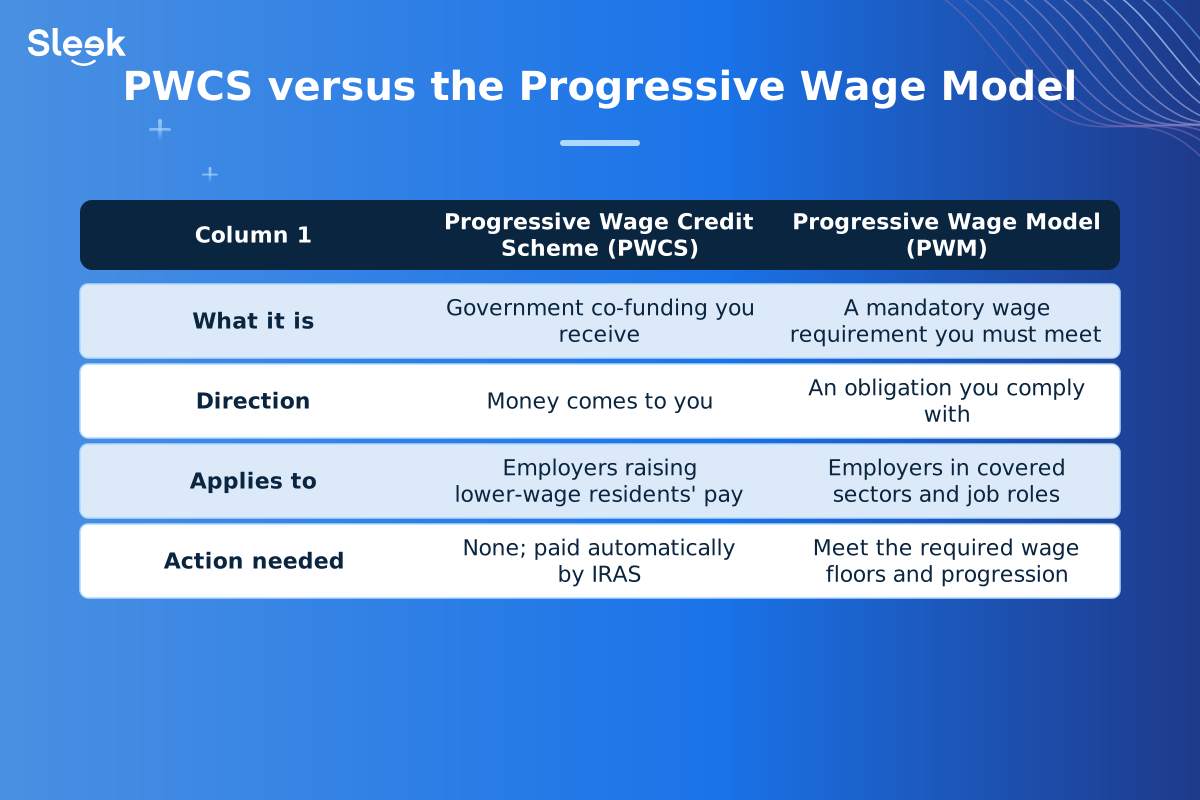
In short, the Progressive Wage Model sets minimum pay and progression steps that certain sectors, such as cleaning, security and retail, are legally required to follow. PWCS is the funding that helps employers afford wage increases, including those they make to comply with the model. They’re complementary, but only one of them is an obligation. Alongside these, the wider set of government grants and support schemes can further offset the cost of investing in your team.
How do you stay eligible without extra admin?
You don’t need a special process for PWCS. You need a reliable payroll process, because the scheme simply reads what you’re already doing. Run payroll on time, contribute CPF accurately for every eligible employee, and record wage increases properly when you give them. Do that, and the co-funding follows.
The employers who miss out tend to be the ones with messy records: raises applied inconsistently, CPF submitted late, or wage data that doesn’t cleanly reflect what people actually earned. If any of that sounds familiar, it’s worth tightening up your payroll before your next round of pay rises. Good payroll and employment records don’t just keep you compliant; they make sure you actually capture the support you’re owed. And if you’re paying yourself as a director too, how to pay yourself from your business shows where that sits in the picture.
How Sleek helps you capture the support you’re owed
PWCS rewards employers who keep clean, accurate payroll records, and quietly penalises the ones who don’t. Sleek runs payroll for Singapore businesses so your CPF contributions are correct and on time every month, which is precisely the data the scheme reads to calculate your payout. You focus on deciding who deserves a raise, and the records that turn that decision into government co-funding take care of themselves.
Give the raises, and let your payroll records do the claiming.
Talk to a Sleek payroll specialist about keeping your CPF and payroll records payout-ready.


450,000
businesses worldwide.


from 4,100+ reviews.

FAQs: Guide to the Progressive Wage Credit Scheme (PWCS)
What is the Progressive Wage Credit Scheme?
PWCS is a government co-funding scheme in Singapore. When employers raise the wages of eligible lower-wage resident workers, the government pays back a share of that increase. It’s administered by IRAS and calculated from employers’ CPF contribution records, so it supports pay rises without adding a claims process.
Do I need to apply for PWCS?
No. There’s no application. IRAS assesses eligibility from the CPF contributions employers make, works out the co-funding automatically, and disburses the payout directly, usually once a year. Your only real responsibility is to run payroll accurately so the underlying CPF data is correct.
Who is eligible for PWCS payouts?
The scheme targets lower-wage resident employees whose gross monthly wage falls within the qualifying range, and employers who give those workers a qualifying pay increase backed by CPF contributions. Because the exact wage ceiling and conditions are set per scheme year, confirm the current-year thresholds with IRAS before relying on a payout.
How much does PWCS pay?
PWCS covers a percentage of the qualifying wage increase, up to a wage ceiling, with the co-funding rate set by the government and tapering over the life of the scheme. Because the current rate and ceiling are reviewed each year, take those figures directly from IRAS rather than assuming last year’s numbers still apply.
Is PWCS the same as the Progressive Wage Model?
No, and it’s a common mix-up. The Progressive Wage Model is a mandatory wage requirement that certain sectors, like cleaning, security and retail, must follow. PWCS is voluntary support that co-funds wage increases. One is an obligation you meet; the other is funding you receive, and they can work together.
How can I make sure I don't miss a PWCS payout?
Keep your payroll clean. Contribute CPF accurately and on time for every eligible employee, and record wage increases properly when you make them. Because the payout is built entirely from CPF data, late or inconsistent submissions can mean under-claiming. Reliable payroll software or a managed payroll service keeps that data payout-ready.