Shivali is the Co-Head of Accounting at Sleek, where she works closely with startups and SMEs, guiding them through accounting, taxation, financial reporting, and regulatory compliance in the Singapore market. With a strong foundation in Accountancy and an MBA in Marketing, she brings a practical, business-first perspective to her advisory work. Shivali is passionate about helping businesses set up smoothly, stay compliant, and grow with confidence at every stage of their journey.
96% customer satisfaction from 16,000+ survey responses.
In this article
Share this post
Facebook
LinkedIn
WhatsApp
Copy to clipboard
Key takeaways
CPF is Singapore's mandatory social security savings scheme. If you employ Singapore Citizens or Permanent Residents, you must contribute every month.
For employees aged 55 and below, the standard total contribution is 37% of wages, split 17% employer and 20% employee, on wages up to the Ordinary Wage ceiling of S$8,000 a month from 1 January 2026.
Employees on work passes such as the Employment Pass, S Pass or Work Permit are not covered by CPF.
CPF is due on the last day of each month and must be paid by the 14th of the following month. Late payment attracts interest of 1.5% per month, and rates for senior workers rise again on 1 January 2027.
Skip the bank queue. Open your account from anywhere.
What CPF is: Singapore’s mandatory Central Provident Fund, a social security savings scheme funded by both employer and employee.
Who pays: Any business employing Singapore Citizens or Permanent Residents. Foreign employees on work passes are not covered.
How much (2026): 37% of wages for staff aged 55 and below, split 17% employer and 20% employee, on the first S$8,000 of monthly wages. Rates step down with age.
The ceilings: The Ordinary Wage ceiling is S$8,000 a month from 1 January 2026. A separate Additional Wage ceiling of S$102,000 a year, minus the wages already subject to CPF, caps contributions on bonuses.
The deadline: Contributions are due on the last day of the month and must be paid by the 14th of the next month. Late payment carries interest of 1.5% per month.
Bottom line for employers: CPF is a non-negotiable cost of hiring locally, roughly 17% on top of salary for younger staff, and it is deadline-bound.
CPF, the Central Provident Fund, is the cornerstone of Singapore’s social security system. For an individual, it is a retirement, housing and healthcare savings pot. For an employer, it is something more immediate: a monthly obligation that adds a real percentage to every local salary you pay, with a firm deadline and interest if you miss it.
Most founders meet CPF the hard way: they build a hiring budget around gross salary and then discover the employer contribution on top of it. CPF is a non-negotiable cost of hiring locally, roughly 17% on top of salary for younger staff, and it is deadline-bound. Most companies in Singapore prefer to use an efficient accounting service that comes with payroll services to deal with CPF. This guide explains what CPF is, who you must pay it for, how much it costs in 2026, and when it is due.
About to make your first hire and unsure what CPF will actually cost you on top of salary?
What is the purpose behind CPF?
CPF is a mandatory savings scheme that Singapore Citizens and Permanent Residents build up throughout their working lives to fund four things: retirement, housing, healthcare and a measure of family protection. Instead of a state-funded pension paid from general taxation, Singapore requires both the worker and the employer to save into the worker’s own CPF accounts every month.
For you as an employer, the purpose is simpler to state. CPF is part of the true cost of employing someone locally, and paying it correctly and on time is a compliance obligation enforced by the CPF Board.
How to contribute to CPF?
Every month, you calculate CPF on your employee’s wages, deduct the employee’s share from their salary, add your employer share on top, and submit the combined amount to the CPF Board. You keep doing this for as long as you employ Singapore Citizens and Permanent Residents.
What is the CPF contribution rate in 2026?
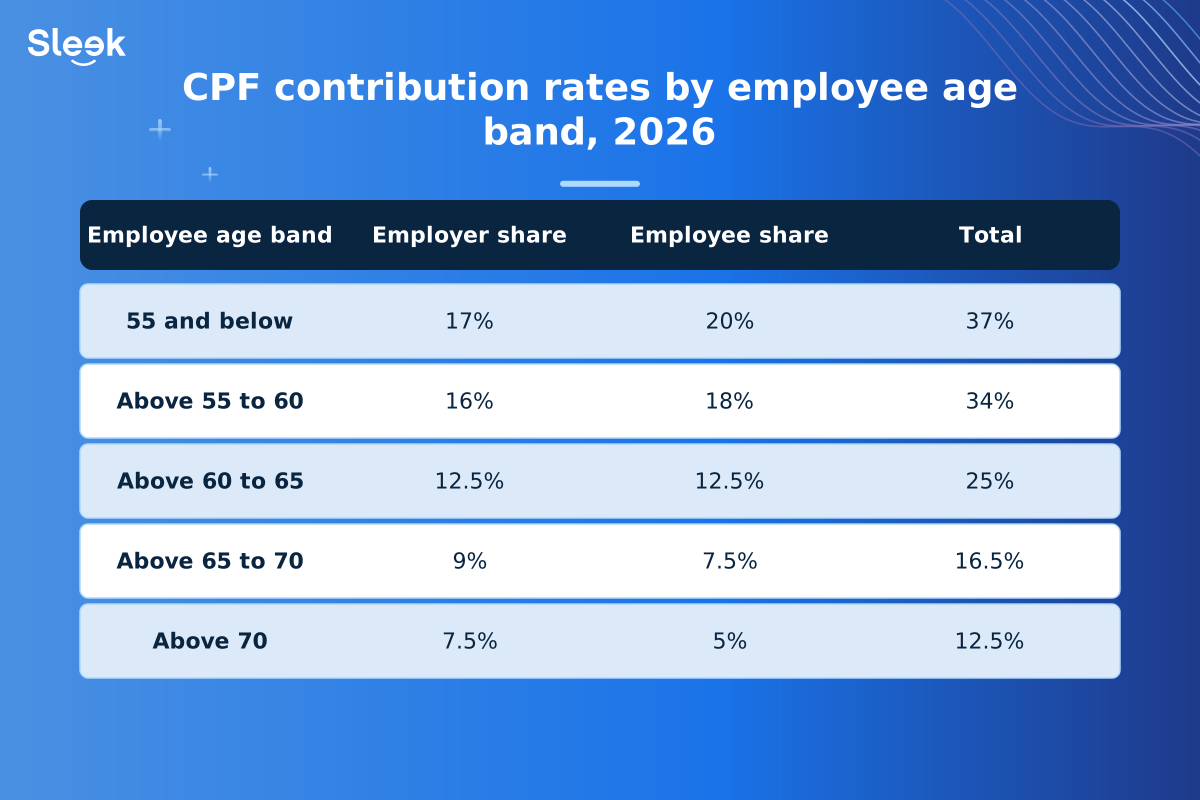
The rate depends on the employee’s age. These are the rates from 1 January 2026 for employees earning more than S$750 a month, per the CPF Board’s contribution rates.
Two things to note. First, the rates for workers aged 55 to 65 rose in recent years and are scheduled to rise again on 1 January 2027, so build the increase into any multi-year cost model. Second, the age band changes the month after an employee’s birthday, which is a common source of small payroll errors.
The Ordinary Wage and Additional Wage ceilings
CPF is not charged on unlimited pay. Two ceilings cap it.
The Ordinary Wage ceiling caps the monthly salary that attracts CPF. From 1 January 2026 it is S$8,000 a month. If you pay someone S$10,000 a month, you only compute CPF on the first S$8,000.
The Additional Wage ceiling applies to bonuses, commissions and other non-monthly payments. It is set at S$102,000 for the year, minus the total ordinary wages that were already subject to CPF. This is where employers make the most expensive mistakes, because it has to be recalculated across the whole year rather than month by month.
What does an employee actually cost you? A worked example
Take a 30-year-old employee on a salary of S$5,000 a month. That is below the S$8,000 ceiling, so CPF applies to the full amount.
Employer share (17%): S$850, paid by you on top of salary.
Employee share (20%): S$1,000, deducted from the employee’s pay.
The employee takes home S$4,000; the CPF Board receives S$1,850 in total.
So the true monthly cost of that hire is S$5,850, not S$5,000. For a founder building a headcount budget, that 17% employer share is the number that most often gets left out.
How to pay CPF, and when
Contributions are due on the last day of each calendar month and must be paid by the 14th of the following month (or the next working day if the 14th is a weekend or public holiday), according to the CPF Board’s due-date guidance. Most employers submit through CPF EZPay.
Miss the deadline, and interest accrues at 1.5% per month, charged from the first day after the due date, with a minimum of S$5, and the Board can take enforcement action (CPF Board, late-payment interest). At 1.5% a month, that works out to nearly 19% a year, so late CPF is an expensive way to manage cash flow. If keeping to a monthly deadline is a concern, our guide on how to manage payroll in Singapore walks through the routine.
Is CPF contribution taxable?
The employer’s CPF contribution is generally not taxable in the employee’s hands when it is made within the statutory rates and ceilings. The employee’s own share is paid from wages that have already been counted as their income. CPF contributions are reported to IRAS each year through the employer’s income reporting, so keep your monthly records clean for the annual filing.
Who is eligible for CPF?
You must pay CPF for Singapore Citizens and Permanent Residents whom you employ, including most part-time, casual and temporary staff, and directors who receive a salary. If you pay yourself a salary as a local director, CPF applies to you too; our guide on how to pay yourself as a sole company director covers the mechanics.
Do foreigners have to pay CPF?
No. Employees on work passes such as the Employment Pass, S Pass or Work Permit are not covered by CPF, and you must not make CPF contributions for them. Foreign employees are instead covered by other mechanisms where applicable, such as the Foreign Worker Levy for certain pass types. Contributing CPF for someone who should not be covered is a genuine error to unwind, so confirm each new hire’s status before you run their first payroll.
A note on directors: CPF is due on a director’s salary or wages, but director’s fees approved by the company are not treated as wages and do not attract CPF. Most owner-directors of small companies pay themselves a salary, so this distinction is worth getting right from the first payroll.
What type of CPF accounts does one have?
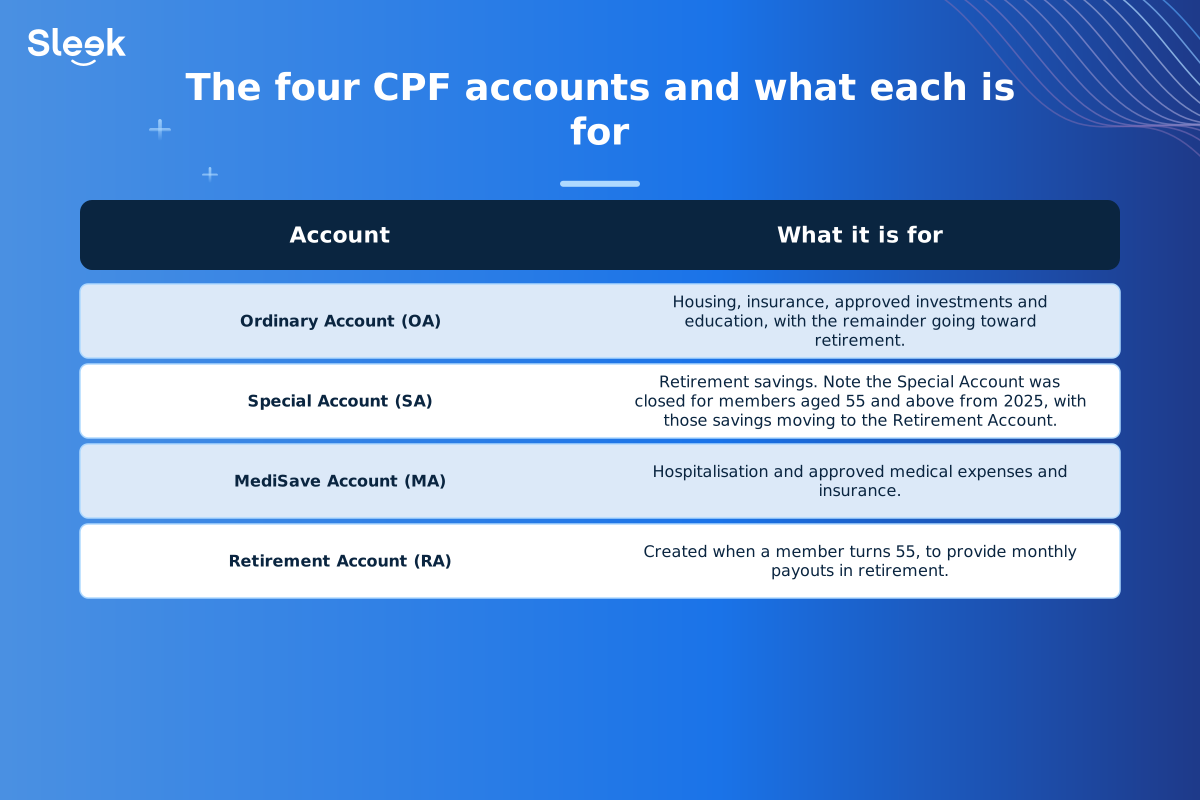
An employee’s CPF is split across separate accounts, each with its own purpose. You do not administer these as an employer, but staff often ask, so it helps to know the outline.
Beyond knowing the accounts exist, retirement adequacy, top-ups and CPF investment are personal decisions for the individual member and the CPF Board, not something an employer needs to advise on.
What is the CPF interest rate?
CPF savings earn interest set by the government and reviewed regularly. As a guide, the Ordinary Account earns a floor of 2.5% a year, while the Special, MediSave and Retirement Accounts earn a floor of 4% a year, with the 4% floor extended through the end of 2026. These rates affect the employee’s savings, not your contribution cost, so from an employer’s point of view they are useful context for answering staff questions rather than a figure you need to act on.
What is SDL?
Separate from CPF, employers also pay the Skills Development Levy (SDL) for all employees, including foreign staff, at a low percentage of wages up to a monthly cap. It funds national workforce training. It is a small amount next to CPF, but it is a distinct obligation, so do not overlook it. Our guide to the Skills Development Levy in Singapore sets out the current rate and cap.
Final thoughts: how Sleek handles CPF as part of payroll
CPF is not complicated once, but it is complicated every single month: the right rate for each employee’s age, the two wage ceilings, the deduction, the submission and the deadline, repeated twelve times a year and penalised if you slip. That monthly grind is exactly what a payroll service takes off your plate.
Sleek’s payroll services calculate each employee’s CPF, apply the correct age band and ceilings, and submit to the CPF Board on time, alongside your payslips and year-end income reporting. If you are still setting up, our incorporation services get the company in place first. To talk it through, contact our payroll team, and for the wider picture.
Stop calculating CPF by hand every month.
Sleek’s payroll team applies the right rate and ceiling for every employee and submits to the CPF Board on time.
CPF, the Central Provident Fund, is Singapore’s mandatory social security savings scheme. Employers and employees both contribute a percentage of wages each month into the employee’s CPF accounts, which fund retirement, housing and healthcare.
Is CPF compulsory for employers?
Yes. If you employ Singapore Citizens or Permanent Residents, contributing CPF is a legal obligation, not optional. You pay an employer share on top of salary, deduct the employee share from wages, and submit both to the CPF Board every month.
Do I need to pay CPF for foreign employees on an Employment Pass?
No. Employees on work passes such as the Employment Pass, S Pass or Work Permit are not covered by CPF, and you should not contribute for them. Making CPF contributions for a work-pass holder is an error you would then need to correct.
How much CPF does the employer pay?
For employees aged 55 and below, the employer share is 17% of wages, on the first S$8,000 of monthly salary from 1 January 2026. The share steps down for older employees, to 16%, 12.5%, 9% and 7.5% across the higher age bands.
When is the CPF submission deadline each month?
CPF is due on the last day of the month and must be paid by the 14th of the following month. If the 14th falls on a weekend or public holiday, the deadline moves to the next working day.
What happens if I submit CPF late?
Late payment attracts interest of 1.5% per month, charged from the first day after the due date, with a minimum of S$5, and the CPF Board can take enforcement action. At 1.5% a month, that is close to 19% a year.
Is CPF submission included in Sleek's payroll service?
Yes. Sleek’s payroll service calculates each employee’s CPF using the correct age band and wage ceilings and submits it to the CPF Board on your behalf every month, so you do not manage the deadline yourself.















 Two things to note. First, the rates for workers aged 55 to 65 rose in recent years and are scheduled to rise again on 1 January 2027, so build the increase into any multi-year cost model. Second, the age band changes the month after an employee’s birthday, which is a common source of small payroll errors.
 Beyond knowing the accounts exist, retirement adequacy, top-ups and CPF investment are personal decisions for the individual member and the CPF Board, not something an employer needs to advise on.