Chester Cheung is the Content Marketing Specialist for the Hong Kong market at Sleek, crafting localized, high-conversion bilingual content that empowers entrepreneurs to make confident business decisions.
Drawing on a background in finance and digital marketing, including roles at HSBC and in the digital agency space, Chester combines commercial rigor and performance-driven storytelling to every piece he ships. His focus is on translating complex business and compliance concepts into clear, actionable insights for busy founders.
Having worked across both structured corporate environments and agile teams, Chester knows what business owners value most: reliable information without the jargon. At Sleek, he leverages this perspective to produce insightful, accessible content that drives customer acquisition and fosters long-term value.
When he’s not writing, Chester is an active runner and an amateur photographer.
Shopify Hong Kong accounting goes wrong at the same place for almost every seller: the bank line is smaller than the sales figure in the Shopify dashboard, and nobody can say why. You book the deposit, the month looks fine, and a year later your auditor asks where the fees went.
The fix is a method, not a bigger spreadsheet. Book what customers were charged, then every deduction taken on the way to the bank.
In this guide, you’ll learn:
How a Shopify payout is actually built, line by line
The chart of accounts a Hong Kong store needs, and the one account it doesn’t
Whether Xero’s native app, a payout tool or a spreadsheet fits your volume
How to close a month so Xero, Shopify and the bank agree
Which files the IRD and your auditor will ask for
Do you still need accounting records if you already have Shopify?
Yes. Shopify records orders and payment activity, but it does not replace your general ledger. Your accounting records still need to capture revenue, expenses, assets, liabilities, inventory and the cash movements behind your Shopify sales.
Revenue, expenses, assets, liabilities and reconciliations
Nothing unless the underlying data is complete
For a Hong Kong business, proper records also support Profits Tax reporting and, where applicable, statutory audit.
Section 51C of the Inland Revenue Ordinance requires sufficient business records to be retained for at least seven years. Failure to comply without reasonable excuse may result in a maximum fine of HK$100,000.
For a corporation that qualifies for Hong Kong’s two-tiered Profits Tax rates, the rates are 8.25% on the first HK$2 million of assessable profits and 16.5% above that, subject to the applicable conditions.
How should you record Shopify sales, fees and payouts?
Record gross sales first, then record each deduction separately and use a clearing account to reconcile the payout to your bank.
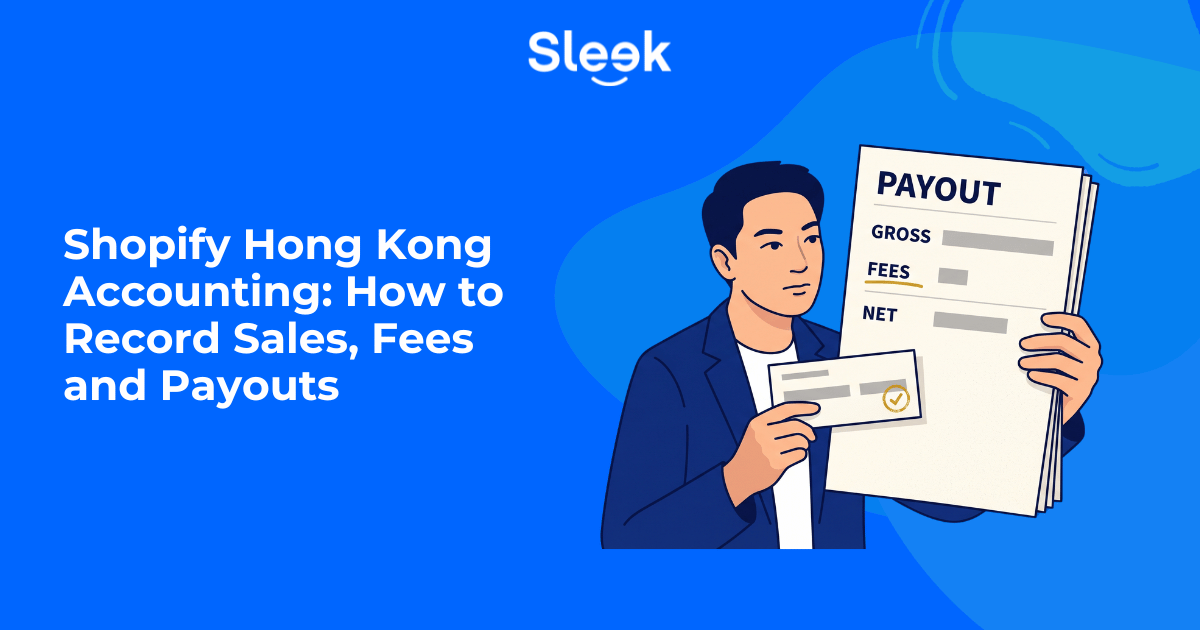
A Shopify payout is six lines: gross order, discount, amount charged, processor fee, clearing account, then the payout to the bank. Sales stay at the gross order. The deposit is cash leaving clearing.
The bank deposit is the amount left after items such as discounts, refunds and payment-processing fees. It should therefore not be used as the sales figure.
Example: a HK$500 Shopify order
Using the Basic-plan Shopify Payments rate in Hong Kong as an illustration:
Step
Amount
Accounting treatment
Order value
HK$500.00
Sales income
Discount
(HK$50.00)
Discounts / contra income
Customer charged
HK$450.00
Shopify Payments clearing
Processing fee
(HK$17.20)
Merchant fee expense
Net payout
HK$432.80
Remains in clearing until payout
Bank payout
HK$432.80
Transfer from clearing to bank
The current Hong Kong Basic plan shows an online card rate of 3.3% + HK$2.35. On a HK$450 charge, that produces a HK$17.20 processing fee in this example.
The accounting point is simple: sales are HK$500, not HK$432.80. The discount and payment fee separately explain the difference.
For Shopify Payments, reconcile payouts rather than trying to match every individual order directly to a bank transaction. Shopify provides payout and transaction records for this purpose.
A few Hong Kong specifics matter here:
Minimum settlement is four business days, so a sale never appears in the bank the same day
Payments captured Friday, Saturday and Sunday are consolidated into one payout
The minimum payout is HK$10
An HKD payout into a Hong Kong HKD account carries no multi-currency payout fee
If you also use Stripe or PayPal, give each processor its own clearing account because settlement timing and fee structures can differ.
Three items deserve particular attention:
Reserves: cash temporarily held by the processor should be tracked separately from sales and discounts.
Chargebacks: record the chargeback and related fee separately from an ordinary customer refund.
Foreign exchange: account for exchange differences where the order and payout currencies differ.
Shopify may also debit your bank when refunds or other adjustments exceed the amount available for payout. Your reconciliation therefore needs to cover withdrawals as well as deposits.
Important note
The money that lands in your bank account is not your revenue. It is what survived after discounts, refunds, processing fees and any amount the processor held back. Book the gross order first and every deduction separately, or your sales figure will be wrong by exactly the amount Shopify charged you.
What chart of accounts does a Hong Kong Shopify store need?
A Shopify store may need a few additional accounts beyond a basic chart of accounts, particularly for payment clearing, fees, refunds and gift cards.
A practical structure can include:
Account
Type
What it records
Sales
Income
Gross order value
Shipping income
Income
Delivery charges paid by customers
Discounts
Contra income
Discount codes and automatic discounts
Refunds
Contra income
Returned orders
Merchant fees
Expense
Shopify Payments, Stripe and PayPal charges
Software subscriptions
Expense
Shopify plan and paid apps
Inventory
Asset
Stock purchased but not yet sold
Shopify Payments clearing
Asset
Payments captured but not yet paid out, plus relevant reserves
Gift card liability
Liability
Unredeemed gift cards
Hong Kong GST payable
Normally omit
Hong Kong has no local GST/VAT output tax
You don’t necessarily need a separate revenue account for every sales channel. Tracking categories or equivalent reporting dimensions can separate Shopify, POS and marketplace sales without making the chart unnecessarily complicated.
Your Shopify subscription and advertising costs are separate expenses. They don’t form part of the Shopify Payments payout.
Tip
Don't create a Hong Kong output tax or GST payable account just because your connector shows a tax field. Local checkout has no output tax to collect. The only reason to open a tax liability account is if Shopify is collecting a foreign tax such as EU VAT on your behalf.
Should you use Xero’s Shopify integration, a payout tool or a spreadsheet?
The right setup depends more on the complexity of your payment and accounting flow than on a fixed order count.
Xero currently offers a Shopify integration that can sync Shopify sales and purchase data into Xero, with Amaka available as an integration setup partner. Xero also states that sales-tax data isn’t supported directly in the Shopify integration.
Option
May suit
Limitation
Shopify integration by Xero
One processor and a relatively straightforward Shopify setup
More work may be needed for multiple processors or overseas tax reporting
Payout-summary tool
Multiple processors, marketplaces or more complex settlements
Adds another software cost
Spreadsheet
Pre-launch stores or low transaction volume
Becomes harder to maintain as refunds, reserves, FX and inventory increase
There isn’t a single order-volume threshold that determines when you need another tool. A smaller store with several processors and currencies can require more reconciliation work than a larger store with one straightforward payment flow.
How should inventory and cost of goods sold work on Shopify?
Unsold stock is an asset, while cost of goods sold relates to inventory that has been sold. Your Shopify inventory report should therefore not automatically be treated as the final accounting figure.
For businesses dealing in goods, the IRD requires records of purchases and sales in sufficient detail to identify sellers and buyers, together with year-end trading-stock statements and the supporting stocktaking records.
Your accounting records should therefore connect:
Purchases → inventory → sales → cost of goods sold
If you use dropshipping, the customer sale and supplier cost remain separate accounting figures rather than being recorded only as the margin.
Shopify and Shopify POS can use one set of books
If the same company operates a Shopify online store and Shopify POS, the sales remain part of the same company’s accounts. Use tracking categories or equivalent reporting dimensions to separate the channels where useful.
How should shipping charges be recorded?
Amounts charged to customers for delivery should generally be tracked separately from the delivery costs you incur. Netting them into sales can make revenue and gross margins harder to analyse.
Where inventory or fulfilment takes place overseas, additional tax considerations may arise. Those issues are outside the basic Shopify bookkeeping flow and should be assessed separately.
What Shopify records should you keep for the IRD and auditor?
Keep records that allow transactions to be traced from Shopify through the payment processor and bank into your accounting records, and retain them for at least seven years. A bank statement alone normally won’t provide that trail because it shows the net cash movement rather than the underlying sales and deductions.
Useful records include:
File
Where to find it
Why it matters
Payouts and transaction exports
Shopify Payments
Connects gross activity to net payouts
Sales reports
Shopify Analytics / Reports
Supports sales and channel reporting
Refund and chargeback records
Shopify Orders
Explains refunds and negative payouts
Gift card records
Shopify
Supports the gift-card liability
Stocktake and inventory records
Your stock records
Supports year-end inventory
Shopify and app invoices
Shopify billing
Supports software expenses
Bank statements
Your bank
Confirms cash received
Trial balance
Xero or your accounting system
Provides the accounting starting point for year-end work
Download key Shopify exports regularly rather than relying on access to the platform at year end.
The cost has several parts: your Shopify subscription, payment-processing fees, accounting software or connectors, and the cost of bookkeeping and accounting support.
Shopify’s current Hong Kong pricing lists the following annual-billing prices:
Cost
Current Shopify Hong Kong pricing
Basic
US$25/month
Grow
US$69/month
Advanced
US$299/month
Current online card rates are 3.3% + HK$2.35 for Basic, 3.2% + HK$2.35 for Grow, and 3.1% + HK$2.35 for Advanced. Shopify also lists third-party payment-provider fees of 2%, 1% and 0.6% respectively.
These are Shopify and payment costs, not accounting fees.
DIY accounting can become harder to maintain as the payment, inventory and tax setup becomes more complex. Order volume is one factor, but it isn’t the only one.
You may want additional accounting support when:
You use several payment processors or currencies
Shopify collects overseas sales tax or VAT
A warehouse outside Hong Kong is involved
Your clearing account contains balances you can’t explain
You are approaching an audit without regularly closed books
Inventory and COGS are becoming difficult to reconcile
DIY may remain workable when:
You have one Hong Kong entity and a straightforward payment setup
Your accounting system is configured correctly
You reconcile payouts regularly
You hold little or no stock
The practical test is whether you can consistently reconcile:
sales → fees → clearing → bank → accounting records
How Sleek handles Shopify accounting in Hong Kong
You now know what a payout is made of, which accounts to open, and what your auditor will ask for. The remaining question is who does it monthly.
With Sleek, you can:
Payout reconciliation: gross orders, fees, refunds and reserves matched to every bank line, on a clearing account that ties.
Xero you can log into: Shopify books on Xero in your own name, not a file you only see once a year.
Audit file: the export pack assembled as the year goes, so the audit isn’t a reconstruction exercise.
Profits Tax pack: accounts prepared so the return has something clean to sit on.
If you already close each month and your clearing account makes sense, keep doing it. Most of the value here is knowing what a good close looks like.
Shopify sales in Xero, ready for audit
Gross orders, processor fees and bank payouts on one ledger, with a named accountant for the year-end file.
Do unused Shopify gift cards count as sales when the customer buys the card?
No. Selling a gift card increases cash or clearing and increases a liability, because you owe the customer goods. Revenue is recognised when the card is redeemed against an order. Cards that expire or go unredeemed are treated separately, and your accountant should set that policy once.
If I use Stripe instead of Shopify Payments, do I still pay Shopify’s third-party transaction fee?
Yes. Shopify charges a third-party transaction fee when you use an external processor: 2% on Basic, 1% on Grow and 0.6% on Advanced as at 18 September 2026. That sits on top of Stripe’s own fee, so an external processor on Basic costs you twice.
What if Shopify debits my bank because refunds exceeded the payout?
Book the debit as cash out of the clearing account, the same way you’d book a payout in reverse. This is the most common reason a clearing account refuses to tie: sellers post deposits only, so nothing offsets the withdrawal. Settlement still runs to a four business day minimum either way.
What if I collect EU VAT or US sales tax at Shopify checkout?
Hong Kong still has no output tax on your local sales. The foreign tax is a liability you hold and remit, so it needs its own account. Note that sales tax is not supported in the Xero and Shopify integration, so that reporting won’t come out of the connector. The wider position sits withe-commerce taxes in Hong Kong.
I sell on Shopify and Amazon through the same Hong Kong company. Do I need separate books?
No. The same legal entity generally has one set of accounting records. You can keep separate clearing accounts and use tracking categories to analyse Shopify, Amazon and other channels separately.
View more
Does Shopify Payments require a Hong Kong bank account?
Yes. For Shopify Payments in Hong Kong, payouts can be received in HKD, and Shopify sets requirements for the connected bank account. Check Shopify’s current Hong Kong eligibility requirements when setting up the account.
Can an overseas director send Shopify records to the accountant or auditor?
Many Shopify and banking records can be exported electronically and shared remotely. The audit itself remains subject to Hong Kong’s applicable audit and appointment requirements.
How far in advance should I prepare for the audit?
Start the year-end accounting and reconciliation before the audit begins rather than reconstructing the books afterwards. The appropriate lead time depends on your financial year end, transaction volume, inventory and the condition of your records.