Ismarina is the Head of Country at Sleek Singapore, where she leads strategic growth, operational excellence, and service delivery. With over 20 years of experience across finance, compliance, and business leadership, she oversees Sleek’s full range of services. These include CFO advisory, accounting, tax, GST, payroll, corporate secretarial, immigration, and client support.
She is known for her clarity in leadership and strength in execution. Ismarina has led large, cross-functional teams in both in-person and virtual settings. She has delivered strong P&L outcomes, scaled operations, and built trusted relationships across businesses of all sizes.
Ismarina combines practical insight with academic depth. She holds an MSc (Hons) in Management, is a Fellow CPA, an ASEAN CPA, and a CIMA-qualified Chartered Global Management Accountant. Her expertise covers project management, construction and nonprofit accounting, judicial management, and liquidation. Her experience running an accounting firm and offering CFO services gives her a sharp understanding of what clients need to grow and stay ahead.
She is also a committed mentor who supports her team’s growth with care and purpose. Before Sleek, she held senior roles at the Project Management Institute and the Football Association of Singapore. She played a key role in leading digital transformation and shaping regional strategy.
Outside of work, you’ll find her immersed in books, sewing projects, and knitting, or cheering on her family at sporting events. She brings the same passion for excellence to everything she does, both professionally and personally.
96% customer satisfaction from 16,000+ survey responses.
In this article
Share this post
Facebook
LinkedIn
WhatsApp
Copy to clipboard
Key takeaways
Tax advisor costs in Singapore vary mainly by business size and complexity.
Small businesses typically pay under SGD 1,200 annually, while larger companies with more complex needs can exceed SGD 3,500 per year.
Compliance services like Form C-S filing are low-cost, but fees increase when you need tax planning, GST support, or multi-entity reporting.
Professional support helps avoid IRAS penalties, ensures correct deductions, and frees up time for business operations, making it a cost-effective choice for most companies.
Tax advisor cost Singapore searches usually mean two things: what filing costs and what advice costs, and the two are priced very differently. This guide shows what drives the price, the figures we could source and what is included at each level, checked on 23 October 2026. If you only need returns filed, start with corporate tax filing.
What drives the price, in short:
Scope: filing only, advice only, or both.
Filing form: Form C-S (Lite), Form C-S or Form C.
Volume and complexity: how many transactions you have, and whether you have cross-border, group or incentive questions.
Billing basis: a one-off quote, or an annual plan that includes bookkeeping.
How much does a tax advisor cost in Singapore?
As of 23 October 2026, tax advisor cost in Singapore depends mainly on scope, filing form, transaction volume and complexity, and we found no independent price list to quote a market average. The filing prices we could source are listed below. We found no published price for tax advice or planning.
Sourced filing prices, all checked on 23 October 2026:
Sleek, Annual Filing & Bookkeeping: from S$75 a month, billed annually, per Sleek’s accounting plans. Sleek’s page says every plan covers ECI and the annual return.
Sleek, Accounting Essentials and Premium: from S$90 and from S$250 a month, on the same page. Both add more frequent bookkeeping and faster support.
Raffles Corporate Services, filing page: Form C-S or C-S (Lite) from S$350 and Form C from S$700, with ECI filing included, on its tax filing page dated 4 October 2026.
Raffles Corporate Services, fee guide: S$600 to S$1,200 for Form C-S, plus S$150 to S$400 for ECI preparation, in its 2026 fee guide. Even one firm’s pages differ, so treat all of these as starting points.
These are not like for like. Sleek’s plans include bookkeeping, while the Raffles fee guide says its fees assume bookkeeping is already complete. Prices may vary with current promotions, so check the latest on the relevant page.
What affects the cost of a tax advisor?
Six things move the price: what you ask for, which filing form applies, how many transactions you have, how complex your affairs are, whether the work is one-off or ongoing, and how urgent it is. The table shows the direction of each, without figures. Your tax rate and reliefs are set in our guide to Singapore corporate tax.
Cost driver
Effect on price
Why it matters
Scope: filing, advice or both
Rises as advice is added
Advice such as planning and restructuring is custom work; filing is a repeated task
Filing form: C-S (Lite), C-S or C
Rises from C-S (Lite) to C-S to Form C
IRAS sets which form you can use; Raffles lists a higher starting price for Form C
Transactions and expenses
Rises with volume
Sleek’s plans are priced by annual expense band, from under S$30,000 up to S$900,000
Complexity: cross-border, group, incentives
Rises with complexity
Raffles says its “from” prices can rise with fixed assets, related-party balances or prior-year clean-up
One-off or ongoing
Varies by billing basis
An annual plan and a one-off quote cover different work, so compare like for like
Urgency
Rises when rushed (our reading)
Short notice before a deadline limits how much time a firm has to plan
Directions are our reading of how firms quote, not published figures. The filing form and expense-band rows come from IRAS, Sleek and Raffles pages, as linked above.
A tax advisor does two jobs: compliance and advice. Compliance means computing your tax and filing ECI and Form C-S or Form C with IRAS. Advice covers corporate tax advisory work such as planning, restructuring and incentive claims, which is where tax planning services sit.
Typical compliance work:
Preparing the tax computation
Filing ECI
Filing Form C-S (Lite), Form C-S or Form C
Answering routine IRAS queries on the return
Typical advice work:
Planning around reliefs and exemptions
Restructuring a company or group
Claiming incentives and checking what qualifies
Cross-border tax questions
Sleek’s pages describe tax computation, ECI, Form C-S or Form C filing and routine IRAS correspondence. They do not list tax planning services as a separate offer. For incentives and deductions, see our guides on tax incentives for businesses and allowable business expenses.
Do I need a tax advisor or just an accountant?
Most small companies need filing and bookkeeping, which an accountant covers. A tax advisor adds value for restructuring, cross-border income and incentive questions. If you are unsure, start with a scoping conversation and ask exactly what is included before you pay.
Your situation
Best fit
What to ask for
Local company with simple trading and routine filings
Accountant
Bookkeeping, tax computation, ECI and the annual return in one scope
Overseas income, group or intercompany dealings
Accountant and tax advisor
A written view on how the income is treated and who files
Considering an incentive, relief or restructuring
Tax advisor, working with your accountant
The basis of the advice, what is claimed, and who submits it
Not sure what you need
Start with an accountant
A short scoping call and a written list of inclusions
Before you speak to anyone, estimate your own position with the corporate tax calculator. Tax planning services and other tax advisory services Singapore firms offer are worth buying when you have a specific decision to make, not as a default.
Real costs compared: DIY vs Sleek vs Traditional Firms
Here’s how the options compare:
Factor
DIY (IRAS e-Filing)
Sleek
Traditional Firm
Cost
From S$0 (your time and effort)
From S$75/month (billed annually)
From S$1,200/year (often higher with add-ons)
What’s included
Filing of Form C-S or C-S (Lite) only
Tax computation, IRAS e-Filing, bookkeeping, and financial statements
Tax computation and filing are often charged separately from bookkeeping
What you handle
All bookkeeping, computation, and submissions
Sleek manages everything online through qualified accountants
Some paperwork handled, but requires manual coordination
Best for
Business owners are comfortable preparing their own financials
Companies seeking a fast, compliant, all-in-one tax solution
Businesses that prefer face-to-face service and don’t mind higher costs
What is the difference between a tax advisor, tax agent and tax consultant?
In everyday use the terms overlap, so check what each firm actually does. Singapore tax consultants and tax advisors advise, a tax agent files on a company’s behalf, and a tax accountant usually combines bookkeeping with filing. The sections below show where the labels differ in practice.
Tax advisor Singapore: the broad term
Tax advisor Singapore firms use the term for anyone who advises on tax, from routine questions to planning. Corporate tax advisory work is the narrower, project-based end of that range.
Tax consultant Singapore: usually the same job
Singapore tax consultants and tax advisors are often the same people under a different label. Ask what the person will do for your company, not what their title says.
Tax agent Singapore: the person who files
IRAS says a company’s employee or a third party, such as a tax agent firm, can file its return once authorised in Corppass. A tax agent Singapore firm therefore files for you, so ask whether it also advises.
Tax accountant: filing plus bookkeeping
A tax accountant usually combines bookkeeping with tax computation and filing. This is the service most small companies need, and it is what bundled plans cover.
Tip
DIY tax filing may save some money at first, but it means managing every compliance step yourself. Sleek’s digital, all-in-one tax service combines bookkeeping, accounting, and e-Filing in one platform. This helps you save time, maintain accuracy, and stay IRAS-compliant, all while avoiding the need to deal with multiple providers.
What is included in a bundled accounting and tax service?
A bundle combines bookkeeping, tax computation and the annual filings in one plan. Sleek’s three plans, as shown on its accounting services page on 23 October 2026, differ mainly by bookkeeping frequency, reporting and support response time. The price depends on your annual expenses, with a selector from under S$30,000 up to S$900,000 and custom quotes above.
Annual Filing & Bookkeeping, from S$75 a month: annual bookkeeping, annual management reports, annual tax return filing, an assigned accountant and a 72-hour support response.
Accounting Essentials, from S$90 a month: adds monthly bookkeeping and reports, with a 48-hour support response.
Accounting Premium, from S$250 a month: adds weekly bookkeeping, quarterly reviews with a senior accountant, payroll for up to 5 employees and a 24-hour support response.
Every plan covers ECI filing and the annual return, according to Sleek’s page. Add-ons are priced separately, including XBRL report preparation at S$500 a year and payroll at S$300 per employee a year. For day-to-day records, see Sleek’s bookkeeping service, and for a comparison with larger firms, read Sleek vs Big 4 accounting.
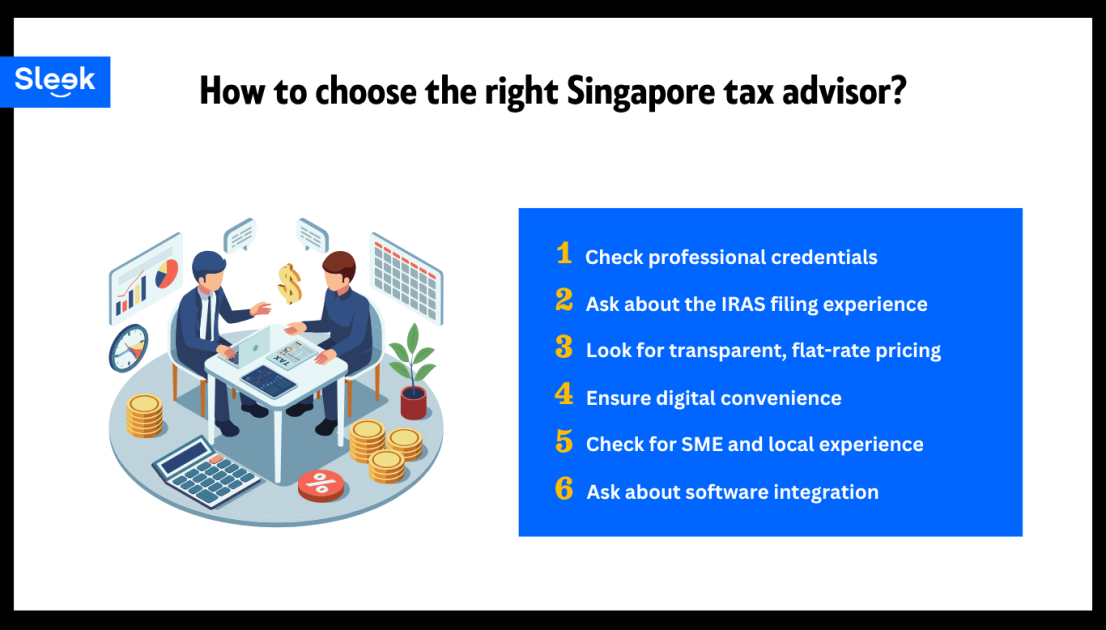
How do I choose a tax advisor in Singapore?
Ask for the scope in writing, the fee basis and who does the work. A good answer names the forms filed, the deadlines handled and what happens if IRAS queries the return. Compare like for like, because one quote may include bookkeeping and another may not.
Questions to ask any tax consultant Singapore businesses shortlist:
What is included in the fee, and what costs extra?
Which forms will you file, and by which date?
Is bookkeeping included, or must it be complete before you start?
Who handles IRAS queries, and is that included?
Who will do the work, and who reviews it?
Do you advise on planning, or only file returns?
What are the red flags in cheap or unclear tax quotes?
A low price is not a red flag by itself, but a vague scope is. A quote that does not say what is covered can hide an extra fee later, such as for ECI or the tax computation. IRAS says a company will face enforcement actions for late or non-filing, so a missed deadline is the real cost.
No written scope or list of inclusions.
ECI, the tax computation or IRAS queries priced separately without saying so.
A price that assumes your bookkeeping is already finished, without saying so.
Yes. IRAS does not require a tax agent, and the company’s own employee or a third party can file once authorised in Corppass as an Approver for Corporate Tax (Filing and Applications). The annual due date for Form C-S, Form C-S (Lite) and Form C is 30 November. Check IRAS’s Form C-S FAQs for your own case.
Who can use Form C-S (Lite)?
IRAS says a company must be incorporated in Singapore and meet the Form C-S conditions, including annual revenue of S$5 million or below and income taxable only at the 17% rate. Form C-S (Lite) is open to those companies with annual revenue of S$200,000 or below, and they can still choose Form C-S or Form C. Non-Singapore incorporated companies and Singapore branches of foreign companies must file Form C.
When do I file ECI?
IRAS says companies must generally file Estimated Chargeable Income within 3 months from the end of their financial year. For example, a company with a 31 December year end would generally file by 31 March. IRAS’s ECI page uses the word “generally”, so check it for exceptions.