Shivali is the Co-Head of Accounting at Sleek, where she works closely with startups and SMEs, guiding them through accounting, taxation, financial reporting, and regulatory compliance in the Singapore market. With a strong foundation in Accountancy and an MBA in Marketing, she brings a practical, business-first perspective to her advisory work. Shivali is passionate about helping businesses set up smoothly, stay compliant, and grow with confidence at every stage of their journey.
Choosing the best accounting software in Singapore often feels straightforward until a business starts to grow. What works at the beginning can quickly become a source of confusion, rework, and risk if the setup is not right.
Many founders only notice problems when filings are due or when the numbers no longer tell a clear story. By then, accounting decisions made earlier are difficult and expensive to undo.
A clear comparison helps business owners make the right choice earlier. That is where this guide helps.
TL;DR: Best accounting software for small business in Singapore
Best for very small / early-stage: QuickBooks Online
Highest risk option: Excel / manual bookkeeping
For most Singapore small businesses, the safest and most effective option is a solution that combines accounting software with local Singapore accounting expertise.
What is the best accounting software for small business in Singapore?
The best accounting software for small business in Singapore is one that:
Generic global accounting tools often record transactions correctly but fail to prevent local compliance mistakes. This is why Singapore businesses increasingly choose solutions that combine software with local accounting expertise.
How this guide was evaluated
This guide evaluates small company accounting software and accounting solutions based on real-world use by Singapore-registered businesses.
Each solution was assessed using the following criteria:
IRAS and GST compliance readiness
Ability to produce ACRA-ready financial statements
Scalability as transaction volume and complexity increase
Clarity of reporting for founders and directors
Availability of local Singapore accounting expertise
Overall compliance risk for the business
Pricing, brand popularity, and global market share were not used as primary ranking factors.
10 best small company accounting software in Singapore (2026)
1. Sleek
Pricing: From SGD $75 monthly
Sleek or Sleek Accounting is designed for Singapore businesses that want their accounting handled properly, without having to manage software, processes, or compliance themselves.
Rather than operating as a standalone accounting tool, Sleek provides a service-led accounting solution, supported by technology and local accounting professionals.
What it does well:
Manages bookkeeping, reviews, and compliance on behalf of the business
Uses SleekBooks for expense tracking, invoicing, and document submission
Applies automation and AI to streamline data capture and routine workflows
Supports more complex workflows on Xero where required, including for businesses already using Xero
Prepares IRAS-, GST-, and ACRA-compliant financial statements
Best for: Singapore SMEs that want their accounting handled correctly without managing software, compliance, or accounting processes themselves.
Not ideal for: Founders who want to fully manage their own bookkeeping or prefer a purely DIY accounting setup.
2. Xero
Pricing: From SGD $39 monthly
Xero is a cloud-based accounting platform commonly used by small businesses and sole traders in Singapore.
It provides tools for everyday accounting needs such as invoicing, expense tracking, bank connections, and financial reporting, and supports integration with other business applications.
What it does well:
Cloud-based invoicing and expense tracking
Bank feed integrations with major Singapore banks
GST tracking and standard financial reports
Large ecosystem of third-party integrations
Best for: Tech-savvy SMEs with basic accounting knowledge who want to manage their own books.
Not ideal for: Businesses that want hands-off accounting or built-in local compliance oversight.
Tip: If you prefer Xero but don’t want to manage bookkeeping yourself, consider a service provider that supports Xero with local accounting oversight.
3. QuickBooks Online
Pricing: From SGD $31 monthly
QuickBooks Online is a cloud-based accounting platform designed for small businesses that want to automate routine financial tasks and keep everything in one place.
What it does well:
Automated transaction categorisation
Invoicing and expense tracking
Bank feeds and basic financial reporting
Mobile access across devices
Best for: Very small or early-stage businesses looking for an affordable accounting tool.
Not ideal for: Businesses with complex compliance, GST, or reporting requirements.
4. ABSS/MYOB
Pricing: Software price starts from SGD $865
ABSS (formerly MYOB) is an established accounting software used by many SMEs in Singapore, especially businesses that prefer a more traditional, desktop-based setup.
What it does well:
Desktop-based accounting with structured workflows
GST reporting and inventory management
Familiar interface for traditional accounting teams
Commonly used by businesses eligible for government grants such as the PSG
Best for: Traditional SMEs with internal finance teams and structured accounting processes.
Not ideal for: Founders seeking a modern, fully cloud-based or hands-off accounting solution.
5. FreshBooks
Pricing: From USD $21 monthly
FreshBooks is a cloud-based accounting platform commonly used by freelancers, consultants, and service-based small businesses. It focuses on making everyday tasks like invoicing, expense tracking, time tracking, and basic reporting easy to manage in one place.
What it does well:
Easy-to-use invoicing and payment tracking
Time and project-based billing
Expense tracking and basic reporting
Simple interface for non-accountants
Best for: Freelancers and service-based businesses billing clients by time or projects.
Not ideal for: Businesses with complex accounting, GST, or statutory reporting needs.
6. Zoho Books
Pricing: Free for basic use
Zoho Books is often chosen by businesses that already use Zoho tools and want their accounting to sit within the same system.
What it does well:
Invoicing, expense tracking, and inventory management
GST reporting and PEPPOL e-invoicing support
Integration with other Zoho business tools
Project and workflow tracking
Best for: Businesses already using Zoho products that want accounting within the same system.
Not ideal for: Businesses that require extensive local accounting guidance or external oversight.
7. Wave Accounting
Pricing: Free for basic use
Wave Accounting is a tool used by freelancers and small businesses to manage basic bookkeeping. It is free to start, with optional paid features for automation.
What it does well:
Free invoicing and expense tracking
Simple dashboard and reports
Easy setup for basic bookkeeping needs
Best for: Freelancers or micro-businesses without GST obligations and minimal transactions.
Not ideal for: GST-registered businesses or companies requiring IRAS- or ACRA-ready reporting.
8. Financio
Pricing: From SGD $20 monthly
For small businesses in Singapore that prefer to keep accounting simple and manageable, Financio is a familiar option. It covers core needs like invoicing, bookkeeping, and GST reporting, giving business owners a clear view of their finances without unnecessary features.
What it does well:
Invoicing and basic bookkeeping
GST reporting for Singapore businesses
Simple, easy-to-navigate interface
Best for: Small Singapore businesses looking for a straightforward, locally built accounting tool.
Not ideal for: Businesses with complex accounting structures or scaling requirements.
9. KashFlow
Pricing: From £12.50 monthly
IRIS KashFlow is an online accounting software designed primarily for small businesses and sole traders. It focuses on keeping accounting tasks such as invoicing, expense tracking, and basic reporting easy to manage through a straightforward, all-in-one system.
What it does well:
Simple invoicing and expense management
Basic financial reporting
Easy-to-use interface for non-accountants
Best for: Small businesses seeking a simple, low-cost accounting tool.
Not ideal for: Singapore businesses with GST complexity or local compliance requirements.
10. Microsoft Excel / Google Sheets (Manual bookkeeping tools)
Pricing: Minimal (Excel may be included with Microsoft 365; Google Sheets is free with a Google account)
Microsoft Excel and Google Sheets are spreadsheet tools often used by early-stage businesses for manual bookkeeping.
What they do well as small company accounting software:
Flexible and familiar tools
Low cost and easy to start
Customisable for basic record-keeping
Best for: Temporary bookkeeping at the very early startup stage with low transaction volume.
Not ideal for: Singapore-registered companies that need GST tracking, IRAS compliance, or ACRA-ready financial statements.
Pricing Disclaimer
Pricing information is accurate as of 20 January 2026 and is subject to change. For the most up-to-date pricing, please refer to each service provider’s official website.
For consistency and ease of comparison, prices in this guide are shown without temporary promotions, discounts, or limited-time offers, even where these may be available.
Best small business accounting software in Singapore: Comparison overview
Rank
Solution
Best for
🥇
Sleek Accounting (Service + Software)
Stress-free, fully compliant accounting with expert local support
🥈
Xero
Tech-savvy SMEs with accounting knowledge
🥉
QuickBooks Online
Budget-conscious or early-stage small businesses
4
ABSS / MYOB
Traditional SMEs with in-house finance teams
5
FreshBooks
Service-based businesses and freelancers
6
Zoho Books
Businesses already using the Zoho ecosystem
7
Wave Accounting
Freelancers without GST obligations
8
Financio
Small Singapore businesses wanting a simple local solution
9
KashFlow
Small businesses seeking a basic, low-cost accounting tool
10
Excel / Google Sheets
Common starting point, but not scalable or compliant
Note: Rankings reflect compliance readiness, scalability, and real-world suitability for Singapore-registered businesses, rather than brand popularity.
How to choose the right small company accounting software in Singapore
Selecting the best accounting software in Singapore
Choosing accounting software in Singapore isn’t about picking the most popular brand or the cheapest plan. It’s about reducing compliance risk, saving time, and gaining clear visibility into your business finances.
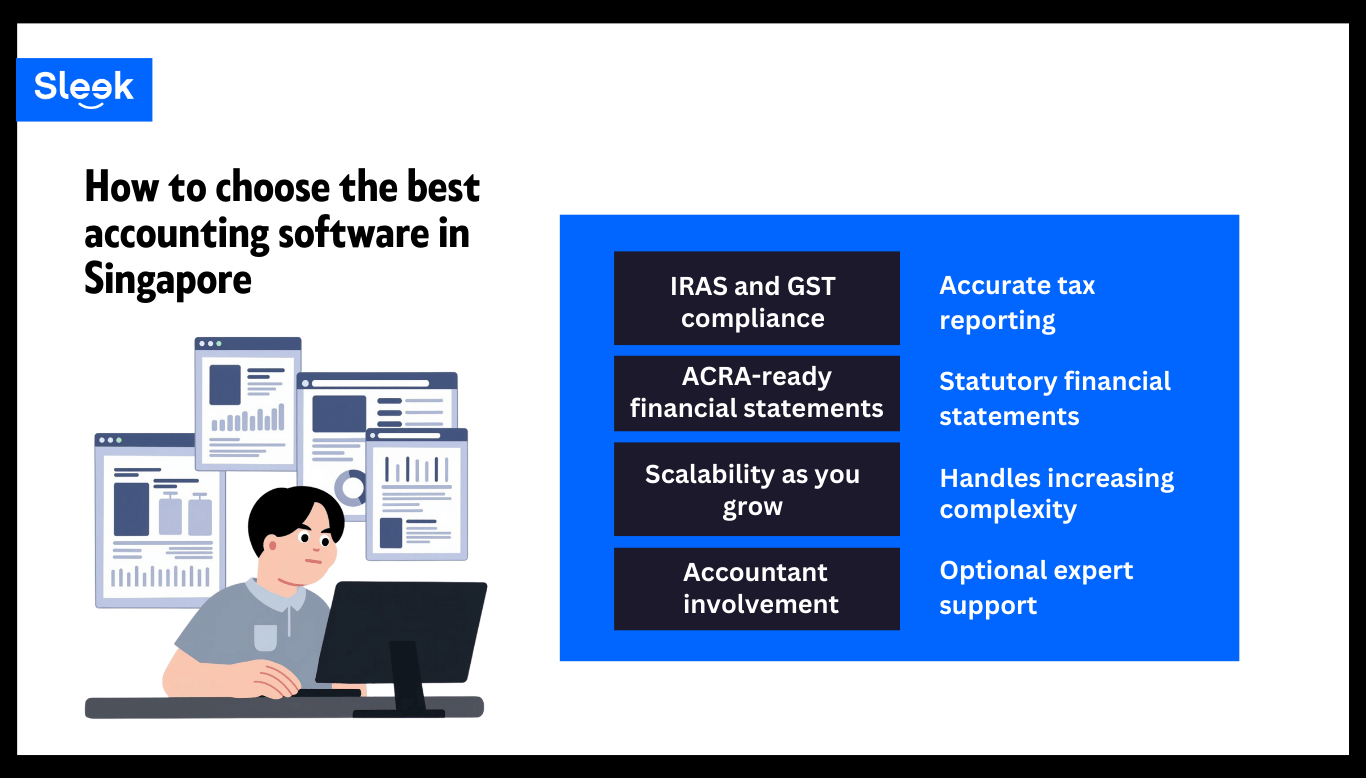
When evaluating accounting software or accounting solutions for small businesses in Singapore, ask yourself the following:
1. Does the accounting software support IRAS and GST compliance?
Singapore’s tax environment is strict. The right accounting solution must accurately track GST, apply the correct tax treatments, and produce IRAS-compliant reports.
However, compliance is not just about features. Even the best software can produce incorrect GST filings if it’s set up incorrectly or used without proper checks. In practice, many IRAS penalties arise from human and process errors, not missing functionality.
Ask yourself: What can the software do and who ensures it’s done correctly every time?
2. Can it produce ACRA-ready financial statements?
All Singapore-registered companies are required to prepare ACRA-compliant financial statements.
While many tools can generate reports, accuracy depends on:
Correct account classification
Proper accruals and adjustments
Professional review before submission
Without expert oversight, issues often surface only at year-end when corrections are stressful, time-consuming, and costly.
3. Will this small company accounting software scale as my business grows?
Many accounting tools work well at the early stage but struggle as businesses scale.
Investor, audit, or statutory reporting requirements
Scalable accounting isn’t just about software capacity. It requires processes, controls, and expertise that grow alongside your business.
4. Will I need an accountant anyway?
This is the most important question.
Most Singapore business owners eventually realise:
Software records transactions
Accountants ensure accuracy, compliance, and interpretation
If professional support is inevitable, the lowest-risk and most efficient approach is choosing a solution where software and accounting expertise are already integrated rather than managing multiple tools and vendors.
DIY Accounting vs Standalone Software vs Sleek (Service + Software)
To choose correctly, it helps to compare the three most common approaches Singaporean small businesses consider.
Aspect
DIY (Excel / Google Sheets)
Standalone Software (Xero, QuickBooks, etc.)
Sleek Accounting (Service + Software)
Setup & Configuration
Fully manual
Self-configured
Fully handled by experts
IRAS & GST Compliance
High risk
Depends on user accuracy
Built-in, professionally reviewed
Error Prevention
None
Limited
Proactive checks and oversight
Financial Accuracy
Inconsistent
Varies by user
Consistently accurate
Time Required from Founder
Very high
Medium to high
Very low
Scalability
Poor
Moderate
High
Peace of Mind
Low
Medium
High
Compliance Risk Level
High
Medium
Low
For most Singapore SMEs, the question is not whether software can record transactions, but who ensures everything is done correctly.
Why Sleek is the smartest long-term accounting choice for Singapore businesses
Most accounting software assumes business owners will set everything up correctly, maintain it over time, and spot issues before they turn into compliance problems. In reality, many Singapore SMEs don’t have the time or accounting expertise to manage this consistently.
Sleek takes a more practical approach by combining accounting software with ongoing support from local Singapore accounting professionals.
With Sleek, you get:
Accounting that’s built around IRAS, GST, and ACRA requirements
Ongoing oversight by locally based accountants
Flexible bookkeeping frequency as transaction volumes increase
Reporting designed for decision-making, not accounting jargon
If you want your accounting handled correctly every year, without the hassle of managing software or compliance, Sleek can help.
Have a question about the top accounting software?
FAQs on the best accounting software for small business in Singapore
What is the best accounting solution for small businesses in Singapore?
For most small businesses in Singapore, the best accounting software is one that supports IRAS, GST, and ACRA compliance, scales as the business grows, and provides clear financial visibility.
Many SMEs find that software alone is not enough. Solutions that combine accounting software with local Singapore accounting expertise reduce compliance risk and provide greater confidence over time.
Is accounting software alone enough for Singapore businesses?
Accounting software can record transactions, but it does not replace professional oversight.
In Singapore, accuracy depends on correct GST treatment, proper account classification, and review before statutory filings. Without expert checks, even well-configured software can lead to IRAS penalties or reporting issues.
For this reason, many Singapore businesses choose accounting solutions that combine software with ongoing professional review.
Do I need to change my accounting software if I work with an accounting firm?
In many cases, yes.
Accounting firms often standardise on specific platforms to ensure consistent workflows, reduce errors, and maintain compliance. If a business is using spreadsheets or unsupported software, migrating to a supported system helps ensure accurate bookkeeping and reliable reporting.
For founders, this usually simplifies accounting rather than adding complexity.
I’m already using another accounting software. Can Sleek still help?
Yes. Many Singapore SMEs come to Sleek while using tools like Excel, QuickBooks, etc.
To ensure reliable bookkeeping and compliance, Sleek typically migrates businesses into SleekBooks or Xero. This allows Sleek’s accounting team to maintain consistent processes, review GST and statutory filings properly, and produce ACRA-ready financial statements without relying on fragmented setups.
For most founders, this removes the stress of managing accounting software and reduces the risk of compliance mistakes.