Ismarina is the Head of Country at Sleek Singapore, where she leads strategic growth, operational excellence, and service delivery. With over 20 years of experience across finance, compliance, and business leadership, she oversees Sleek’s full range of services. These include CFO advisory, accounting, tax, GST, payroll, corporate secretarial, immigration, and client support.
She is known for her clarity in leadership and strength in execution. Ismarina has led large, cross-functional teams in both in-person and virtual settings. She has delivered strong P&L outcomes, scaled operations, and built trusted relationships across businesses of all sizes.
Ismarina combines practical insight with academic depth. She holds an MSc (Hons) in Management, is a Fellow CPA, an ASEAN CPA, and a CIMA-qualified Chartered Global Management Accountant. Her expertise covers project management, construction and nonprofit accounting, judicial management, and liquidation. Her experience running an accounting firm and offering CFO services gives her a sharp understanding of what clients need to grow and stay ahead.
She is also a committed mentor who supports her team’s growth with care and purpose. Before Sleek, she held senior roles at the Project Management Institute and the Football Association of Singapore. She played a key role in leading digital transformation and shaping regional strategy.
Outside of work, you’ll find her immersed in books, sewing projects, and knitting, or cheering on her family at sporting events. She brings the same passion for excellence to everything she does, both professionally and personally.
96% customer satisfaction from 16,000+ survey responses.
In this article
Share this post
Facebook
LinkedIn
WhatsApp
Copy to clipboard
Key takeaways
IRAS administers every corporate tax obligation in Singapore: ECI filing, the annual Form C-S/C return, GST, and withholding tax, each with its own deadline and penalty regime.
Singapore corporate income tax is a flat 17%, reduced for qualifying new companies by the Start-Up Tax Exemption (SUTE) and for all other qualifying companies by the Partial Tax Exemption (PTE).
Missing IRAS deadlines trigger composition fines from S$200, rising to S$5,000 for serious non-compliance. Directors remain personally liable even when a tax agent has been engaged.
IRAS, the Inland Revenue Authority of Singapore, is the national body that sets every tax obligation your company must meet. File Estimated Chargeable Income within 3 months of your financial year-end. Submit Form C-S or Form C by 30 November. Register for GST once taxable turnover crosses S$1 million. Each obligation has a deadline, a form, and a penalty for missing it, with directors personally liable. Singapore’s corporate tax rate is a flat 17%, and the structure is straightforward. But the compliance calendar is wider than most founders expect.
IRAS is a big part of managing your money in Singapore, whether you earn a salary or run a business.
But for many, it’s not easy to figure out. This guide explains what you need to know, so you don’t run into trouble.
At a glance:
IRAS (the Inland Revenue Authority of Singapore) is the national tax authority. For a Singapore-incorporated company, it sets four core obligations: (1) filing Estimated Chargeable Income (ECI) within 3 months of your financial year-end; (2) submitting an annual corporate tax return (Form C-S, C-S Lite, or C) by 30 November each year; (3) registering for GST if annual taxable turnover exceeds S$1 million; and (4) withholding tax on payments to non-resident recipients where applicable. Corporate income tax is charged at a flat 17% on chargeable income. ACRA, by contrast, governs company registration and annual returns. It is a separate regulator with entirely different obligations and deadlines.
What is IRAS and what does it govern?
What is IRAS
The Inland Revenue Authority of Singapore was established as a statutory board in 1992. Its mandate covers three areas: collecting taxes, administering tax legislation, and advising the Ministry of Finance on tax policy.
For companies, IRAS administers four main pieces of legislation:
Stamp Duties Act (transactions involving property and shares)
Withholding tax provisions on cross-border payments to non-residents
Singapore’s corporate tax system is a one-tier structure. Tax is paid once at the company level. Dividends paid to shareholders carry no further Singapore tax liability in their hands, which is a significant structural advantage compared with many other jurisdictions.
IRAS collects over 77% of Singapore’s government revenue. Those funds pay for public healthcare, education, transport, and national infrastructure. The practical result for a company director: IRAS is not an occasional interaction. It governs your tax calendar every year from the moment your company is incorporated.
What tax obligations does IRAS set for your company?
Every Singapore company carries at least two mandatory IRAS obligations, regardless of whether it made a profit: the ECI filing and the annual corporate tax return. Additional obligations apply depending on your business activities.
IRAS obligations reference table
Obligation
Who it applies to
Deadline
Form/Platform
ECI filing
All companies (unless exempt)
Within 3 months of FYE
myTax Portal (Corppass Approver)
Annual corporate tax return
All companies, including loss-making and dormant
30 November annually
Form C-S Lite / Form C-S / Form C via myTax Portal
GST registration
Turnover exceeds S$1 million in a 12-month period
Within 30 days of crossing threshold
GST F1 via myTax Portal
Quarterly GST return
All GST-registered companies
Monthly or quarterly (based on turnover)
GST F5 via myTax Portal
Withholding tax
Companies making certain payments to non-residents
By 15th of following month
Form IR37 via myTax Portal
IR8A / AIS submission
Employers with employees on payroll
1 March following calendar year
Auto-Inclusion Scheme (AIS) via myTax Portal
Note: CPF contributions (for Singapore Citizens and Permanent Residents) are administered by the CPF Board, not IRAS. They run on a separate calendar and submission channel.
Sleek’s accountants track every IRAS deadline and handle your filings. See how we can help.
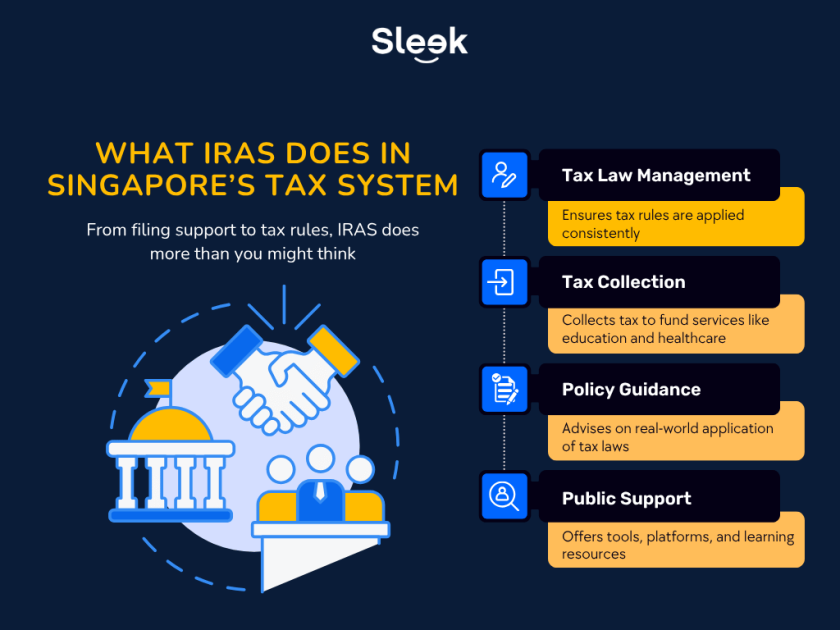
IRAS plays several critical roles across tax policy, enforcement, and public service. It’s not just a tax collector. It’s a key driver of Singapore’s fiscal system and economic stability.
1. Tax administrator
IRAS administers Singapore’s core tax legislation and ensures that tax obligations are applied consistently and fairly. These include:
Income Tax Act – Covers individual and corporate income taxes
Property Tax Act – Imposes taxes based on the annual value of properties
Stamp Duties Act – Applies to legal documents involving shares and property
Betting and Sweepstake Duties Act – Covers duties on betting, lotteries, and gaming
Casino Control Act (Part IX) – Enforces the casino tax regime for licensed casino operators
2. Revenue collection
IRAS collects taxes from individuals, businesses, and property owners in Singapore. The money is used to fund services like healthcare, education, transport, and other development projects.
Withholding Tax on cross-border payments to non-residents
Casino and Gambling Duties
IRAS also handles payouts and tax benefits, like the Jobs Growth Incentive and the Enterprise Innovation Scheme.
3. Tax policy advisor
IRAS Singapore doesn’t just collect taxes; it also helps shape how tax rules are made.
While the Ministry of Finance sets the official tax policies, IRAS shares its insights to make those policies work better in real life. It supports this by:
Understanding how taxes impact people and businesses day to day
Sharing ideas to make tax rules easier to follow
Tracking worldwide tax trends to help Singapore stay ahead
4. Public engagement and support
IRAS isn’t just about enforcement; it also provides tools and services to help taxpayers comply with ease. Key initiatives include:
Partnering with tax agents based on trust, fairness, and teamwork
Auto-Inclusion Scheme (AIS), where employers submit employee income data directly to IRAS
Digital platforms like myTax Portal, eGIRO, and PayNow QR for seamless filing and payments
Offering learning tools like webinars and simple resources
Support for small businesses, including simplified filing options and record-keeping templates
Its goal is to make compliance easy and accessible, focusing on “right design, right service, right action, and right values.”
Tip
Set up Corppass access early and confirm you have at least one 'Approver' role for Corporate Tax (Filing and Applications). Without an Approver, your company cannot submit ECI or your annual return, regardless of who prepared the figures. This is the single most common administrative delay for first-time filers.
How does IRAS differ from ACRA?
IRAS and ACRA are frequently confused because both are government regulators that every Singapore company must deal with. Their mandates do not overlap. For a full breakdown, see how IRAS differs from ACRA.
IRAS
ACRA
What it regulates
Tax obligations: corporate income tax, GST, withholding tax, employer reporting
Company existence: incorporation, directorships, share structures, annual returns
Primary filing
Form C-S/C by 30 November; ECI within 3 months of FYE
Annual Return within 7 months of FYE
Platform
myTax Portal (mytax.iras.gov.sg)
BizFile+ (bizfile.acra.gov.sg)
Penalty for late filing
Composition fines from S$200, up to S$5,000 and court prosecution
Varies; directors may face disqualification for repeated non-compliance
The critical practical point: filing your ACRA Annual Return does not satisfy your IRAS obligations, and vice versa. They are parallel obligations with different deadlines, different forms, and different regulators. Missing one while believing you have covered both is a common and expensive mistake.
How to stay compliant with IRAS?
IRAS in Singapore believes most taxpayers are willing to comply; they need support. Here’s how you can stay on track:
For Individuals
Even if you’re not a business owner, you may still need to deal with IRAS every year. Here’s what to check:
File your tax return if required – You must file if your total income is more than $22,000 or your self-employed net income is more than $6,000 in the past year.
Check pre-filled info carefully – Being on the Auto-Inclusion Scheme means your details might be pre-filled. But it’s worth checking, just in case you’ve changed jobs, earned rental income, or used CPF to buy a home.
Declare all side income – Tuition, freelance gigs, Grab driving, influencer deals, and online sales – all count as income and must be declared.
Respond to IRAS notices – Think there’s an error in your tax bill or need to change your info? Just inform IRAS within 30 days.
Requirement
When It Applies
File a tax return
Income > S$22,000 or self-employed net > S$6,000
Check pre-filled details
Always, especially after a job change or CPF use
Declare all side income
Freelance, tuition, Grab, online sales
Respond to IRAS notices
Within 30 days
For Businesses and Self-employed Individuals
Running a business in Singapore means staying on top of multiple filing and reporting requirements. Here’s what IRAS expects:
File your Estimated Chargeable Income (ECI) – This must be done within 3 months after your financial year ends, unless you qualify for a waiver.
Submit your annual tax return – Choose the correct form (Form C, C-S, or C-S Lite) based on your company size and revenue.
Register for GST – If your taxable turnover crosses S$1 million in 12 months, GST registration is mandatory. You can also register voluntarily if it benefits your business.
Keep proper records for 5 years – This means keeping things like receipts, invoices, bank statements, and tax papers. Small businesses may be eligible for Simplified Record-Keeping.
Don’t claim private or inflated expenses – Personal groceries, home utilities, or family trips shouldn’t be included as business expenses.
Disclose any mistake – Use IRAS’s Voluntary Disclosure Programme to correct past errors. If you come forward early, you may get reduced or waived penalties.
Requirement
Details
File Estimated Chargeable Income (ECI)
Within 3 months of FYE, unless exempt
Submit Annual Return
Use Form C, C-S, or C-S Lite
Register for GST
Mandatory if turnover > S$1 million
Keep records for 5 years
Includes receipts, invoices, statements
Don’t claim private expenses
Only claim actual business-related costs
Disclose past mistakes
Use Voluntary Disclosure Programme
What happens if you miss an IRAS deadline?
IRAS enforces compliance, and the consequences escalate with time. For the annual corporate tax return (Form C-S/C), late or non-filing is an offence under the Income Tax Act 1947.
Scenario
Consequence
Late filing: first offence
Composition fine typically starting at S$200
Late filing: repeat offence
Composition fine up to S$1,000
Continued non-filing
Penalties of up to S$5,000; court prosecution
Missing ECI 3-month window
Loss of GIRO instalment option for that year
Late GST registration
Penalties from IRAS for the period of non-registration
Incorrect past filing
Come forward under IRAS’s Voluntary Disclosure Programme to reduce penalties.
Directors bear personal responsibility for accurate and timely filing even when a tax agent is appointed. IRAS issues enforcement notices directly to directors. Engaging an external accountant transfers the operational work but not the legal obligation.
If you discover a past error, IRAS operates a Voluntary Disclosure Programme. Filing a voluntary disclosure before IRAS contacts you typically results in reduced or waived penalties. Acting early is considerably cheaper than waiting for IRAS to find the issue first.
What are the common IRAS compliance red flags in Singapore
IRAS doesn’t aim to penalise, but it does monitor these red flags to ensure fair compliance:
1. Under-reported income
This is especially common in cash-heavy and online businesses such as retail shops, influencers, tutors, and online sellers.
2. Withholding tax
Payments made to overseas vendors for services may be subject to withholding tax, even if you’re a startup or new business.
3. Incorrect GST claims
Some businesses, especially dormant or home-based ones, mistakenly claim GST on private expenses or on purchases without valid tax invoices.
4. Using shell companies to reduce tax
Setting up multiple companies just to split income or reduce tax exposure may trigger audit scrutiny.
5. Big-ticket asset purchases that don’t match your declared income
If you buy a high-value property or luxury car without a corresponding income trail, IRAS may follow up to ensure everything adds up.
6. Low-value GST refund claims and missing documentation
Dormant or home-based businesses may be audited if they make frequent small GST refund claims without supporting tax invoices, permits, or export records.
How to contact IRAS?
Need help or have a tax question? Here are the easiest ways to reach IRAS:
Go online: Use myTax Portal with Singpass or Corppass to file, check, or pay taxes.
Use Ask Jamie: Chat with IRAS’s virtual assistant any time on their website.
Call IRAS: Call at +65 6356 7012 from Monday to Friday, 8 am to 5 pm (except public holidays)
Send by post (if needed): Inland Revenue Authority of Singapore, 55 Newton Road, Revenue House, Singapore 307987
Visit in person: Book a slot on myTax Portal and bring your documents. Remember, walk-ins are not allowed.
How Sleek helps you stay on top of your IRAS obligations
IRAS obligations follow a predictable calendar, but managing them accurately means knowing which form your company files, whether you qualify for SUTE or PTE, whether your ECI was submitted in time to unlock instalment payments, and whether any cross-border payments trigger withholding tax. Sleek’s accounting team handles all of that: ECI preparation and submission, Form C-S/C filing, corporate tax return preparation, GST registration and quarterly returns, and withholding tax compliance. You stay focused on your business. Sleek ensures the IRAS calendar never catches you off-guard.
With the right support, you don’t have to lose time or sleep over tax rules and deadlines. Let us handle your IRAS requirements, while you focus on building something bigger.
Get your IRAS filings handled by qualified accountants.
What is IRAS and why does every Singapore company need to deal with it?
IRAS is the Inland Revenue Authority of Singapore, the statutory body responsible for collecting taxes and administering tax legislation. Every Singapore-incorporated company must interact with IRAS to file its annual corporate income tax return by 30 November, submit ECI within 3 months of its financial year-end, and manage GST or withholding tax obligations where applicable. Singapore uses a one-tier corporate tax system, meaning dividends paid to shareholders are tax-free in their hands. That makes IRAS’s role especially important to understand: tax is assessed and settled entirely at the company level, which is why every obligation lands on the company directors.
What is the difference between IRAS and ACRA?
IRAS and ACRA are two separate government regulators with entirely different functions. IRAS administers tax obligations: corporate income tax, GST, withholding tax, and employer reporting. ACRA governs your company’s legal existence: incorporation, changes to directors and shareholders, and the Annual Return (filed via BizFile+ within 7 months of your financial year-end). Filing your ACRA Annual Return does not satisfy your IRAS filing obligations. Missing one while assuming it covers both is one of the most common compliance errors Singapore companies make.
When does my company file its first tax return with IRAS?
Your first ECI filing is due within 3 months of your company closing its first financial year. Your first annual corporate tax return (Form C-S/C) is due by 30 November of the assessment year following your first financial year-end. If your company is incorporated and begins business in the same calendar year, you may be required to file even without having received an IRAS notification. IRAS sends notifications as a courtesy, but the obligation to file exists regardless of whether a notification arrives.
What are the penalties for missing the 30 November IRAS filing deadline?
Missing the annual corporate tax return deadline is an offence under the Income Tax Act 1947. Composition fines typically start at S$200 and can reach S$1,000 for repeat offences. Continued non-compliance may result in court prosecution and penalties of up to S$5,000. Directors are personally responsible for timely, accurate filing even when a tax agent is engaged. If you identify a past error, IRAS’s Voluntary Disclosure Programme may significantly reduce your penalties if you come forward before IRAS initiates an audit or contact.
Does a dormant company still need to file with IRAS?
Yes. Even if your company carried on no business and earned no income in a financial year, it must file a simplified corporate income tax return with IRAS using the “File Form for Dormant Company” digital service on myTax Portal. The 30 November deadline still applies. Being dormant does not grant an automatic exemption from filing obligations. It does, however, make your company potentially eligible for the ECI filing waiver (if ECI is nil), so you may be exempt from the ECI step but not from the annual return.