



What types of renewable energy companies can you start in Hong Kong?
Below are the most promising renewable energy business models you can build in Hong Kong:
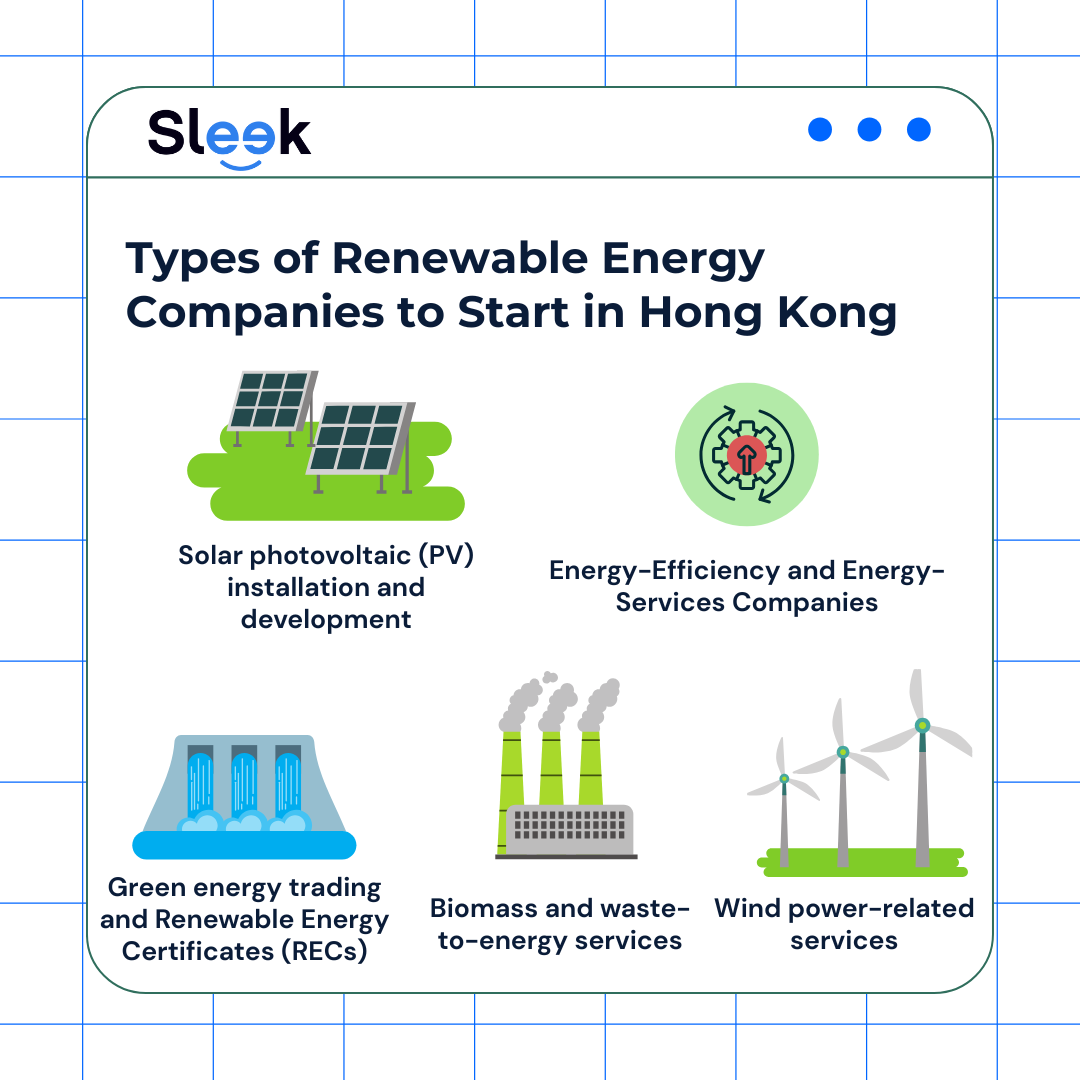
Solar Photovoltaic (PV) installation and development
Solar remains the most commercially viable renewable energy option in Hong Kong, thanks to available rooftop space and the Government’s Feed-in Tariff (FiT) scheme. You can build a business around:
- Solar PV system design and installation
- Rooftop solar leasing (you install, clients lease the system)
- Solar project development for SMEs, schools, or industrial buildings
- Long-term maintenance and monitoring services
This model offers strong long-term revenue if you combine installation fees with maintenance contracts.
Energy-Efficiency and Energy-Services Companies (ESCOs)
Many commercial buildings in Hong Kong are under pressure to cut emissions and improve ESG reporting, making energy-efficiency solutions a high-growth business.
An ESCO model typically includes:
- Energy audits
- Lighting and HVAC upgrades
- Automation and smart-building controls
- Performance-based contracts (you get paid based on energy saved)
This model is low on initial capital and high on recurring income, ideal for entrepreneurs entering the green sector without heavy infrastructure investment.
Biomass and waste-to-energy services
Hong Kong faces ongoing waste-management challenges, creating opportunities for biomass processing, recycling-to-energy, and organic waste applications. Possible business angles include:
- Food waste conversion to biogas
- Biomass fuel supply chain management
- Small-scale waste-to-energy consulting or equipment supply
- Partnerships with F&B and industrial sectors
While this segment requires more specialised expertise, it aligns well with Hong Kong’s circular-economy goals.
Green energy trading and Renewable Energy Certificates (RECs)
As more companies commit to carbon neutrality, the demand for Renewable Energy Certificates (RECs) continues to grow. A company can build offerings around:
- Brokerage of local or international green certificates
- Corporate sustainability advisory
- Carbon accounting and reporting tools
- Helping firms offset emissions through recognised RECs
This is a lean, knowledge-based model suitable for founders with corporate or financial backgrounds.
Wind power-related services (equipment, consulting, R&D)
Although large-scale wind farms are limited in Hong Kong, opportunities exist in:
- Small-scale wind turbine supply
- Offshore wind project consulting (especially for the Greater Bay Area)
- R&D partnerships specialising in energy storage or hybrid systems
- Technical services for regional energy developers
This business model is more specialised but can be valuable for founders targeting B2B markets.
How do you legally register your renewable energy company in Hong Kong?
Before you begin taking on clients, securing installation contracts, or applying for incentives like the Feed-in Tariff (FiT), you must formally register your renewable energy company in Hong Kong. Instead of looking at every business structure in detail.
Below is a sector-specific breakdown of the incorporation process to help you set up correctly from day one.
1. Choose a compliant company name that reflects your renewable energy focus
In the green-energy space, your brand name can influence trust and credibility. Founders typically choose names that signal:
- Sustainability (e.g., “Green”, “Eco”, “Renew”, “Solar”, “Energy”)
- Technical expertise (e.g., “Solutions”, “Systems”, “Technologies”)
- Professional services (e.g., “Consulting”, “Engineering”)
This matters when bidding for installation projects, FiT applications, or corporate sustainability contracts.
2. Decide your shareholding and directorship structure early
Because renewable energy companies often deal with engineering partners, equipment suppliers, and investors, founders should think ahead about:
- Whether to include technical partners as minority shareholders
- Whether directors will need engineering or energy-sector credentials
- In bringing in overseas founders, Hong Kong allows 100% foreign business ownership, which is useful for international green-tech companies entering the city
A credible directorship structure helps when approaching property developers, corporates, or cross-border partners.
3. Prepare your incorporation documents with sector-specific considerations
While the statutory documents are standard, renewable energy companies often include additional internal or operational considerations, such as:
- Clear definitions of engineering roles and system-design responsibilities
- IP ownership around designs, performance-modelling, or energy-audit methodologies
- Provisions for long-term servicing, warranties, or performance guarantees
- Clauses facilitating future investment or partnerships in the Greater Bay Area
4. Register your renewable energy company with the Companies Registry
You can submit your documents online, but many green-energy founders delegate this step to focus on sourcing equipment, surveying project sites, or evaluating FiT opportunities.
5. Obtain your Business Registration Certificate (BRC)
Issued by the Inland Revenue Department, the Business Registration Certificate allows your company to legally operate.
Renewable energy firms often need it immediately to:
- Sign solar PV or energy-efficiency contracts
- Apply for the FiT scheme
- Submit quotations or tenders for building projects
6. Open a business bank account geared for energy-sector transactions
A business bank account is essential for:
- Receiving FiT payments
- Purchasing solar panels, inverters, batteries, or equipment
- Managing staged installation payments
- Collecting subscription or maintenance fees
Digital business accounts offer fast onboarding, while traditional banks are useful for large project financing.
7. Maintain compliance with renewable-energy-related obligations
Beyond Hong Kong’s annual filing and accounting requirements, renewable energy companies must also manage:
- Accurate reporting for FiT submissions and energy output
- Documentation supporting ESG statements or carbon-reduction claims
- Clean financial statements for investors or green-funding applications
- Reliable audit trails for installation and maintenance contracts
What licences, permits and regulatory issues apply to a renewable energy company?
Once your renewable energy company is incorporated, you will need a clear breakdown of the licences, permits, and regulatory considerations that renewable energy businesses must understand.
Licensing requirements for solar photovoltaic (PV) companies
If your company installs solar panels or develops rooftop PV projects, you must ensure compliance with:
1. Electrical and mechanical safety compliance (EMSD)
The Electrical and Mechanical Services Department (EMSD) oversees safety standards for renewable energy installations. Depending on the scope of work, your company may need:
- Registered Electrical Worker (REW) involvement for system connection
- Compliance with the Code of Practice for the Electricity (Wiring) Regulations
- Certification of PV system components (inverters, cabling, mounting systems)
Even if your company outsources installation, you’re responsible for ensuring certified workers are engaged.
2. Grid connection approvals
All PV systems must be reviewed and approved by:
- CLP Power, or
- HK Electric
Depending on your region. Businesses must submit system designs, technical data, and engineering documentation for validation.
3. Feed-in Tariff (FiT) application process
If you plan to help clients earn FiT revenue, you’ll need to prepare:
- System design packages
- Safety test reports
- Commissioning documentation
Your company does not need a special FiT licence, but you must follow each power company’s technical guidelines.
Regulatory considerations for energy-efficiency and ESCO businesses
Energy-services companies (ESCOs) typically do not require special licences, but they must follow professional and regulatory standards, such as:
- EMSD guidelines for building energy efficiency
- Hong Kong’s Building Energy Code, if you work with large commercial buildings
- Technical standards for HVAC, controls, or lighting retrofits
- Client data and ESG reporting compliance (especially for carbon audits)
If your company offers carbon audits, ESG reporting, or sustainability consulting, accuracy and documentation standards are critical. Many corporate clients require validated methodologies.
Permits for biomass, waste-to-energy, and environmental services businesses
Companies involved in waste handling or biomass conversion may require permits from:
1. Environmental Protection Department (EPD)
Depending on your activities, you may need approvals related to:
- Waste collection and transportation
- Biomass processing
- Waste-to-energy operations
- Emissions management
- Organic waste conversion or handling
These approvals are case-specific and depend on the scale and nature of your technology.
2. Land use and facility approvals
If you operate a facility (e.g., a processing site), you may need:
- Planning permission
- Environmental impact assessments (EIAs) for larger operations
- Fire Services Department approvals for specific equipment or storage conditions
Most small-scale biomass or consulting businesses do not require full facility licensing.
Compliance requirements for green energy trading and REC businesses
Renewable Energy Certificate (REC) or carbon-credit-related businesses often need to comply with:
- International renewable energy standards (I-REC, RE100, etc.)
- Proper tracking of energy generation data
- Anti-fraud and data-integrity guidelines
- Hong Kong’s business and financial reporting regulations
There is no specific licence for REC trading, but credibility and transparent documentation are essential.
General compliance obligations for all renewable energy businesses
Regardless of your model, you must ensure:
- Workplace and on-site safety compliance
- Transparent invoicing, documentation, and audit trails
- Clear contractual terms for installation or performance guarantees
- Insurance coverage (public liability, workers’ compensation, professional indemnity)
- Proper handling of technical data and client ESG reporting
These factors significantly affect trust when working with corporate clients, developers, or government entities.