With 12 years of industry experience, including a tenure at a Big 4 firm, Yuk Ming is a seasoned professional specializing in accounting, audit, tax, and project management. A member of both HKICPA and ICAEW, he brings a wealth of expertise to Sleek, particularly in advising and supporting SMEs.
Outside work, Yuk Ming enjoys staying active through tennis and badminton. He also likes watching movies and playing video games in his free time.
97% customer satisfaction from 16,000+ survey responses.
In this article
Share this post
Facebook
LinkedIn
WhatsApp
Copy to clipboard
Key takeaways
Almost every Hong Kong company must be audited. The Companies Registry states the audit is required for all companies except dormant ones under section 447.
Only a firm registered with the AFRC can sign your audit report. “Licensed” is the wrong word, and the distinction matters because registration is publicly checkable.
The reporting exemption is not an audit exemption. It simplifies what you disclose, not whether you are audited.
Choosing an external auditor in Hong Kong starts with one basic check: can the firm legally hold your audit appointment? Your auditor must be eligible to audit your financial statements, and you can verify the firm against the AFRC’s public register before appointing it.
Once that’s confirmed, compare availability, relevant experience and fees. A lower quote isn’t useful if the firm can’t take on your audit when your financial year end arrives.
In this guide, you’ll learn:
Whether you need an auditor and the main exception
Who can legally audit your company and how to check
What to compare before making an appointment
What affects Hong Kong audit fees
How to change auditors without disrupting the audit timetable
Do Hong Kong companies need an external auditor?
Yes, unless the company is formally dormant. Hong Kong companies generally must have their financial statements audited, with dormant companies exempt under section 447.
There’s no general size threshold that removes the audit requirement. Revenue, headcount or assets don’t by themselves exempt a company.
The main source of confusion is the reporting exemption under sections 359 to 366. Qualifying companies can prepare simplified financial statements, but this changes the reporting requirements rather than removing the audit requirement.
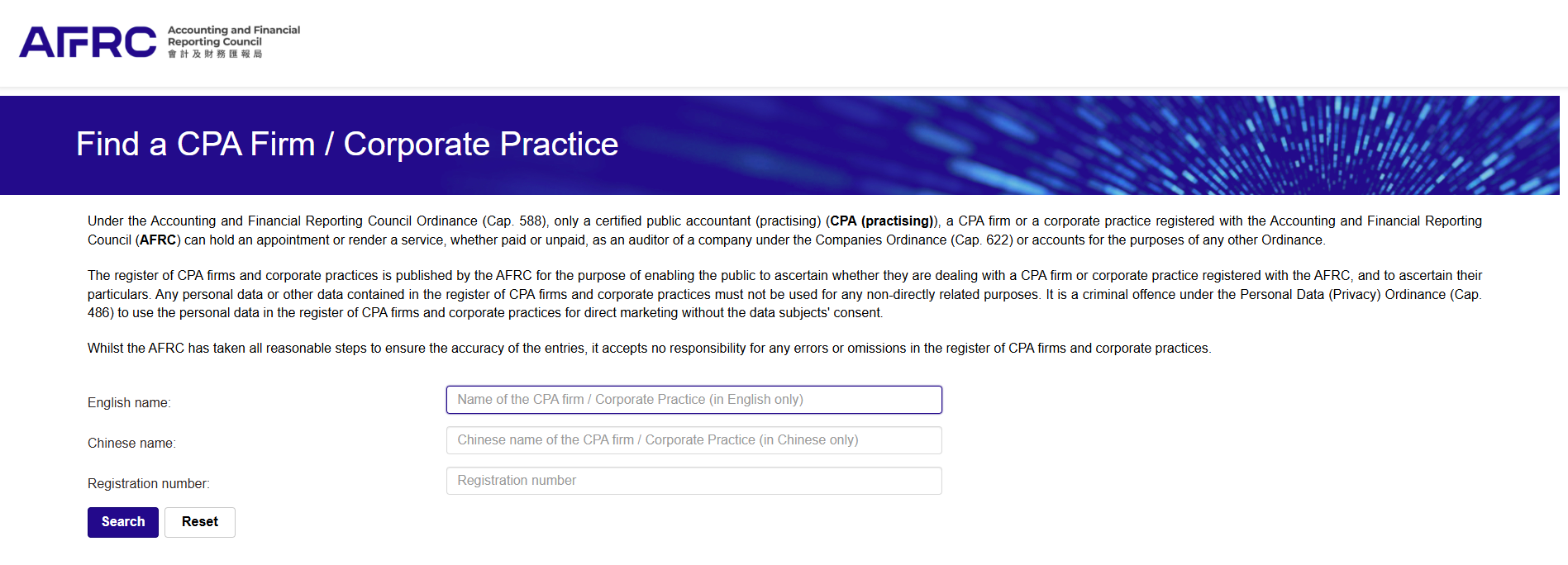
A company’s statutory auditor must be a CPA (practising), CPA firm or corporate practice registered with the Accounting and Financial Reporting Council (AFRC).
When checking a prospective auditor, use the legal entity that will hold the appointment, not just the brand name on its website.
A separate registration applies to practices carrying out public interest entity (PIE) engagements, such as listed-company audits.
Important note
Search the exact entity name from your engagement letter on the AFRC's public register of CPA firms and corporate practices before you sign. A well-known brand tells you nothing about whether the specific entity billing you is registered to sign your report. If a prospective auditor cannot tell you which registered entity will hold the appointment, that's your answer.
How do you check whether an auditor is registered?
Search the auditor’s exact legal entity name on the AFRC’s public register before you appoint them. Don’t rely on the firm’s brand name alone.
Use this quick check:
Ask for the legal entity name that will hold the audit appointment.
Check that the registration is current and matches the entity in your engagement documents.
Ask who will sign the audit report if the firm has multiple teams, entities or offices.
The important detail is the registered practice, not the website or network brand. The AFRC states that only a CPA (practising), CPA firm or corporate practice registered with the AFRC can hold an audit appointment or provide audit services for a company under the Companies Ordinance.
This check is free and can be done before you sign the engagement letter.
Tip
Auditors decline work as well as accepting it. A firm approaching capacity in your year-end month may simply say no, and that answer often arrives late. If you are switching, start the conversation a season ahead rather than a month, and treat a fast yes with the same scrutiny as a slow one.
What should you compare before appointing an auditor?
Registration comes first; then compare independence, availability, experience, and communication. Price matters, but only once you know you’re comparing the same scope of work.
1. Registration
Check that the exact legal entity that will hold the appointment is registered with the AFRC. The brand name alone isn’t enough.
2. Independence
Ask how the firm handles bookkeeping and audit work if it offers both. The audit arrangement must meet the applicable independence requirements.
3. Availability
Confirm the firm can take on your audit around your financial year end. Availability can matter more than a lower fee if the engagement starts too late.
4. Relevant experience
Look for experience with issues your company actually has, such as multiple currencies, group structures, inventory or related-party transactions.
5. Communication
Ask who will handle questions, how you’ll communicate with the team, and how quickly you can expect responses.
Ask each auditor to quote against the same scope in writing. That makes the fee comparison more meaningful.
When should you appoint an auditor?
Appoint your auditor before the year-end audit work starts. Waiting until the accounts are ready can leave too little time for the auditor to understand the records and complete the work.
Just after a sign-off is the cheap window to change auditors. It closes as your year end approaches.
The process is straightforward:
Choose the auditor and confirm its AFRC registration.
Agree the scope and fee in writing.
Make the appointment for the relevant financial year.
Prepare the records the auditor will need.
Start the audit around the company’s financial year end.
Your financial year end sets the broader timetable, so choosing the auditor early gives both sides time to plan.
How much does a Hong Kong audit cost?
There’s no single standard audit fee. The cost depends mainly on the company’s records, structure, complexity and timing.
The main factors are:
Factor
Why it affects the fee
Transaction volume
More transactions generally mean more audit work
Quality of the books
Reconciled records require less preparation
Group structure
Consolidation and overseas subsidiaries add complexity
Accounting issues
Multi-currency, inventory and revenue judgements can require more work
Timing
Compressed work may affect the scope and cost
The best way to compare prices is to give each firm the same scope and ask for a written fee. Be careful comparing headline numbers where the services included are different.
You can change auditors, but do it early enough for the incoming firm to take over properly. The transition is easier after the previous audit has been completed than immediately before a filing deadline.
Before switching:
Check the new auditor’s AFRC registration.
Agree the handover and any work already in progress.
Confirm who is responsible for the current financial year.
Complete the required cessation filing.
For a resignation, Form NA2 is due within 15 days of the company receiving the notice under section 417. For removal, the company must pass the required resolution and file Form NA1 within 15 days under section 419.
The practical rule is simple: don’t wait until the filing deadline is close to start a change of auditor.
How Sleek helps with your Hong Kong statutory audit
Sleek provides statutory audit services through its Hong Kong CPA team, including preparing and signing statutory audit reports. This means you may not need to source a separate audit firm for your company’s statutory audit.
With Sleek, you can:
Prepare your audited financial statements: Sleek’s Hong Kong audit service handles the statutory audit through qualified CPA practitioners.
Keep your accounting and audit together: Accounting and tax filing can keep the underlying records ready for the audit.
Coordinate the process: Keep accounting, audit and tax filing on the same timetable.
Review pricing upfront: See available plans before deciding what level of support you need.
Already have an auditor you’re happy with? You can keep your existing auditor and use Sleek for your accounting and related support instead.
Year-end is booked out before most founders start looking
Tell us your financial year end and what state the books are in. We will tell you what the audit needs and when to start it.
Can my accountant and my auditor be the same firm?
It depends on the services and the applicable independence requirements. A firm that maintains your accounting records may face independence restrictions if it also audits those records. Larger firms may provide both services through separate teams or entities, but the arrangement needs to meet the relevant professional requirements.
Do I have to appoint a new auditor every year?
No. You need an auditor for each financial year, but you don’t have to change firms every year. Members generally reappoint the auditor at the AGM. In some cases, the existing auditor may be deemed reappointed if no AGM is required.
What happens if I never appoint an auditor?
The company remains responsible for meeting its statutory audit obligations. Delaying the appointment can leave too little time to complete the audit and the filings that depend on the audited figures. Catching up later can also mean auditing more than one period at once.
Can a firm outside Hong Kong audit my Hong Kong company?
Only if the practice is eligible to hold the Hong Kong audit appointment. The key issue is the practice’s AFRC registration, not where its office or your directors are located. An overseas accountant can help prepare financial information, but the statutory audit appointment must be held by an eligible practice.
How long does a Hong Kong audit take?
It depends mainly on the condition and complexity of the records. A clean, reconciled set of accounts can be completed relatively quickly, while incomplete records or transactions that need to be reconstructed can extend the process significantly.
View more
Can I keep my current auditor if Sleek takes over the books?
Yes. Sleek can prepare and maintain the accounting records while your existing registered audit practice remains responsible for the statutory audit and signs the report. You don’t need to change auditors simply because you change your accounting provider.