Chester Cheung is the Content Marketing Specialist for the Hong Kong market at Sleek, crafting localized, high-conversion bilingual content that empowers entrepreneurs to make confident business decisions.
Drawing on a background in finance and digital marketing, including roles at HSBC and in the digital agency space, Chester combines commercial rigor and performance-driven storytelling to every piece he ships. His focus is on translating complex business and compliance concepts into clear, actionable insights for busy founders.
Having worked across both structured corporate environments and agile teams, Chester knows what business owners value most: reliable information without the jargon. At Sleek, he leverages this perspective to produce insightful, accessible content that drives customer acquisition and fosters long-term value.
When he’s not writing, Chester is an active runner and an amateur photographer.
AI accounting has automated a real slice of the work. It’s a smaller slice than most of the marketing suggests, and the boundary matters more than the capability, because you’re the one who signs off what gets filed.
This page doesn’t have a percentage for you. Nobody publishes a credible one, and the figures circulating on this topic mostly originate with vendors selling the software. What it has instead is a task-by-task account of where automation genuinely lands in a Hong Kong SME’s books, where it only assists, and where it still needs a person.
In this guide, you’ll learn:
Which bookkeeping tasks are automated today, and which only look automated
Where AI assists but doesn’t decide
Whether AI is going to replace your accountant or bookkeeper
The Hong Kong transactions that reliably break automated coding
What automation doesn’t change about your audit and tax filing
What does AI actually automate in a Hong Kong SME’s books?
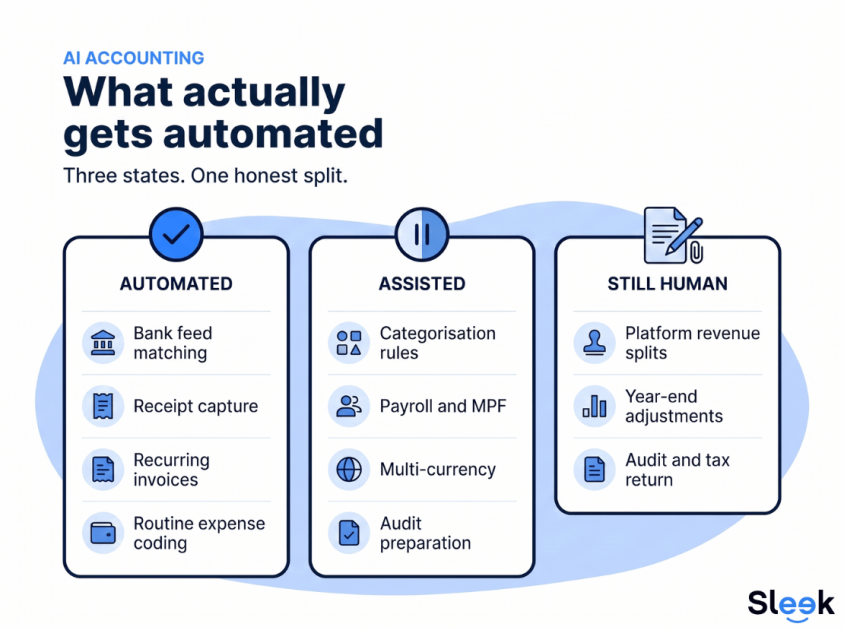
Some of it fully, more of it partially, and the statutory end of it not at all. Here’s where each task in a normal set of books lands.
Bank feeds and receipts can run on their own. Categorisation and payroll still need a person to confirm. Audit, tax and year-end adjustments stay human.
Task
Status
Bank feed import and matching
Automated
Receipt capture and reading
Automated
Recurring invoices and payment reminders
Automated
Routine expense coding
Automated
Expense categorisation rules
Assisted
Payroll runs and MPF
Assisted
Multi-currency transactions
Assisted
Audit preparation
Assisted
Platform revenue with commission splits
Still human
Year-end adjustments
Still human
Audited accounts and the profits tax return
Still human
The three sections below explain each group. If you only read one, read the third: it’s the one that decides what you still have to pay a person for.
Which bookkeeping tasks are genuinely automated now?
The mechanical, high-volume ones, where the software isn’t deciding anything, just finding an answer that already exists. Four tasks make up most of it:
Bank feeds pull transactions straight from the account into the ledger and match them against existing invoices and bills. Sleek’s own client tool, SleekBooks, connects through API bank feeds, and Sleek runs client accounting on Xero with the feed and reconciliation set up for you.
Receipt reading takes a photograph of a receipt and pulls out the date, amount, supplier and tax treatment. The Xero app ecosystem handles this through connected tools, covered in more depth on how Xero works in Hong Kong.
Recurring invoices and reminders generate and chase on a schedule you set once.
Routine expense coding applies the pattern it has already seen: the same supplier, the same amount, the same account, month after month.
What these four share is that a right answer already exists and the software only has to find it. A transaction has one correct match, a receipt says one date and one amount, last month’s coding tells this month’s what to do. That’s the whole category, and it’s genuinely useful: it can clear the bulk of the volume before anyone looks at the books.
Get the mechanical layer running properly
Bank feeds, reconciliation and monthly reporting set up and operated for you, with your own access to the numbers.
Where the software proposes and a person confirms. This middle column is bigger than either end, and it’s where the sceptical questions belong. In each of these, the tool does the volume and a human still owns the call:
Categorisation
Rules learn from what you have coded before. That works well until something new arrives, at which point the software guesses from the closest match it knows, and a wrong guess propagates quietly across every later transaction that looks similar.
Payroll and MPF
The maths is reliable once set up. The judgement around it isn’t automatic: whether someone is an employee or a contractor, how a bonus should be treated, whether a new hire is enrolled correctly. Get the classification wrong and the software calculates the wrong answer perfectly.
Multi-currency
Cloud accounting records and converts cleanly. But which rate applies, and how a gain or loss should be treated at year end, is a decision the software can’t make for you.
Audit preparation
This is where the assist shows most. Records that are already reconciled with documents attached mean the auditor asks fewer questions, and keeping them organised before the audit starts is exactly what the Xero and SleekBooks combination is for.
The common thread: the software is fast and consistent, but it can’t tell when it’s confidently wrong. That’s the job of the person confirming, and it’s why this column has a person in it at all.
What still needs a person?
The parts where somebody carries the consequence of being wrong. There are three.
Year-end adjustments are judgement. Accruals, prepayments, provisions, depreciation policy, whether a cost belongs in this year or the next. The ledger doesn’t hold the answer, because it isn’t a fact to look up. It’s a call to make.
Unusual transactions need a decision before they can be coded. A one-off disposal, a related-party balance, a grant, a deposit that might be revenue or a liability. The software can’t file what nobody has decided how to treat.
The statutory output is the firm boundary. A company’s audited financial statements are signed by a CPA, and filing your profits tax return is a submission somebody stands behind. Automation changes how the records are produced, not who answers for them.
This is the honest answer to the cost question too. Automation compresses the routine layer, which is why bookkeeping done for you and Sleek’s accounting service can cover the mechanical work below an hourly bookkeeper’s price. The judgement layer still costs what judgement costs: you’re not paying for keystrokes, you’re paying for someone to be answerable.
Will AI replace your accountant or bookkeeper?
Not on current capability, and the reason is specific rather than reassuring. What has been automated is the finding of answers that already exist. What hasn’t is deciding what the answer should be when the ledger doesn’t contain it, and taking responsibility for that decision in a document somebody signs. The first is a search problem. The second is a judgement problem, and only the first has been solved.
The role is changing, though, and it’s worth being straight about the direction:
Shrinking: time spent keying in transactions and chasing receipts.
Not shrinking: time spent on treatment questions, on reviewing what the automation proposed, and on the year-end and audit cycle.
The practical read for an SME owner: you’re less likely to be paying someone to type, and no less likely to be paying someone to decide. So look at what your current arrangement actually buys. If it’s mostly typing, that’s worth revisiting, because automation now does that part cheaper. If it’s mostly judgement, automation makes that support cheaper to provide, not unnecessary.
Where does automation struggle in Hong Kong?
On transactions that arrive as one number but mean several. Two patterns account for most of it, and both are ordinary here.
Platform revenue: Take an app sold through the App Store, where the platform takes a commission before paying out. What lands in the bank is a net payout. What the books need is gross revenue, the platform’s commission as an expense, and the currency conversion, all reconstructed from a statement the bank feed never sees. One figure in, three out.
Multi-currency operations: HKD, USD, and RMB in one set of books is normal for a Hong Kong SME. The recording is handled. What isn’t: the rate policy, the treatment of realised and unrealised differences, and the year-end position. Those are decisions, and they have to be made the same way every time.
Both share one trap. The automation sees a clean number and books it cleanly, which is the problem, because the number was never clean.
Important note
This is the mechanic worth understanding. A platform payout is one net figure standing in for at least three entries: gross sales, the commission deducted, and any FX difference. A bank feed sees the net number and will happily code all of it as revenue. Your revenue is then understated, your expenses are missing a line, and nothing looks wrong until someone reconciles to the platform statement.
What does this mean for Hong Kong compliance?
Less than the automation story implies. Two obligations don’t move:
Your accounts still need auditing by a CPA.
Your profits tax return still has to be prepared and filed.
What automation changes is the quality and timeliness of the records those outputs are built from. That’s a real benefit. It’s also a different claim from removing the obligation, and the two get blurred often enough to be worth separating:
Where it helps: the gap between messy records and audit-ready ones. Reconciled ledgers with documents attached make the audit your accounts still need shorter and less interrogative.
Where it doesn’t: the obligation itself. Automation removes the friction of getting to the audit and the filing, never the audit and the filing.
Tip
The automation story depends on the stack. Sleek runs client books on Xero, and Sleek is a Xero-certified accounting partner, so the capabilities described here are the ones available in that ecosystem. If you’re on QuickBooks or something else, the specific features differ even where the principle holds. The Xero vs QuickBooks comparison covers that choice, and accounting software options in Hong Kong covers the wider field.
How Sleek helps with your bookkeeping and accounts
Sleek’s position on this is unglamorous: automate the mechanical layer properly, then put a named person on the part that needs one.
With Sleek, you can:
Run your books on Xero: set up and operated for you, including the automated bank feed, reconciliation and reporting, with your own access to the numbers.
Get a named accountant: a dedicated point of contact rather than a ticket queue, which matters when the question is a treatment call and not a data-entry problem.
Have the compliance layer handled: financial statements prepared to HKFRS and SME-FRS standards, audit coordination, and the profits tax return prepared and submitted.
See your position monthly: management reporting covering profit and loss, balance sheet and cash flow, rather than finding out at year end.
If you want to know what could be automated in your specific books, that’s a conversation about your actual transactions. The Hong Kong accounting and audit FAQs cover the recurring questions.
Automate the routine layer, keep a person on the judgement.
Books run on Xero with a named accountant, statements prepared to HKFRS and SME-FRS, audit coordination and the profits tax return handled.
FAQs about AI and accounting for Hong Kong businesses
Which accounting software does Sleek use?
Xero. Sleek runs client bookkeeping on Xero and is a Xero-certified accounting partner, so that’s the stack any automation sits inside. Sleek also has its own client-facing tool, SleekBooks, which sits alongside Xero rather than replacing it. If Sleek runs your accounting, you’ll be told which platform your books are on.
Does Sleek use AI in its accounting service?
Sleek’s client work runs on Xero with automated bank feeds and reconciliation, plus SleekBooks connecting through API bank feeds. That’s automation inside an established accounting platform rather than a separate AI product. If you want a precise answer on specific AI features, ask the Hong Kong team directly rather than relying on a general description.
What happens if the automation miscodes a transaction?
It stays miscoded until somebody notices, and the risk is that similar transactions follow the same wrong pattern. This is the main argument for review rather than pure automation. A person checking the coding catches a systematic error early. A year-end reconciliation catches it after twelve months of repetition.
Do you still need a human to review your accounts before filing?
Yes, and it’s more than good practice. Audited financial statements are signed by a CPA, and the profits tax return is a submission somebody is answerable for. Sleek’s service includes preparing the statements and the return with a named accountant on your account, so the review is part of the process rather than an optional extra.
Does automation mean your accounting costs less?
It changes what you’re paying for rather than guaranteeing a lower bill. Mechanical work that once took hours takes less, which is why fixed-fee bookkeeping is viable at all. Judgment work is unchanged. Whether your total goes down depends on how much of your current arrangement was mechanical, so compare on scope rather than on the automation claim.
Can you switch to automated bookkeeping mid-year?
Yes, and mid-year is common. The practical requirement is a clean starting point: the opening balances have to reconcile to your last finalised accounts before routine processing begins. Expect the first month to involve more setup than steady state, particularly connecting bank feeds and agreeing the categorisation rules.














 Important note