Ismarina is the Head of Country at Sleek Singapore, where she leads strategic growth, operational excellence, and service delivery. With over 20 years of experience across finance, compliance, and business leadership, she oversees Sleek’s full range of services. These include CFO advisory, accounting, tax, GST, payroll, corporate secretarial, immigration, and client support.
She is known for her clarity in leadership and strength in execution. Ismarina has led large, cross-functional teams in both in-person and virtual settings. She has delivered strong P&L outcomes, scaled operations, and built trusted relationships across businesses of all sizes.
Ismarina combines practical insight with academic depth. She holds an MSc (Hons) in Management, is a Fellow CPA, an ASEAN CPA, and a CIMA-qualified Chartered Global Management Accountant. Her expertise covers project management, construction and nonprofit accounting, judicial management, and liquidation. Her experience running an accounting firm and offering CFO services gives her a sharp understanding of what clients need to grow and stay ahead.
She is also a committed mentor who supports her team’s growth with care and purpose. Before Sleek, she held senior roles at the Project Management Institute and the Football Association of Singapore. She played a key role in leading digital transformation and shaping regional strategy.
Outside of work, you’ll find her immersed in books, sewing projects, and knitting, or cheering on her family at sporting events. She brings the same passion for excellence to everything she does, both professionally and personally.
96% customer satisfaction from 16,000+ survey responses.
In this article
Share this post
Facebook
LinkedIn
WhatsApp
Copy to clipboard
Key takeaways
Singapore also offers startup tax exemption schemes that lower your tax bill in the first few years of operation.
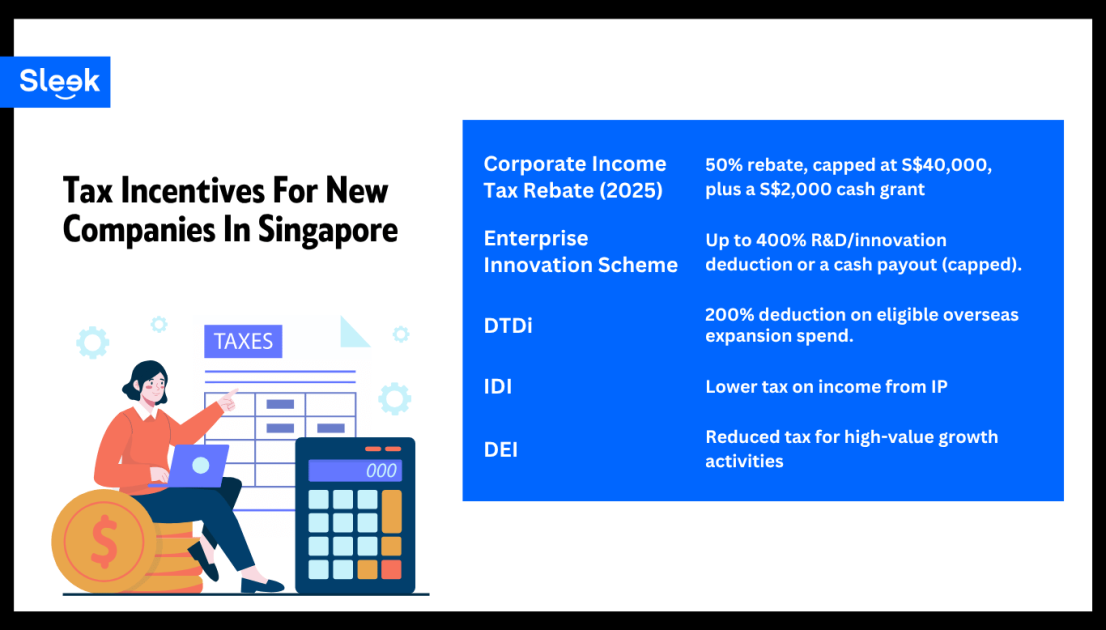
Corporate Income Tax Rebate (2026): 50% rebate, capped at S$40,000, plus a S$2,000 cash grant if you had at least one local employee in 2024.
Businesses engaged in high-value activities such as regional headquarters, advanced manufacturing, or analytics may enjoy reduced tax rates (5%-15%) on qualifying profits.
Tax incentives for new companies in Singapore make it one of the easiest places in the world to start and grow a business.
Alongside a low 17% corporate tax rate, new companies can tap into various Singapore tax incentive schemes that reduce costs, support innovation, and encourage long-term growth.
Singapore also offers startup tax exemption schemes that lower your tax bill in the first few years of operation. You can explore those in detail in our guide about exemptions for startups.
Tax incentives for new companies in Singapore can cut your corporate tax bill substantially in your first years of operation. Singapore’s corporate tax rate is a flat 17%, but most new Pte Ltd companies pay far less in their early years through two structural exemptions: the Start-Up Tax Exemption (SUTE) and the Partial Tax Exemption (PTE).
In this article, we’ll focus on the other tax incentives that help businesses invest in R&D, innovate, and scale with confidence.
What tax incentives can a new Singapore company get?
New Singapore companies can access one of two tiered corporate tax exemptions on their chargeable income, with additional sector-specific incentives available depending on their activities. The SUTE is the more generous option and applies to qualifying new companies for their first three Years of Assessment (YAs); the Partial Tax Exemption (PTE) is the fallback for companies that do not meet SUTE’s conditions or whose SUTE window has closed.
What is Corporate income tax rebate and cash grant (2026)
In 2025, Singapore introduced a new Corporate Income Tax (CIT) Rebate to help businesses manage cash flow.
All companies receive a 50% Corporate Income Tax (CIT) rebate, capped at S$40,000 for YA 2025.
Active companies with at least one local employee (Singapore Citizen or Permanent Resident) in 2024, for whom CPF contributions were made, will also receive a minimum S$2,000 cash grant, which is not taxable.
The total maximum benefit (CIT rebate + cash grant) is capped at S$40,000.
If the computed CIT rebate is less than S$2,000, only the cash grant will be provided.
Singapore tax incentives for innovation and growth
Tax Incentives For New Companies In Singapore
Innovation is at the heart of Singapore’s economy, and the government actively encourages and rewards it. Here are the key Singapore tax incentives that encourage businesses to build, innovate, and expand their operations.
Example: A creative agency earning royalties from its original logo designs pays a lower tax rate on that IP income.
This scheme encourages founders to protect their ideas and build valuable assets locally.
Development and Expansion Incentive (DEI)
The Development and Expansion Incentive (DEI) rewards companies that scale up and contribute to Singapore’s economic growth.
Businesses engaged in high-value activities such as regional headquarters, advanced manufacturing, or analytics may enjoy reduced tax rates (5%-15%) on qualifying profits.
Example: A logistics startup opening a regional operations hub in Singapore can qualify for a lower tax rate on that income.
The DEI helps fast-growing companies reinvest profits and expand sustainably.
How to apply for tax incentives for new companies in Singapore
Working with a good accountant or corporate advisor ensures you don’t miss out on any savings.
How Sleek helps you make the most of Singapore tax incentives
Starting a business is exciting, but it can also be overwhelming. Between managing operations, hiring, and compliance, it’s easy to miss out on the tax benefits you deserve.
That’s where Sleek comes in.
Our team helps you:
Set up your company correctly so you qualify for key Singapore tax incentive schemes.
Handle your filings and bookkeeping seamlessly, ensuring you don’t miss a rebate or deduction.
Identify the right incentives, from the CIT rebate that boosts cash flow to R&D and internationalisation schemes, that reward innovation and growth.
Because every dollar saved is a dollar you can reinvest into your dream.
Get your corporate tax handled — on time, every year.
FAQs: Tax incentives for new companies in Singapore
What tax incentives are available for new companies in Singapore?
Singapore offers several tax incentives to support new and growing businesses. These include the Corporate Income Tax (CIT) Rebate, the Enterprise Innovation Scheme (EIS) for R&D, the Double Tax Deduction for Internationalisation (DTDi), and incentives for intellectual property and business expansion, like the IDI and DEI.
What is the Enterprise Innovation Scheme (EIS) in Singapore?
The EIS encourages research and innovation. It allows businesses to claim up to a 400% tax deduction on approved R&D costs or opt for a cash payout. This helps startups recover part of their product development and testing expenses.
How do I claim tax exemptions for my Singapore company?
Neither SUTE nor PTE requires a separate application form. Both are claimed through your annual corporate tax return, filed via myTax Portal by 30 November. IRAS applies the exemption to the chargeable income figure you declare; any tax payable on income above the exempt tiers is billed automatically. You must also submit your ECI within three months of your financial year end. If you work with Sleek’s accounting team, both the ECI and the annual return are handled as part of your standard tax compliance cycle.
How do I know if my company qualifies for Singapore tax incentives?
Most incentives apply to Singapore-incorporated and tax-resident companies. Some, like the CIT rebate, are automatic, while others (such as DTDi or IDI) require applications through IRAS, Enterprise Singapore, or EDB. A professional advisor can help assess your eligibility.