“How to start a food business in Singapore” is a question many aspiring founders ask. In a city where food is culture, opportunity is everywhere, from hawker stalls to chef‑driven concepts and delivery‑first brands. But behind the glossy feeds are real rules, fees, and timelines.
Short answer: You’ll incorporate with ACRA, secure the right SFA licence (Food Shop or Food Stall), ensure food‑handler training, and add permits like liquor, signage, and fire‑safety where relevant. GST is 9% in 2026 and compulsory once taxable turnover crosses S$1M.
Pro Tip: Great food helps you open. Licences, structure and hygiene systems keep you open. SFA uses a Points Demerit System (PDS) and a new performance‑based SAFE framework; repeated lapses can suspend your licence.
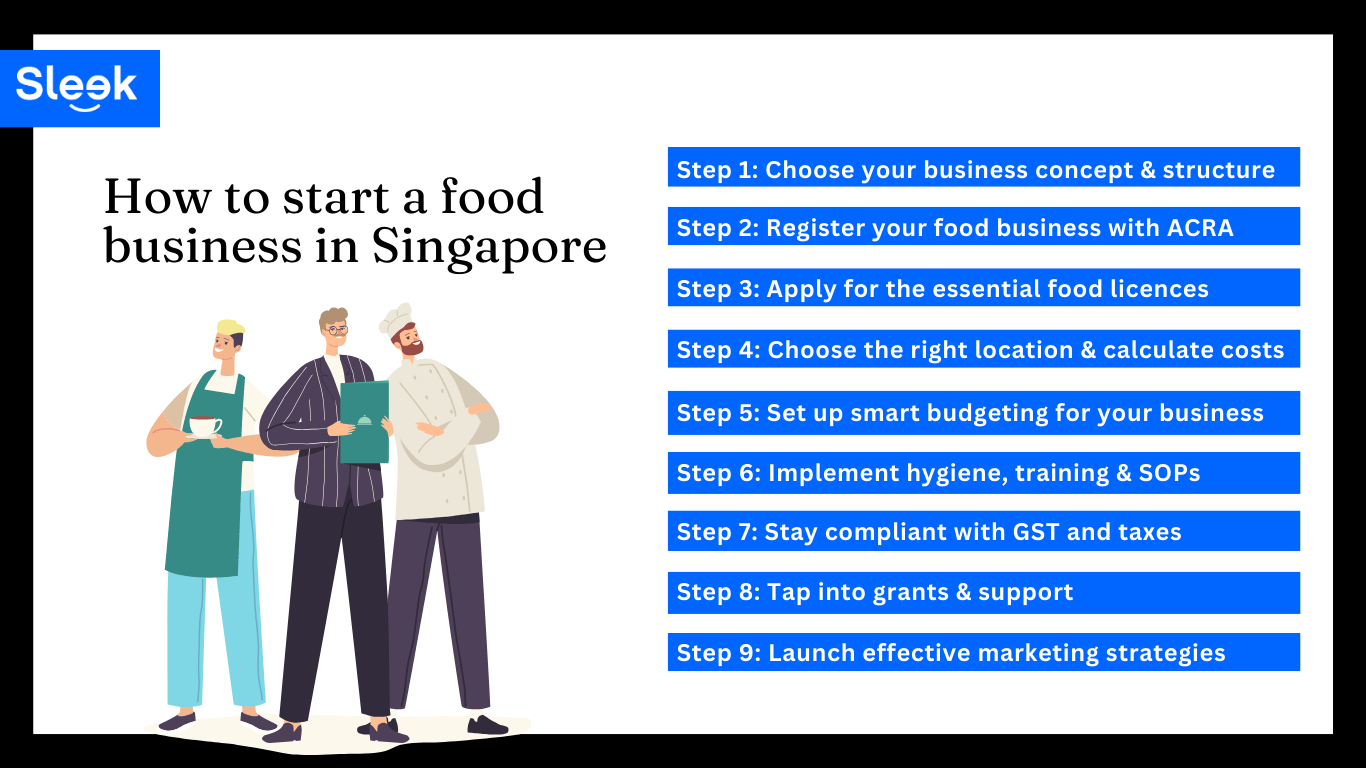
How to start a food business in Singapore in 9 steps
Steps on starting a food and beverage business in Singapore
Step 1: Define your food business concept & choose the right structure in Singapore
First, get crystal clear on your idea. Ask yourself:
Will you run a hawker stall (low rent, fast turnover)?
A café or restaurant (higher costs, higher margins)?
Or a delivery-first cloud kitchen (lower risk, digital reach)?
Private Limited (Pte Ltd): most founders choose this for credibility, liability protection, and fundraising. Requires ≥1 resident director and a Singapore address.
To start any business in Singapore, the first step is registering with ACRA. For food and beverage founders, this is the first official milestone to tick off.
The basics
Name reservation: Costs S$15 via Bizfile and holds your chosen name for 120 days. ACRA will reject names that are identical, too similar to existing ones, or contain prohibited words (e.g., “bank,” “university”) unless you have approval from relevant authorities.
Company registration (Pte Ltd): Costs S$300 in government fees. This is the most common structure for serious F&B operators because it offers liability protection and business credibility.
A stated paid-up capital of at least S$1 (you can increase this later to strengthen your company profile, especially if you’re applying for work passes).
Timeline: If your documents are in order, many straightforward applications are approved within hours via Bizfile.
Pro Tip: While you can handle registration yourself on Bizfile, many founders prefer going through a corporate service provider like Sleek. It saves them time and gives peace of mind, since every step is managed and nothing gets overlooked.
Step 3: Apply for the essential food licences in Singapore
Food and beverage businesses in Singapore are tightly regulated. You can’t sell a single plate of food until the right licences are in place. Most F&B startups underestimate the timeline and inspection process, which can delay opening day (and burn cash on rent).
Core SFA licences
SFC licences
Food Shop Licence: It’s required for restaurants, cafés, food kiosks, bakeries, and other retail food outlets.
Fee:S$195/year.
Process: Submit application with layout plan → pay fee → pass pre-licensing inspection by the Singapore Food Agency (SFA).
Common mistakes: Missing grease traps, poor exhaust/ventilation design, or layout changes that don’t match submitted plans.
Food Stall Licence: It’s required for hawker centre or coffee shop stalls.
Fee:S$32/year
Process: Apply after securing a stall from NEA tender/landlord → ensure hygiene facilities are adequate → pass inspection
Additional permits, depending on your concept
Liquor Licence (SPF): Needed if you serve alcohol on-site or sell it online/off-site. Class and fees vary depending on trading hours and format.
Advertising Sign/Signboard Licence (BCA): Required for outdoor signage. Always check URA/BCA guidelines before fabrication.
Fire Safety Certificate (SCDF): Commercial kitchens must follow fire safety rules, such as installing hood fire suppression systems and using LPG safely.
Import licences: If you import meat, seafood, dairy, or processed foods, you’ll need an SFA import licence and a Cargo Clearance Permit for each consignment.
Halal Certification (MUIS): It’s optional but valuable if you target Muslim diners. The process includes audits and regular checks.
Step 4: Choose the right location & calculate food business costs in Singapore
Choosing the right location is often the single biggest cost driver for your F&B business. Whether you’re starting lean with a hawker stall or going for a café in a shopping mall, the commitments and compliance checks are very different.
Hawker route (tendered stalls)
How it works: NEA runs monthly tenders; S$500 tender deposit; if you succeed, you’ll pay rental, S&CC, security deposit (2 months’ rent), and SFA hawker licence fee at signing. You’ll have up to 3 months to commence ops.
What others pay: As of Mar 2024, median rents for cooked‑food stalls were ~S$1.7k (SEHCs) and ~S$1.6k (NEA‑managed).
Café/restaurant in a mall or shophouse
Planning permission: Before you sign the lease, make sure the space has the proper ‘Change of Use’ approval, for instance, from ‘shop’ to ‘restaurant’. URA handles this for private property and HDB for public housing, and missing approval can mean extra time and cost.
Prime retail rent:
Orchard: ~S$31.2 psf/month
Marina/City Hall/Bugis: ~S$26.4 psf/month
Suburban areas: ~S$26.8 psf/month Always budget floor area × psf rate + service charge to get the true monthly outlay.
Step 5: Set up smart budgeting for your F&B business
Money is often the toughest part of running an F&B business. Beyond your menu and location, you need to know how much it costs to start and how long you can last before profits come in.
One-time setup costs
Item
Typical cost
Notes
ACRA government fees (Pte Ltd)
S$315 (S$15 name + S$300 incorporation)
Mandatory to legally operate
SFA Food Shop Licence
S$195/year
Required for restaurants, cafés, kiosks
SFA Food Stall Licence (hawker)
S$32/year (hawker & school canteens S$13/year)
Required for hawker operations
Liquor Licence (if applicable)
Varies by class & trading hours
Apply via SPF / GoBusiness portal
Outdoor signboard licence (if applicable)
Based on signage size & placement
Required for external signs (BCA/URA approval)
Fit-out & renovations
S$10,000 – S$50,000+
Kitchen exhaust, grease traps, fire safety systems add cost quickly
Kitchen equipment
Variable (can exceed S$50,000 for full restaurants)
Consider leasing for cash flow
Monthly running costs
Think about what you’ll spend each month:
Rent: From around S$1.6k for hawker stalls to S$20k+ for mall restaurants.
Supplies: Packaging, disposables, and cleaning materials.
Marketing: Social media ads, promotions, listing fees.
Staff costs: Wages, CPF, and training. The Progressive Wage Model (PWM) sets minimum pay and training standards for local food-service workers. Hiring foreigners also means pass quotas and levies.
Inventory: Ingredients and stock.
Cash runway
It takes time for most F&B outlets to break even. Keep at least 6–12 months of operating expenses in reserve to cover rent, staff, and suppliers until sales are steady.
Pro Tip: Open a business bank account as soon as possible. It keeps your personal money apart from company spending and makes cash flow clearer.
Step 6: Implement hygiene, training & SOPs for your food business
Food safety is essential in Singapore. Even a small slip can bring fines, bad press, or a suspended licence. Clear hygiene routines from day one protect your customers and your business.
Training
All food handlers must complete the WSQ Food Safety Course (FSC) Level 1 before starting work.
Refresher training is required every five years.
Some restaurants, caterers and canteens also need a Food Hygiene Officer (FHO) trained at FSC Level 3.
Daily routines
Create opening and closing checklists so cleaning and preparation are consistent.
Keep temperature logs to ensure safe food storage and cooking.
Put in place clear rules for allergens and cross-contamination so staff know how to handle ingredients and special requests.
SAFE and PDS
The SAFE framework grades outlets Bronze, Silver or Gold based on their safety record and systems. A higher grade signals reliability to customers and regulators.
The Points Demerit System (PDS) gives points for hygiene offences. Too many points can mean fines or suspension. Regular internal checks help avoid problems before inspections.
Step 7: Manage GST and taxes properly for your F&B business in Singapore
In Singapore, GST is a 9% tax (since 1 January 2024) charged on most goods and services. For food and beverage operators, it’s something you need to plan into your pricing.
Small outlets sometimes register voluntarily to claim GST on setup costs, but this also means more admin.
Pro Tip: Build GST into your pricing and cash flow early.
RELATED GUIDE
How To File For GST In 2026
Step 8: Tap into grants and support for food business owners in Singapore
Singapore has several grants to help small businesses lower their startup costs. They’re especially handy for F&B owners investing in equipment, systems, or staff training.
Productivity Solutions Grant (PSG)
Funds up to 50% of pre-approved solutions.
Good for tools like POS, online ordering, payroll, and accounting software.
Apply through the GoBusiness portal.
Enterprise Development Grant (EDG)
Supports projects that help a business upgrade, innovate, or expand.
Often used for consultancy, new equipment, or overseas growth.
Applications require a strong business case.
SkillsFuture Enterprise Credit (SFEC)
Provides a S$10,000 one-time credit to offset training and development costs.
Can be used together with PSG or EDG.
Extended until 2026.
Step 9: Marketing strategies for food and beverage businesses in Singapore
Great food is just the beginning. To thrive in Singapore’s busy F&B scene, you also need people to notice you. The right marketing depends on the kind of business you run.
Hawker stalls
Show up online: List your stall on Google Business Profile and keep it updated.
Use local search terms: Think simple, like “laksa Toa Payoh” or “chicken rice near MRT.”
Attract regulars: Lunchtime sets and bundles work well for office crowds.
Cafés and restaurants
Be social: Post on Instagram and TikTok with great food shots and short clips.
Get people talking: Make dishes photo-worthy and share customer posts to build buzz.
Keep them coming back: Run loyalty schemes or send WhatsApp updates on specials and new launches.
Delivery-first or cloud kitchens
Menu design: Use photos that look good in delivery apps and highlight dishes that travel well.
Promotions: Plan offers around peak hours and make sure discounts still leave room for profit.
Platform presence: Work with delivery apps to boost visibility, join their campaigns, and reply quickly to reviews.
Pro Tip: Consistency matters for any F&B business. Update your listings, answer reviews, and keep content current. Customers tend to trust and try places that stay active.
Quick‑start checklist
Decide format (hawker / café‑restaurant / cloud kitchen)
Choose structure (Sole Prop or Pte Ltd) and incorporate
Secure premises and confirm Change of Use (if needed)
Design layout to meet SFA/SCDF requirements
Apply SFA Food Shop / Food Stall licence
Train food handlers (FSC L1) and appoint FHO if required
Add Liquor/Signboard licences (if applicable)
Set up accounting, POS, payroll (PWM in scope), and GST plan
Build hygiene SOPs; prepare for SAFE grading
Launch lean; monitor costs, reviews, and compliance
Special case: Home‑based food businesses (HBB)
No SFA licence is needed for small‑scale home‑based food businesses, but you must comply with HDB/URA schemes and SFA’s food‑safety requirements.
How Sleek helps with starting your F&B business
Opening a food business in Singapore is full of opportunities, but it also takes work. From sorting out licences to managing costs and following the rules, there’s a lot to cover. Careful planning will give your idea the best chance to succeed in Singapore’s busy F&B market.
Many founders find it easier to work with a partner who can take care of the formalities while they focus on their concept and customers. Sleek supports entrepreneurs by:
A Food Shop Licence is required for restaurants, cafés, kiosks, bakeries, and other retail food outlets. It costs S$195 per year and is issued by the Singapore Food Agency (SFA).
A Food Stall Licence is required for hawker centre or coffee shop stalls. It costs S$32 per year, with a reduced fee of S$13 per year for school canteen stalls.
In short, Food Shop Licences cover full retail outlets, while Food Stall Licences are for hawker-style setups.