Chee Koon has 13 years of experience handling visa applications to Singapore. He is Sleek's in-house expert to assist and advice businesses and foreigners with their Singapore Immigration issues.
Chee Koon's certifications include:
Singapore State Award: National Day Award "The Commendation Medal, 2020"
Certificate of Employment Intermediaries (CEI)
Bachelor of Economics (First Class Honors), Nanyang Technological University
For Chee Koon, there is no greater work satisfaction than to successfully obtain work passes approval for his clients, for them to work and stay in Singapore.
During his free time, Chee Koon enjoys cycling around and exploring the country.
Working in Singapore as the spouse of a ONE Pass or Tech.Pass holder is possible. But it requires the right work authorisation and understanding of Singapore’s immigration rules.
Many expat families relocating to Singapore assume that a spouse can automatically start working once they arrive. Unfortunately, that’s not the case.
If you hold a Dependant’s Pass (DP) or Long-Term Visit Pass (LTVP) tied to your spouse’s work pass, you generally cannot work immediately without additional approval. You must first obtain either:
A Letter of Consent (LOC)
Your own Employment Pass (EP) or S Pass
Approval to start and run a business in Singapore
Understanding these options is crucial before accepting a job or launching a company.
In this guide, we’ll explain:
Whether spouses of ONE Pass or Tech.Pass holders can work in Singapore
The different work visa options available
How to apply for a Letter of Consent (LOC)
How spouses can start a business in Singapore
Common mistakes that delay approvals
What Is the ONE Pass and Tech.Pass?
Singapore introduced specialised work passes to attract highly skilled professionals and entrepreneurs.
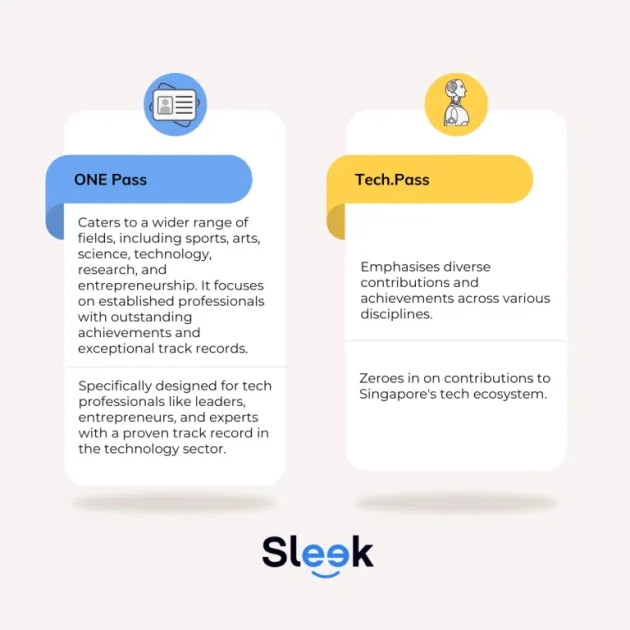
Key differences between Singapore’s ONE Pass and Tech.Pass
ONE Pass (Overseas Networks & Expertise Pass)
The ONE Pass is designed for top global talent across industries such as technology, finance, science, and entrepreneurship.
Benefits include:
Ability to work for multiple companies simultaneously
Greater flexibility for entrepreneurship
Ability to bring family members to Singapore
The ONE Pass also allows holders to start and operate businesses while working for other companies, making Singapore particularly attractive for founders and executives. If your spouse holds a ONE Pass, you will typically receive a Dependant’s Pass so you can live in Singapore.
Tech.Pass
The Tech.Pass is another high-level work visa aimed at experienced technology leaders, entrepreneurs, and investors.
Tech.Pass holders can:
Launch or join startups
Mentor local companies
Work across multiple organisations
Just like ONE Pass holders, Tech.Pass holders can bring their spouses and children to Singapore under family passes.
However, spouses still need work authorisation before taking up employment.
Can the spouse of a ONE Pass holder work in Singapore?
Yes, but not automatically. Spouses of ONE Pass or Tech.Pass holders usually receive a Dependant’s Pass (DP).
A Dependant’s Pass allows you to:
Live in Singapore
Enter and leave the country freely
Open bank accounts and sign rental agreements
But it does not automatically grant employment rights.
To work legally, you must obtain approval from Singapore’s Ministry of Manpower (MOM) through one of the following routes.
Work options for spouses in Singapore
If you are the spouse of a ONE Pass or Tech.Pass holder, there are four main ways to work legally in Singapore. The right option depends on your employment plans, income level, and whether you want to start a business.
1. Employment pass (EP)
For most spouses, the Employment Pass (EP) is the most common and straightforward route.
An EP allows you to:
Work full-time for a Singapore-registered employer
Earn a qualifying salary set by the Ministry of Manpower (MOM)
Access professional roles across industries
How it works:
Your employer submits the application via MOM
The application is assessed based on salary, qualifications, and the COMPASS framework
If approved, you hold your own independent work pass
2. S pass
The S Pass is designed for mid-skilled roles and may be an option if you do not meet EP criteria.
Apply for an LOC (if eligible) or another work pass
Why this works well for ONE Pass / Tech.Pass families
Singapore’s ecosystem is designed for founders, and your spouse’s pass already supports relocation and stability.
How to choose the right work option for you as a spouse of ONE Pass/Tech.Pass Holder
Choosing the right path depends on your situation. Here’s a simplified breakdown:
Situation
Best option
Corporate job offer
Employment Pass (EP)
Mid-skilled role
S Pass
Starting a company
LOC (with business setup)
Freelance / consulting
Company + LOC or EP
What most spouses do with a ONE Pass/Tech.Pass Holder?
Most spouses of ONE Pass or Tech.Pass holders follow a practical, step-by-step path to start working in Singapore. This approach aligns with how employers hire and how MOM evaluates applications.
Step 1: Relocate on a Dependant’s Pass (DP)
When you move to Singapore, you typically enter on a Dependant’s Pass linked to your spouse’s work pass.
This allows you to:
Settle in Singapore
Open a bank account
Secure housing
Explore job opportunities locally
However, at this stage, you cannot legally work yet.
Step 2: Start your job search
Once settled, most spouses begin applying for roles in Singapore.
Common approaches include:
Applying through job portals (e.g. LinkedIn, MyCareersFuture)
Networking within industry communities
Leveraging your spouse’s professional network
At this stage, it’s important to:
Be transparent with employers that you require work authorisation
Focus on roles that meet EP or S Pass criteria
Step 3: Employer applies for an Employment Pass
After securing a job offer, your employer will:
Submit an Employment Pass (EP) or S Pass application to MOM
Provide your salary details, qualifications, and job scope
You do not apply directly—this is handled by the employer.
Approval depends on:
Salary level
Skills and experience
Company profile and hiring criteria
Step 4: Transition to your own work pass
Once your work pass is approved:
You transition from a Dependant’s Pass to your own independent work pass
Your right to work is now tied to your employer, not your spouse
This gives you:
Greater professional independence
More flexibility in your career
A clearer long-term path in Singapore
Why this route works best for spouses with ONE Pass or Tech.Pass
This is the most common path because it is:
More predictable: Employers and MOM are familiar with this process, making approvals more straightforward.
Easier for employers: Companies are used to sponsoring EP applications and prefer this over less common routes like LOC.
Aligned with current MOM policies: Singapore’s work pass framework is structured around employer-sponsored passes, making this the most compliant and widely accepted option.
When this path may not apply
You might consider alternatives (like starting a business) if:
You want more flexibility or independence
You are not seeking traditional employment
You already have entrepreneurial plans
Common mistakes that delay approvals for spouses of a ONE Pass/Tech.Pass Holder
Applying for work authorisation in Singapore is usually straightforward, but small mistakes can lead to delays, rejections, or unnecessary back-and-forth with MOM.
Here are the most common issues to avoid:
Common mistakes that delay work approval for Dependant’s Pass holders in Singapore
1. Assuming you can work immediately
Many spouses assume that once they arrive in Singapore on a Dependant’s Pass, they can start working right away.
That’s not the case.
A Dependant’s Pass only allows you to live in Singapore, not work. You must first obtain:
An Employment Pass (EP)
An S Pass
Or relevant approval (e.g. LOC for business owners)
Starting work without approval can lead to compliance issues and penalties.
2. Applying under the wrong scheme
This is one of the biggest causes of delays.
For example:
Applying for a Letter of Consent (LOC) when an EP is required
Attempting routes that don’t match your employment type or eligibility
Each pathway has specific use cases, and choosing the wrong one often results in rejection or resubmission.
When in doubt, align your application with your actual work setup (employee vs business owner).
3. Submitting incomplete documentation
MOM applications require accurate and complete documentation.
Common missing items include:
Educational certificates
Detailed job descriptions
Salary information
Passport details
Even small gaps can:
Delay processing
Trigger additional document requests
Affect approval timelines
Always double-check requirements before submission.
4. Employer unfamiliarity with the process
Not all employers are experienced in hiring Dependant’s Pass holders.
This can lead to:
Incorrect application types
Missing information
Misunderstanding of eligibility rules
As a result, applications may be:
Delayed
Rejected
Submitted incorrectly
Working with employers familiar with Singapore’s hiring framework can significantly improve approval chances.
5. Ignoring eligibility requirements
Each work option in Singapore has its own criteria.
Failing to meet these requirements before applying can result in:
Immediate rejection
Wasted time and effort
Always verify the latest requirements via official MOM sources before applying.
Tip
Most delays happen before submission, not after. Getting the right setup from the start makes the biggest difference.
Can you switch from a Dependant’s Pass to your own work pass?
Yes. Many spouses eventually transition from a Dependant’s Pass to their own Employment Pass or S Pass.
Benefits of switching:
Greater independence
More flexibility in employment
Clearer long-term residency pathway
Once your work pass is approved:
Your Dependant’s Pass will typically be cancelled
You become the primary work pass holder
Can you work remotely for an overseas company?
This is a common question, and the answer depends on how your work is structured. In general, even if your employer is based overseas, working while physically located in Singapore may still require proper work authorisation under Ministry of Manpower (MOM) rules. Singapore regulates work based on where the work is performed, not just where the company is located.
To stay compliant, it’s important to review the latest MOM guidelines and, in some cases, consider structuring your work through a Singapore-registered entity—especially if your activities are ongoing or business-related. If you’re unsure how this applies to your situation, this guide on spouses for DP provides a helpful breakdown of available options.
How Sleek helps spouses work and start businesses in Singapore
Navigating Singapore’s work pass and company setup process can be complex—especially if you’re relocating.
We are the right choice for you if:
You want to start a business in Singapore
You need help navigating incorporation and compliance
We’re experts in simplifying complex processes, and we can help you with your LOC application from start to finish. Don’t let administrative hurdles slow you down. Focus on what matters most, your career in Singapore.
Ready to start working in Singapore without the guesswork?
FAQs : Working in Singapore as a spouse of a ONE Pass/Tech.Pass holder
Can a spouse of a ONE Pass holder work in Singapore?
Yes, but not automatically. Spouses usually hold a Dependant’s Pass, which allows them to live in Singapore but not work. To take up employment, they must obtain valid work authorisation such as an Employment Pass, S Pass, or approval to operate a business under applicable MOM rules.
Is a Letter of Consent enough to start working in Singapore?
A Letter of Consent is not always sufficient. It is typically used for specific cases, such as business owners who meet MOM requirements. Most spouses who want to work as employees will need an Employment Pass or S Pass sponsored by an employer rather than relying on an LOC.
Can I apply for a job while on a Dependant’s Pass in Singapore?
Yes, you can search and interview for jobs while holding a Dependant’s Pass. However, you cannot begin working until your employer successfully obtains an approved work pass for you. Starting work without approval may lead to penalties or complications with your immigration status in Singapore.
Do employers need to sponsor my work pass in Singapore?
Yes. For Employment Pass and S Pass applications, the employer must submit and sponsor the application through the Ministry of Manpower. They are responsible for providing job details, salary information, and supporting documents as part of the approval process.
Can I start a business as the spouse of a Tech.Pass holder in Singapore?
Yes, you can start a business in Singapore. Many spouses choose this route for flexibility. You will typically need to register a company with ACRA and ensure compliance with MOM requirements. Depending on your setup, you may also need approval, such as a Letter of Consent to operate the business.
How long does it take to get a work pass approved in Singapore?
Processing times vary depending on the type of work pass and the completeness of your application. Employment Pass applications may take a few weeks, while other approvals can vary. Delays often occur if documents are missing or if additional review is required by the authorities.