Ismarina is the Head of Country at Sleek Singapore, where she leads strategic growth, operational excellence, and service delivery. With over 20 years of experience across finance, compliance, and business leadership, she oversees Sleek’s full range of services. These include CFO advisory, accounting, tax, GST, payroll, corporate secretarial, immigration, and client support.
She is known for her clarity in leadership and strength in execution. Ismarina has led large, cross-functional teams in both in-person and virtual settings. She has delivered strong P&L outcomes, scaled operations, and built trusted relationships across businesses of all sizes.
Ismarina combines practical insight with academic depth. She holds an MSc (Hons) in Management, is a Fellow CPA, an ASEAN CPA, and a CIMA-qualified Chartered Global Management Accountant. Her expertise covers project management, construction and nonprofit accounting, judicial management, and liquidation. Her experience running an accounting firm and offering CFO services gives her a sharp understanding of what clients need to grow and stay ahead.
She is also a committed mentor who supports her team’s growth with care and purpose. Before Sleek, she held senior roles at the Project Management Institute and the Football Association of Singapore. She played a key role in leading digital transformation and shaping regional strategy.
Outside of work, you’ll find her immersed in books, sewing projects, and knitting, or cheering on her family at sporting events. She brings the same passion for excellence to everything she does, both professionally and personally.
The employer CPF contribution rate in Singapore is 17% for Singapore Citizens and third-year-onwards Permanent Residents aged 55 and below. From 1 January 2026, the Ordinary Wage ceiling rose to S$8,000 a month and rates went up for employees aged above 55 to 65, with a further increase due in January 2027. Employers must pay contributions by the last day of each month; late-payment interest applies from the day after the due date, and enforcement action can follow if payment remains outstanding by the 14th of the following month.
This guide sets out what you owe, for whom and by when, with every figure checked against the CPF Board, and shows where payroll services can take the monthly work off your plate.
CPF contributions at a glance (2026)
Employer rate: 17% for employees aged 55 and below, with lower rates for older age groups. Employer rates step down for older workers, from 16% (above 55 to 60) to 7.5% (above 70).
Employee rate: 20% for employees aged 55 and below, deducted from their wages.
Wage ceiling: S$8,000 per month for Ordinary Wages.
Who qualifies: Singapore Citizens and Permanent Residents, with graduated rates for eligible PRs in their first two years.
Payment deadline: Last day of the month; the 14th of the following month is the enforcement threshold, not the payment due date.
Two changes took effect on 1 January 2026, and both touch the way you run payroll. The Ordinary Wage ceiling rose from S$7,400 to S$8,000 a month, the final step of a phased increase that began in September 2023.
The second change is easy to miss: contribution rates went up for employees aged above 55 to 65. The extra amount flows straight into the employee’s Retirement Account, up to the Full Retirement Sum, and into the Ordinary Account after that.
If your payroll system is still running 2025 senior-worker rates, it is now under-contributing for those staff. That is the single most common 2026 error we see, and it is worth a five-minute check this month.
Who must pay CPF, and who is exempt?
You must pay CPF for every Singapore Citizen and Singapore Permanent Resident you employ who earns more than S$50 a month, including part-time and casual staff. You do not pay CPF for foreign employees on an Employment Pass, S Pass, Work Permit or Dependant Pass.
The most common confusion on this point involves foreign hires. If you employ an engineer on an Employment Pass, there is no employer CPF on their salary at all. A separate foreign worker levy can apply to some S Pass and Work Permit categories, but that is paid to the Ministry of Manpower, not the CPF Board.
One scenario trips up groups with an overseas parent: a Singapore employee paid from abroad. If the employment relationship sits with your Singapore-incorporated company, the CPF obligation stays with that entity, even when the salary is funded or paid from overseas.
The table below is the quick lookup most employers need. Use it as your first filter before you touch any rates.
Employee profile
CPF?
Notes
SG Citizen, full-time, on salary
Yes
Standard rates by age band
SG Citizen, part-time or casual, on salary
Yes
Payable once monthly wages exceed S$50
SG PR, Year 1 of PR status
Yes
Graduated (lower) rates
SG PR, Year 2 of PR status
Yes
Graduated rates, stepped up from Year 1
SG PR, Year 3 onwards
Yes
Full standard rates, same as a Citizen
Foreign employee on EP / S Pass / Work Permit / DP
No
No employer CPF; a foreign worker levy may apply
Director (SG Citizen/PR) on a salary
Yes
Treated as an employee
Director receiving only director’s fees
No
Fees are not salary
Director receiving only dividends
No
Dividends are shareholder returns, not wages
What are the 2026 CPF contribution rates by age?
For Singapore Citizens and Permanent Residents from their third year onwards, earning more than S$750 a month, the 2026 rates run from 37% of Ordinary Wage for the youngest band down to 12.5% for the oldest. The employer CPF contribution rate is 17% for employees aged 55 and below and steps down to 7.5% above 70, while the 2026 increases fall on the bands above 55 to 65.
This is the CPF contribution rate 2026 table for Citizens and third-year PRs, so read it as employer share, employee share, then total. New rates apply from the first day of the month after an employee’s 55th, 60th, 65th or 70th birthday, so a staff member who turns 60 in March moves to the next band from 1 April.
Age band
Employer %
Employee %
Total %
55 and below
17
20
37
Above 55 to 60
16
18
34
Above 60 to 65
12.5
12.5
25
Above 65 to 70
9
7.5
16.5
Above 70
7.5
5
12.5
Permanent Residents in their first two years sit on lower graduated rates. For a PR aged 55 and below earning more than S$750, the rate is 4% employer and 5% employee (9% total) in Year 1, rising to 9% employer and 15% employee (24% total) in Year 2, before full rates apply from Year 3.
These graduated rates did not change for 2026. Full rate tables sit on the CPF Board website.
Tip: Diarise each employee’s birthday month, because the employer CPF contribution rate changes on the first of the following month. A missed age-band transition is one of the easiest errors for an auditor to spot.
From 1 January 2027, CPF rates rise again for employees aged above 55 to 65, so a 2027 payroll budget built on the CPF contribution rate 2026 table will understate your costs. Here is what changes for wages above S$750 a month:
Above 55 to 60: employer 16% to 16.5%, employee 18% to 19%, total 34% to 35.5%.
Above 60 to 65: employer 12.5% to 13%, employee 12.5% to 13%, total 25% to 26%.
Rates for employees aged 55 and below, above 65 to 70 and above 70 do not change, and the graduated rates for first- and second-year PRs stay the same. The increase is allocated to the employee’s Retirement Account, up to the Full Retirement Sum.
How do the CPF wage ceilings work?
Four numbers govern how much of an employee’s pay attracts CPF, and together they make up the CPF contribution cap 2026 employers work to. The Ordinary Wage ceiling is S$8,000 a month, so monthly salary above that does not attract CPF on the Ordinary Wage side.
The annual salary ceiling is S$102,000, the most CPF can be charged on across a full year. The Additional Wage ceiling, which covers bonuses and other non-monthly pay, is S$102,000 minus the total Ordinary Wage already subject to CPF for the year.
Sitting above all of these is the CPF Annual Limit of S$37,740, the maximum total CPF (employer plus employee) for one employee in a year. Of the four figures in the CPF contribution cap 2026 set, only the Ordinary Wage ceiling changed this year.
A quick bonus example shows why the Additional Wage ceiling matters. An employee on S$5,000 a month has S$60,000 of Ordinary Wages for the year, so their Additional Wage ceiling is S$42,000 (S$102,000 minus S$60,000). A year-end bonus up to S$42,000 attracts CPF; anything above that does not.
Ceiling
2026 figure
What it caps
Ordinary Wage (OW) ceiling
S$8,000 / month
Monthly salary subject to CPF
Annual salary ceiling
S$102,000 / year
Total wages subject to CPF in a year
Additional Wage (AW) ceiling
S$102,000 minus yearly OW subject to CPF
Bonuses and other additional wages
CPF Annual Limit
S$37,740 / year
Total CPF per employee per year
Worked examples: Three CPF scenarios for employers
Numbers make the rules concrete. Here are three common situations, each calculated end to end on the 2026 figures.
Example 1: Citizen, age 30, S$5,000 a month
Salary is below the S$8,000 ceiling, so CPF is charged on the full S$5,000. Employer pays 17% (S$850), the employee pays 20% (S$1,000), for S$1,850 total each month.
On the annual side, Ordinary Wages of S$60,000 for the year leave an Additional Wage ceiling of S$42,000 (S$102,000 minus S$60,000) for any bonus.
Example 2: Citizen, age 58, S$10,000 a month
Salary is above the S$8,000 ceiling, so CPF is charged on S$8,000 only. This employee is in the above 55 to 60 band, so the 2026 rates are 16% employer and 18% employee.
That is S$1,280 employer and S$1,440 employee (S$2,720 total). The senior-worker portion flows into the Retirement Account up to the Full Retirement Sum. An employer still running 2025 rates would under-pay here.
Example 3: PR in Year 1, age 35, S$4,000 a month
First-year PRs are on graduated rates. At 4% employer and 5% employee, that is S$160 and S$200, for S$360 total on a S$4,000 salary, well below the full-rate figure a Citizen on the same pay would attract.
From Year 3, this employee moves to full rates.
What does CPF actually cost an employer each month?
A question we hear often from first-time employers is whether CPF is an extra cost on top of salary. It is: the employer share is paid on top of the agreed wage every month, while the employee share comes out of it.
Here is how to calculate CPF for employees in two steps: cap the wage at the S$8,000 Ordinary Wage ceiling, then apply the employer and employee rates for the person’s age band. The table shows the employer cost at a glance for staff aged 55 and below.
Monthly salary
Wage subject to CPF
Employer CPF (17%)
Employee CPF (20%, deducted)
Total monthly cost to you
S$5,000
S$5,000
S$850
S$1,000
S$5,850
S$8,000
S$8,000
S$1,360
S$1,600
S$9,360
S$12,000
S$8,000
S$1,360
S$1,600
S$13,360
Above the ceiling, employer CPF stops growing: CPF applies only to the first S$8,000 of Ordinary Wages, so S$1,360 is the most you pay each month for one employee in this age band. The total covers salary plus employer CPF only and excludes the Skills Development Levy (SDL) and any foreign worker levy.
If working out how to calculate CPF for employees every month is not how you want to spend payroll week, you can outsource CPF and payroll to a team that runs these numbers daily.
Do you pay CPF when you pay yourself as a director?
The answer turns on how you are paid, not on your job title. If you draw a salary and you are a Singapore Citizen or PR, that salary attracts CPF in exactly the same way an employee’s would.
Director’s fees are different. Fees voted by the board for your services as a director are not wages, so no CPF is due on them. Dividends you receive as a shareholder are not wages either, so they carry no CPF.
Many founders pay themselves with a mix of all three. CPF applies only to the salary portion, while the tax treatment of fees and dividends is a separate question handled through payroll taxes in Singapore and your annual filings.
When is CPF due, and how do you submit it?
The CPF submission deadline for a month’s wages is the last day of that month. If payment has not reached the CPF Board by the 14th of the following month (or the next working day if the 14th falls on a weekend or public holiday), enforcement action starts and late payment interest is charged from the day after the due date. In practice the 14th is your hard stop, but only paying by month-end keeps you fully on time.
Most employers submit through CPF EZPay, the CPF Board’s free online service, which computes the contributions for you. Payroll software can also prepare the submission, with payment by GIRO, eNETS or direct debit.
If this is your first hire, there is one step before any of that: apply for a CPF Submission Number (CSN), which links your company to the CPF Board for submissions. You can apply online through the CPF website, and you will need it before your first contribution is due, so do it as soon as the offer is signed rather than in the week the CPF submission deadline lands.
What happens if you pay CPF late?
Late CPF is not a soft deadline, and employer CPF penalties grow the longer an amount stays unpaid. Here is what the non-compliance sequence looks like in practice:
Interest applies from the day after the due date. Late payment interest is 1.5% per month (minimum S$5), so a S$1,500 monthly CPF bill paid a month late costs an extra S$22.50.
The cost keeps building. Interest runs on the full outstanding amount each month until you pay, so three months late on the same bill adds S$67.50.
Composition comes before court. The CPF Board typically lets an employer settle by paying a composition amount instead of facing prosecution, and formal enforcement notices follow if that is not taken up.
Prosecution is possible. Persistent or significant non-payment is an offence under the CPF Act and can lead to a fine or imprisonment.
You cannot pass the cost to the employee. Only the employee’s own share may be deducted from their salary, so the employer share and any interest sit with the company.
Most employer CPF penalties trace back to a missed date or a stale rate table. Both are easy to prevent with a fixed monthly routine.
Should you run CPF yourself or let Sleek handle it every month?
You can run CPF yourself: CPF EZPay is free, and a small team with one or two employees can manage it with a monthly checklist. What you are really deciding is who carries the time and the risk of a missed age band, ceiling or deadline each month.
Do it yourself (CPF EZPay or payroll software)
Outsource to Sleek
Monthly work
You compute, submit and pay CPF, SDL and SHG funds
Sleek computes and submits; payment goes out by direct debit from your account
Risk of a late or wrong payment
Rests on your own checks of rates, ceilings and dates
Specialists track rate changes, age bands and deadlines
IR8A and AIS
You prepare and submit each year
Included
Cost
Free portal, plus your time and any software fees
S$300 per employee per year
Sleek’s payroll team handles CPF computation and submission, SDL and Self-Help Group contributions, monthly payslips and annual IR8A filing through the Auto-Inclusion Scheme. To weigh the trade-offs in more depth, read our guide to in-house vs outsourced payroll, or compare payroll service providers before you decide.
What CPF mistakes do Singapore employers make most often?
Most CPF errors are not exotic. They cluster around a handful of recurring slips, and almost all of them are avoidable with a monthly check before payroll runs.
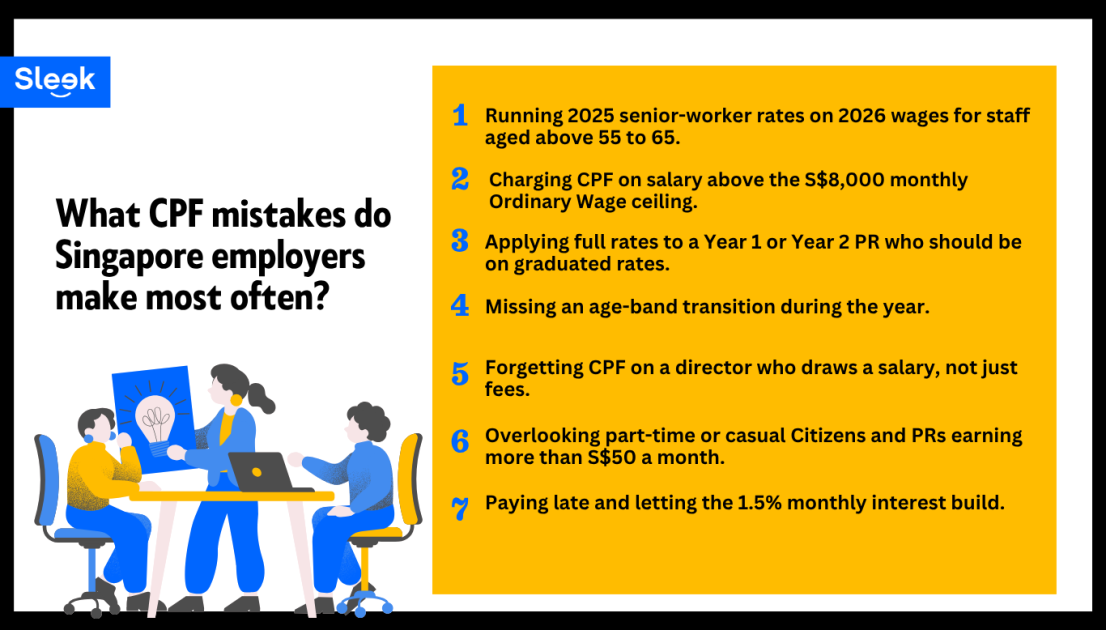
Running 2025 senior-worker rates on 2026 wages for staff aged above 55 to 65. If your payroll system was not updated before the first 2026 run, you have been under-contributing since January and will need a CPF Board adjustment, with back-interest on the gap.
Charging CPF on salary above the S$8,000 Ordinary Wage ceiling. Over-contributing is an error too, and recovering it means applying to the CPF Board for a refund.
Applying full rates to a Year 1 or Year 2 PR. Graduated rates apply by default unless the employer and employee have jointly applied to use full rates early, so diarise each PR’s Year 2 and Year 3 start dates.
Missing an age-band transition during the year. A staff member who turns 60 in March moves to the above 60 to 65 band from 1 April, not from their birthday or the start of the financial year.
Forgetting CPF on a director who draws a salary. CPF is due on a director’s salary but not on fees or dividends, and many founders get this the wrong way round.
Overlooking part-time or casual Citizens and PRs earning more than S$50 a month. There is no minimum-hours threshold, so a part-timer on S$800 a month attracts CPF at the same age-band rates as a full-timer.
Paying late and letting the 1.5% monthly interest build. A calendar reminder on the 25th of each month gives you five clear days to compute, check and submit before month-end.
What about foreign employees, the self-employed and senior-worker support?
Foreign employees on a work pass attract no employer CPF, full stop. If a foreign employee later becomes a PR, CPF starts from the month after their PR status takes effect, beginning on the same Year 1 and Year 2 graduated rates covered earlier in this guide.
Self-employed people and freelancers sit outside the employer CPF framework entirely. Their obligations are chiefly MediSave-based and follow different thresholds; freelancers have a dedicated guide, and more payroll topics sit in the Sleek resources hub.
For the broader picture of how contributions flow across an employee’s CPF accounts, read how CPF works for employees alongside this guide.
Employers hiring or retaining staff aged 55 and above may also be eligible for the Senior Employment Credit, a government wage offset scheme that partially offsets the cost of employing older workers. The qualifying age, offset percentage and income ceiling are confirmed annually, so check the current figures with the Ministry of Manpower before factoring them into a hiring budget.
How Sleek helps you stay on top of CPF and payroll
CPF goes wrong in the gaps: a birthday that shifts a rate, a ceiling that quietly capped a calculation, a deadline that landed on a busy week. Sleek can run your accounting and payroll in one place, folding monthly CPF submission in with your bookkeeping so one team tracks the rates, the transitions and the deadlines.
Payroll comes built into the Accounting Premium package for up to five employees, or as Payroll Expert Support at S$300 per employee per year.
Want Sleek to run CPF for S$300 per employee a year?
When do I pay CPF for a new hire who joins mid-month?
You pay CPF on the wages you actually pay for that month, so a new hire who starts on 4 November attracts CPF on their November pay. That contribution is due by 30 November and must reach the CPF Board by 14 December to avoid enforcement and late payment interest. Make sure your CPF Submission Number is in place before the first payroll run.
Can a payroll provider submit CPF on my behalf?
Yes. A payroll provider can compute and submit your monthly CPF under your company’s CPF Submission Number, with payment drawn from your account by direct debit or GIRO. Your company remains legally responsible for paying the right amount on time, so choose a provider that tracks rate changes for you, such as Sleek’s payroll service.
Are employer CPF contributions tax-deductible?
Yes. The CPF contributions you are required to make as an employer are deductible business expenses when you file corporate tax. Voluntary contributions above the mandatory amount are treated differently, so check the IRAS rules before topping up an employee’s CPF.
Do I pay the Skills Development Levy for employees who don't get CPF?
Yes. SDL is payable for every employee working in Singapore, including foreigners on work passes who do not attract CPF. It is 0.25% of each employee’s monthly remuneration, with a minimum of S$2 and a maximum of S$11.25 a month, paid to the CPF Board together with your CPF contributions.