Dharini Jegadeesan, ACS, ACIS, is a seasoned Company Secretarial and Compliance professional with over 10 years of experience navigating Singapore’s regulatory landscape. As Co-Head of Corporate Secretary at Sleek, she brings a pragmatic, solutions-focused approach to help founders stay compliant and scale with confidence at every stage of growth.
She holds an ICSA qualification from the Chartered Secretaries Institute of Singapore and a Master’s degree in International Commerce. She is also a proud member of the Singapore Institute of Directors (SID) and the Singapore Business and Professional Women’s Association, where she continues to advocate for good governance and women’s leadership in business.
Dharini is known for her people-first leadership and pragmatic style. It’s this approach that fuels her commitment to helping founders scale with confidence. She also supports startups through fundraising, from seed to Series G, guiding them through due diligence, cleaning up cap tables, and ensuring they are investor-ready when it counts.
Dharini believes the company secretarial function shouldn’t be a burden for founders. She’s committed to making it clear, organized, and scalable.
96% customer satisfaction from 16,000+ survey responses.
In this article
Share this post
Facebook
LinkedIn
WhatsApp
Copy to clipboard
Key takeaways
Dividends from Singapore subsidiaries are not taxed again; foreign dividends can be exempt if taxed abroad at a headline rate of 15% or more.
Gains on selling shares are tax-free if you held at least 20% for 24 months. From 1 Jan 2026 there is no end date, and the 20% can be met across your group.
Gains on selling foreign assets can be taxed if the money comes into Singapore and the company has no real substance here.
Investment holding companies can’t use the start-up tax exemption; they get the partial exemption instead.
Setup is the same as any Singapore company: S$315 ACRA fees, a resident director and a company secretary.
A Singapore holding company is a private limited company that owns shares in other companies. Founders use one to separate risk from operations, receive dividends from subsidiaries, and sell businesses without paying tax on the gain. Since 1 January 2026, gains on selling shares held at least 24 months stay tax-free with no end date. A holding company is set up exactly like any Singapore company, for S$315 in ACRA fees.
In this guide, you will learn:
What a holding company is and how it works in practice
Why Singapore is one of the best places to set up
The requirements and compliance rules you need to know
How taxes apply to holding companies
Step-by-step instructions to incorporate smoothly
What is a Singapore holding company, and how is it structured?
A holding company owns shares in one or more other companies (its subsidiaries) rather than trading itself. The holding company sits at the top; the subsidiaries run the business, hold contracts and carry the risk. If a subsidiary is sued or fails, the holding company’s other assets are usually protected.
A holding company is a business that owns things instead of selling things. These can be shares in other companies, intellectual property like trademarks in Singapore, or even cash. It usually doesn’t deal directly with customers.
Setup
How it looks
When it makes sense
HoldCo → OpCo
One holding company owns one or more operating companies
You want to keep profits and future sale gains away from day-to-day business risk
HoldCo → IPCo → OpCo
A separate company owns trademarks, software or patents and licenses them to the operating company
Your IP is your main asset and you want it out of reach of operating liabilities
Regional HQ
A Singapore holding company owns subsidiaries in several countries
You run businesses across Asia and want one place to collect dividends and manage the group
Founders use a holding company to:
Keep ownership of different businesses in one place
HoldCo → OpCo(s): One parent company at the top that owns several operating companies.
HoldCo → IPCo → OpCo: A parent company that also owns an IP company, which then licenses the brand or technology to the operating companies.
Regional headquarters: A parent company in Singapore that controls subsidiaries across Asia.
How a Singapore holding company is taxed, at a glance
Income or gain
Tax in Singapore
Condition
Dividends from a Singapore company
Not taxed (one-tier system)
None
Foreign dividends, branch profits, service income
Exempt (Section 13(8))
Taxed abroad; headline rate there is 15% or more; IRAS considers the exemption beneficial
Gains on selling shares (Singapore or foreign company)
Not taxed (Section 13W)
At least 20% held for at least 24 months before the sale; from 1 Jan 2026 the 20% can be met on a group basis and preference shares treated as equity count
Gains on selling foreign assets, received in Singapore
Taxed (Section 10L), even if 13W applies
Only for groups with a presence outside Singapore, and only if the company lacks economic substance in Singapore
Other income (interest, rent, fees)
17%, with partial exemption
Start-up exemption not available to investment holding companies
Dividends you pay to shareholders
No withholding tax
None
A holding company only pays tax on what isn’t covered above. For a typical founder holding company that collects Singapore dividends and sells shares after two years, that can be close to zero.
Types of holding companies in Singapore
Holding companies can be structured in different ways depending on their role within a corporate group. In Singapore, two common types are investment holding companies and financial holding companies.
1. Investment Holding Company (IHC)
An Investment Holding Company (IHC) primarily holds investments rather than conducting active business operations.
Its main function is to own assets such as:
Shares in subsidiary companies
Intellectual property (IP)
Real estate or other investments
Financial instruments such as bonds or funds
An IHC typically earns passive income, including dividends, interest, royalties, or rental income. Many multinational groups use Singapore investment holding companies to centralise the ownership of regional subsidiaries and manage investments efficiently.
2. Financial Holding Company (FHC)
A Financial Holding Company (FHC) is used when the parent company owns entities operating in regulated financial sectors such as banking, insurance, or financial services.
These structures are generally subject to regulatory oversight by the Monetary Authority of Singapore (MAS) and are used to supervise and manage financial institutions within a corporate group.
While most businesses setting up holding companies in Singapore establish investment holding companies, financial holding companies are more common among large financial groups and multinational institutions.
Feature
Investment Holding Company (IHC)
Financial Holding Company (FHC)
Primary purpose
Holds investments such as shares, IP, real estate, or financial assets
Owns and controls companies operating in financial services
Activities
Typically passive (receiving dividends, interest, royalties, rental income)
Oversees and manages regulated financial institutions
Regulatory oversight
Generally not regulated beyond normal corporate requirements
Often subject to oversight by the Monetary Authority of Singapore (MAS)
Typical users
Multinational groups, investment entities, and family offices
Banking groups, insurance companies, and financial institutions
Why base your holding company in Singapore?
Singapore’s corporate rate is 17%, but founders rarely choose it for the rate. They choose it for what isn’t taxed: Singapore dividends, qualifying foreign dividends and most share-sale gains. Add no withholding tax on dividends paid out, a wide treaty network and 100% foreign ownership, and the structure is simple to run.
Competitive and predictable tax system
Companies in Singapore pay 17% tax on profits. Shareholders don’t pay tax again on dividends, and there’s no dividend withholding tax. Withholding applies to some overseas payments, like interest or royalties.
Wide treaty network
With around 100 tax treaties, Singapore makes it easier for companies to avoid being taxed twice and often lowers foreign withholding taxes.
Easy and pro-business incorporation
Founders and investors often choose Singapore because foreigners can own 100% of a company. You only need one share to start. Rules are clear, the process is online, and many straightforward applications are approved very quickly.
When a holding company isn’t worth it
A holding company adds a second set of accounts, filings and secretarial fees every year. It usually isn’t worth it if you run one small company with no plans to sell, raise money or expand abroad. It also can’t use the start-up tax exemption if its main activity is investment holding, so a new company that would have qualified may pay more tax in its first three years.
What are the requirements of holding comanies in Singapore
Directors & secretary
At least one director ordinarily resident in Singapore (citizen, PR, or holder of certain passes).
Appoint a company secretary (you have 6 months after incorporation to do so).
Share capital & registered office
At least one issued share; no formal minimum (S$1 is common).
Maintain a registered office address in Singapore.
Ownership
You may have one to 50 shareholders (for a private company).
100% foreign ownership is allowed.
Statutory registers
Keep required registers (e.g., Register of Registrable Controllers).
How Singapore holding companies are taxed in 2026
Corporate income tax (CIT)
The standard corporate tax rate in Singapore is 17%. This applies to chargeable income after deductions and exemptions.
Singapore-source dividends
Dividends paid by a Singapore company are tax-free for shareholders. They are not taxed again because of Singapore’s one-tier tax system. There’s no dividend withholding tax in Singapore, but interest or royalty payments to non-residents may be taxed.
Foreign-sourced dividends
Dividends received from foreign subsidiaries and sent to Singapore can be exempt under Section 13(8). But this applies only if three rules are met:
The dividend was already taxed in the foreign country (including corporate tax).
The foreign country has a headline tax rate of at least 15%.
The exemption is considered beneficial to the Singapore company by IRAS.
Tip: To claim tax treaty benefits or the Section 13(8) exemption, your Singapore holding company must be treated as tax resident in Singapore. This means control and management should be exercised in Singapore. You will also need a Certificate of Residence (COR) from IRAS.
Selling shares — Section 13W, updated for 2026
Gains from selling shares are not taxed if the holding company owned at least 20% of the company for at least 24 months before the sale. From 1 January 2026 the scheme has no end date (it was due to expire on 31 December 2027), gains on preference shares treated as equity also count, and the 20% can be met across your group. Shares in companies mainly holding Singapore property are excluded.
Selling foreign assets — Section 10L
Since 1 January 2024, gains from selling foreign assets, including shares in overseas companies, are taxed when the money is received in Singapore, even if 13W would otherwise apply. This only affects groups with a company or branch outside Singapore, and it doesn’t apply if the Singapore company has enough economic substance here: people, premises and decisions made in Singapore. Pure share-holding companies face a lighter substance test.
Investment holding company tax
IRAS taxes an investment holding company on its investment income, such as dividends, interest and rent, on a financial-year basis. It can deduct expenses incurred to earn that income, but not costs linked to investments that produce no income, and not the cost of buying investments. It can’t claim capital allowances or the start-up tax exemption.
Which expenses can an investment holding company deduct?
Type
Examples
Deductible?
Direct expenses
Interest on a loan used to buy income-producing shares or property; property tax, insurance and repairs on a rented property
Yes, against the income they produce
Statutory and regulatory expenses
Audit, accounting, tax filing, secretarial and ACRA fees
Yes
Other allowable expenses
Admin and management fees, directors’ fees, general office costs
Yes, but as a guide IRAS expects these to stay within 5% of gross investment income
Costs of non-income-producing investments
Interest on a loan used to buy shares that pay no dividend
No
Capital costs
Stamp duty and legal fees on buying shares or property
No
Expenses are matched to the income they produce. If one investment’s expenses exceed its income, the excess can’t be set off against income from another source.
Investment holding vs investment dealing
An investment holding company keeps investments for the long term; its sale gains are usually capital and not taxed. An investment dealing company buys and sells investments as its business; its gains are trading income taxed at 17%. IRAS looks at how often you sell, how long you hold and why you bought, not just the company’s stated activity.
Start-Up Tax Exemption (SUTE) caveat
Some new companies in Singapore enjoy large tax breaks under the Start-Up Tax Exemption (SUTE) scheme. However, pure investment holding companies do not qualify. They can still claim the Partial Tax Exemption (PTE) that applies to most other companies.
Does your holding company need real presence in Singapore?
Yes, if you want treaty benefits or plan to sell foreign assets. To get a Certificate of Residence, which unlocks treaty rates, a foreign-owned investment holding company needs a Singapore-based executive director or key employee, or must be managed by a related Singapore company. This has applied since 2025. Without one, subsidiaries may pay full foreign withholding tax on dividends.
What counts as substance
People: a director or employee in Singapore who makes or carries out the key decisions.
Decisions: board meetings held and minuted in Singapore.
Records: accounts, registers and filings kept up to date here.
Premises: a registered address, and for active groups, office space.
Ongoing compliance for a Singapore holding company
ACRA annual return: Private companies must file within 7 months after the financial year end (FYE).
Corporate income tax return: File Form C-S / C-S (Lite) / C by 30 Nov each Year of Assessment. (IRAS sometimes extends to 15 Dec if you file via approved software, but plan for 30 Nov.)
Audit: Many holding companies qualify for small company audit exemption (meet at least 2 of 3: revenue ≤ S$10m, assets ≤ S$10m, employees ≤ 50) measured over consecutive years.
How to set up your Singapore holding company
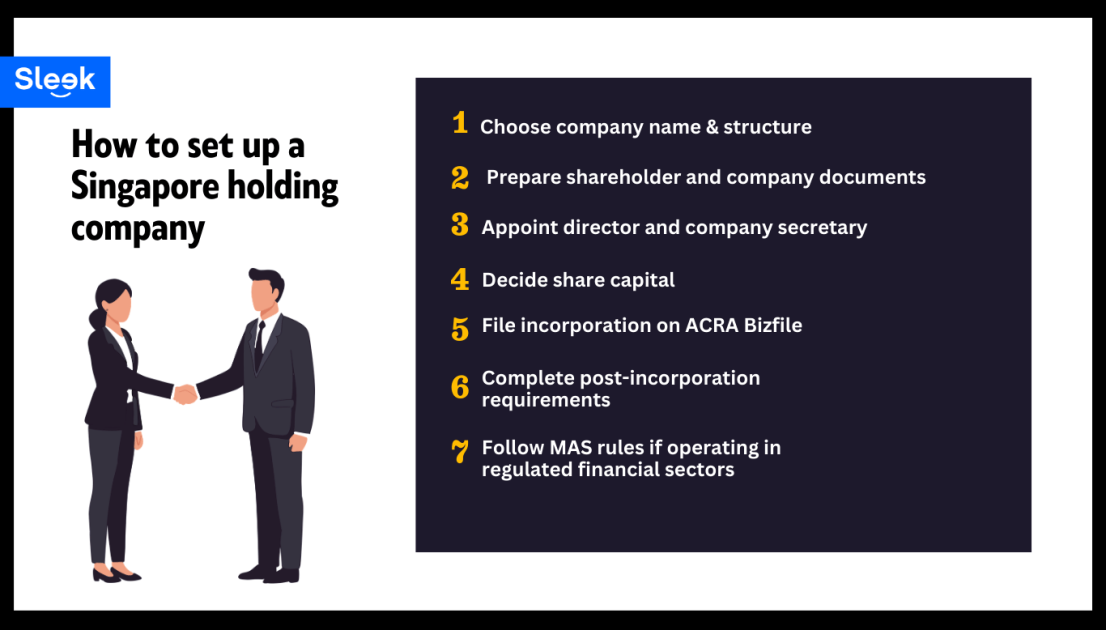
Step-by-step process for setting up a Singapore holding company
1. Choose your company name and structure
Decide how your holding company will sit above subsidiaries. For example, one parent company owns several operating companies. Check that your company name is available on Bizfile and confirm if any licences are required.
2. Prepare the basic documents
Get your shareholder details ready. This usually means identity documents, proof of address, KYC information, and a short business description. You will also need a registered office address in Singapore.
3. Appoint company officers
Every Singapore holding company must have at least one director who is a local resident. You must also appoint a company secretary within six months of incorporation.
4. Decide on share capital
You only need one issued share to start, often set at S$1. You can increase the share capital later if required.
5. File your incorporation on Bizfile
Incorporation is done online via ACRA Bizfile. You’ll pay S$15 for the name application and S$300 for registration, making S$315 in total. Most straightforward filings are approved quickly.
6. Complete post-incorporation tasks
After you incorporate, complete your Company Constitution and required registers, including the Register of Registrable Controllers. Apply for a Certificate of Residence (COR) to enjoy tax treaty benefits. Then, draft simple intragroup agreements such as service, loan, or IP licensing contracts.
7. Regulated exception
Planning to own a bank or insurer through your holding company? In Singapore, that means following special rules set by the Monetary Authority of Singapore (MAS). They differ from standard regulations, so expert guidance is a must.
Singapore holding company setup costs and timeline
Government fees
The official cost to incorporate a Singapore holding company is S$315. This includes S$15 for the name application and S$300 for registration.
Processing
Most straightforward applications are approved quickly on Bizfile. Delays can happen if further due diligence or approvals are required.
Annual costs
Plan a yearly budget for essentials. This includes a registered office address, company secretary services, annual return filing, and corporate tax filing. If your company does not qualify for the small company audit exemption, you must also factor in audit fees.
How Sleek helps with holding company formation in Singapore
A Singapore holding company is one of the best ways for founders to protect assets, simplify structures, and expand with confidence. But keeping up with incorporation steps and compliance rules can take valuable time away from running your business.
No. The corporate tax rate in Singapore is 17%. However, many companies pay less after exemptions and credits. Dividends from Singapore subsidiaries are tax-free for shareholders, and there is no dividend withholding tax. Foreign-sourced dividends may also be exempt under Section 13(8) if certain conditions are met.
Can foreigners own 100% of a Singapore holding company?
Yes. Singapore allows 100% foreign ownership. There are no restrictions on shareholders being non-residents.
Do I need a local director for a holding company in Singapore?
Yes. Every company in Singapore, including holding companies, needs at least one local resident director (a citizen, PR, or certain work pass holder). Sleek can help you meet this requirement safely and legally.
When are the filing deadlines for a Singapore holding company?
ACRA annual return: Must be filed within 7 months after the financial year end (FYE).
Corporate tax return (Form C-S/C): Due by 30 November each year. If you use approved software, IRAS may extend the deadline to 15 December, but plan for 30 November.
Do holding companies qualify for the Start-Up Tax Exemption (SUTE) in Singapore?
No. Investment holding companies are excluded from SUTE. They can still benefit from the Partial Tax Exemption (PTE).
Can a Singapore holding company also run a business?
Yes. A holding company can also engage in business activities if you choose a mixed structure. Many founders prefer to keep the holding entity separate for asset protection and compliance reasons.