














The most profitable business ideas in Singapore for 2026 include digital marketing agencies, e-commerce brands, IT and cybersecurity services, and niche consulting. Most founders register a company in Singapore as a private limited company for these, which costs S$315 in ACRA fees, and some ideas need a licence from the relevant agency before trading.
If you are wondering what business to start in Singapore, this guide will help. We have listed 20 of the most profitable business ideas in Singapore for 2026.
Each idea explains who it suits, what tools you need, and a Singapore-specific tip so you can picture yourself starting right away.

What are the 20 most profitable business ideas in Singapore?
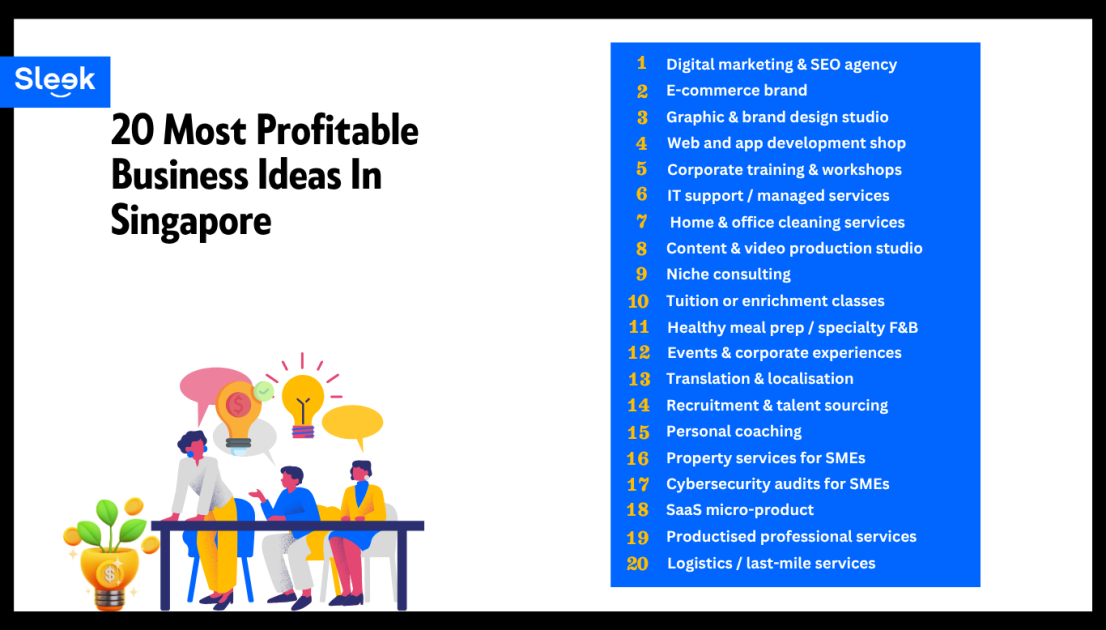
Wondering what kind of business works in Singapore today? This list of 20 ideas highlights what’s in demand and how you can take the first steps toward starting your own. They are the top business opportunities in Singapore we see founders pursue.
1. Digital marketing & SEO agency
What it is: You help companies grow online through SEO, ads, and social media marketing.
How it makes money: Clients pay monthly retainers and one-off campaign fees.
Who it suits: People who enjoy creative problem-solving, following digital trends, and showing results. Great for marketers who want independence.
Starter steps: Pick one niche, such as F&B or professional services, build a website with your services, and publish three case studies.
Example: An agency that supports consulting businesses with Facebook ads and SEO.
Tools to try: Google Ads, Ahrefs, Canva, Trello.
Singapore tip: Local SMEs trust referrals. Collect testimonials from early clients and display them on your site.
2. E-commerce brand (own product or private label)
What it is: Sell products online that you design, source, or brand as your own.
How it makes money: Profits come from product sales, with potential for recurring revenue if you offer subscriptions.
Who it suits: Creative people who spot trends and enjoy experimenting with products.
Starter steps: Start with one or two products, set up a Shopify store, and test demand with ads.
Example: A Singapore skincare brand selling eco-friendly masks and packaging them for regional markets.
Tools to try: Shopify, Stripe, Canva, and Google Analytics.
Singapore tip: Offer multi-currency checkout for cross-border customers in Malaysia
Disclaimer: If selling regulated products (such as cosmetics, food, or health products), ensure compliance with relevant authorities such as the Health Sciences Authority (HSA) or Singapore Food Agency (SFA) before selling.
3. Graphic & brand design studio
What it is: Create visual identities, logos, and marketing materials for businesses.
How it makes money: High-margin project fees with potential for long-term retainers.
Who it suits: Designers who enjoy helping brands stand out visually.
Starter steps: Build a small portfolio in one niche, like F&B menus or tech startup pitch decks.
Example: A studio that focuses on branding for Singapore cafes and lifestyle brands.
Tools to try: Adobe Creative Cloud, Figma, Canva Pro.
Singapore tip: Businesses value fast turnaround. Position yourself as responsive and reliable.
4. Web and app development shop
What it is: Build websites, apps, and digital tools for companies.
How it makes money: Clients pay for development projects and ongoing maintenance.
Who it suits: Developers who want to serve startups and SMEs with practical digital solutions.
Starter steps: Create a simple MVP package aimed at startups with limited budgets.
Example: A Singapore agency that builds appointment-booking apps for clinics.
Tools to try: WordPress, Webflow, GitHub, Slack.
Singapore tip: SMEs often ask for ongoing support. Bundle maintenance plans into your pricing.
5. Corporate training & workshops
What it is: Provide skill-based training sessions for companies.
How it makes money: Businesses pay per workshop or on a retainer for regular training.
Who it suits: Professionals who enjoy teaching and have deep expertise in a subject.
Starter steps: Define two flagship workshops, such as data literacy or AI productivity. Trainers may consider accreditation under SkillsFuture Singapore (SSG) if they plan to offer subsidised courses.
Example: A Singapore trainer offering GenAI workshops for financial services teams.
Tools to try: Zoom, Notion, Google Slides.
Singapore tip: Companies prefer trainers with practical case studies. Share success stories from previous sessions.
6. IT support or managed services
What it is: Provide outsourced IT setup, security, and troubleshooting for SMEs.
How it makes money: Monthly recurring fees per user or per device.
Who it suits: IT professionals who like structured, ongoing work.
Starter steps: Package a per-seat IT support plan with backups and security.
Example: An MSP that serves coworking spaces in Singapore.
Tools to try: Remote desktop software, antivirus tools, ticketing systems.
Singapore tip: Highlight cybersecurity in your offers. Many SMEs are under pressure to comply with partner requirements.
7. Home & office cleaning services
What it is: Provide professional cleaning for homes, offices, and co-working spaces.
How it makes money: Clients pay per session, per square foot, or through ongoing contracts.
Who it suits: People who are detail-oriented, good at managing teams, or comfortable with operational work.
Starter steps: Start small with residential cleaning, then expand into office cleaning with long-term contracts.
Example: A cleaning company serving co-working spaces and small offices in Singapore’s CBD.
Tools to try: Jobber, Google Calendar, WhatsApp Business.
Singapore tip: Businesses prefer cleaning packages they can count on. Keep pricing simple and service consistent.
8. Content & video production studio
What it is: Create videos and content for marketing, ads, and social media.
How it makes money: Per-project fees and monthly retainer plans.
Who it suits: Creators who enjoy storytelling and visual production.
Starter steps: Offer a monthly content sprint where you batch-produce videos and images.
Example: A studio in Singapore producing TikTok ads for F&B outlets.
Tools to try: Adobe Premiere Pro, Canva, CapCut.
Singapore tip: Many social media agencies promise too much. Show quick results and share local success stories.
9. Niche consulting as one of the most profitable business ideas
What it is: Provide specialised advisory in one field.
How it makes money: Hourly consulting, retainers, or project fees.
Who it suits: Experienced professionals who want a lean, low-overhead business.
Starter steps: Publish three teardown posts online to show expertise.
Example: An HR expert helping young companies in Singapore create review processes.
Tools to try: Google Docs, Notion, LinkedIn.
Singapore tip: Word of mouth is key. Share your expertise at small events to attract clients.
10. Tuition or enrichment classes
What it is: Teach academic subjects or enrichment skills to children and teens.
How it makes money: Parents pay per class or package.
Who it suits: Teachers or subject experts who enjoy working with kids.
Starter steps: Start with small groups or online workshops. If you plan to run a physical tuition or enrichment centre, you must register the courses and teachers with the Ministry of Education (MOE) and obtain the necessary approvals.
Example: A Singapore coding club for kids aged 8 to 12.
Tools to try: Zoom, Canva, Google Classroom.
Singapore tip: Parents want more than school subjects. Focus on skills like coding, design, or speaking.
11. Healthy meal prep/specialty F&B
What it is: A service delivering fresh meals tailored to health or lifestyle needs.
How it makes money: Customers pay per meal, sign up for weekly subscriptions, or pre-order in bundles.
Who it suits: Food lovers who enjoy cooking, experimenting with nutrition, or building a lifestyle brand around health.
Starter steps: Begin by testing a few meal options with preorders from friends and family, then promote them on Instagram or WhatsApp groups. As demand grows, look into commercial kitchens.
Example: A Singapore-based meal prep brand offering office lunch subscriptions for busy CBD professionals.
Tools to try: Instagram, Canva for menu design, GrabFood or Deliveroo for delivery partnerships.
Singapore tip: Apply for the SFA Food Shop Licence, such as a Food Processing Establishment Licence for central kitchens or a Food Shop Licence if operating a retail outlet. Check food-hygiene rules early.
12. Events & corporate experiences
What it is: A business that designs and runs events, workshops, or unique team-building activities for companies.
How it makes money: Corporate clients pay project fees, retainers for annual planning, and you can also earn through vendor commissions.
Who it suits: People who are organised, detail-oriented, and enjoy managing logistics while being creative.
Starter steps: Create curated event packages, such as cooking classes, wellness retreats, or themed workshops. Build a reliable network of vendors.
Example: A team-building company that offers cooking challenges and escape room events tailored to corporate groups.
Tools to try: Eventbrite for registration, Canva for proposals, and Google Sheets for vendor coordination.
Singapore tip: Singapore hosts lots of MICE events. Work with HR teams and present yourself as more than an event planner.
13. Translation & localisation
What it is: Provide translation and cultural adaptation for businesses expanding across Southeast Asia.
How it makes money: Charge per word, per project, or retainers for ongoing localisation needs.
Who it suits: Multilingual individuals or entrepreneurs who can build a network of skilled translators.
Starter steps: Start with two to three languages you can confidently deliver, then grow your network. Create a QA system to ensure quality.
Example: A service helping ecommerce stores translate product descriptions into English, Mandarin, Malay, and Tamil.
Tools to try: Smartcat for workflow, Grammarly for quality checks, Notion for project management.
Singapore tip: Accuracy is key in regulated industries. Market your service as translation plus compliance support.
14. Recruitment & talent sourcing
What it is: Help companies source and hire employees in niche areas such as finance, healthcare, or technology.
How it makes money: Earn placement fees for successful hires or charge companies on a monthly retainer for ongoing recruitment support.
Who it suits: Networkers who enjoy connecting people and have industry knowledge. Ideal for professionals transitioning from HR.
Starter steps: Focus on one hiring niche, such as fintech or healthcare. Build relationships with hiring managers and candidates.
Example: A boutique agency that specialises in placing cybersecurity professionals in Singapore startups.
Tools to try: LinkedIn Recruiter, JobStreet, Zoom for interviews, and Notion for candidate tracking.
Singapore tip: Starting a recruitment agency requires an Employment Agency Licence from MOM. Check the licence type and personnel registration before you begin marketing.
15. Personal coaching as one of the most profitable business ideas in Singapore
What it is: Offer structured one-to-one or group coaching programs to help people achieve goals in their career, health, or personal development.
How it makes money: Sell fixed-duration programs, packages of sessions, or group coaching cohorts.
Who it suits: Goal-oriented individuals who enjoy mentoring and motivating others. Works well for people with strong expertise in HR, leadership, or fitness.
Starter steps: Design a signature program, such as a six-week career accelerator or fitness reset. Collect testimonials to build trust.
Example: An executive coach in Singapore who supports startup founders with leadership challenges.
Tools to try: Zoom for sessions, Calendly for scheduling, Notion or Google Docs for resources.
Singapore tip: Networking groups like SGInnovate or entrepreneur communities are good places to meet potential clients. Word-of-mouth is very powerful.
16. Property services for SMEs
What it is: Help small and medium businesses move, renovate, or fit out their offices. Services often include planning, project management, and vendor coordination.
How it makes money: Charge project management fees, earn referral commissions from contractors, or offer end-to-end packages.
Who it suits: People with project management skills and connections to contractors or designers.
Starter steps: Start by offering relocation planning and gradually expand into renovation or design partnerships.
Example: A Singapore company helping SMEs plan efficient moves from co-working spaces to permanent offices.
Tools to try: Trello for task tracking, Slack for communication, and AutoCAD for design collaboration.
Singapore tip: Office space in Singapore moves quickly. Position your service as fast and stress-free to win over SMEs that need to expand fast.
17. Cybersecurity audits for SMEs
What it is: Review and strengthen the digital security of small businesses. Provide assessments, recommendations, and ongoing support.
How it makes money: Fixed-fee audits, monthly security packages, or project-based remediation plans.
Who it suits: IT professionals with cybersecurity knowledge who want to work with smaller businesses instead of large enterprises.
Starter steps: Design a clear entry-level audit package that SMEs can afford and upsell remediation services later.
Example: A firm that audits law firms in Singapore to ensure compliance with client data security requirements.
Tools to try: Nessus, Nmap, password managers, and Google Sheets for reports.
Singapore tip: Position your audits as a growth enabler. SMEs often need to prove security standards to secure bigger contracts.
18. SaaS micro-product
What it is: Build and sell a small software tool that solves one clear problem for a niche audience.
How it makes money: Monthly or annual subscriptions with minimal delivery costs.
Who it suits: Developers who enjoy building products more than consulting.
Starter steps: Identify one pain point in a specific industry and create a simple tool that fixes it. Focus on usability over features.
Example: A scheduling tool designed specifically for local gyms or tuition centres in Singapore.
Tools to try: AWS for hosting, Stripe for payments, Figma for design.
Singapore tip: Target industries that run on subscriptions, such as fitness studios or clinics. They are used to paying monthly and appreciate automation.
19. Productised professional services
What it is: Turn your expertise into ready-made digital products like templates, policy packs, or standard contracts.
How it makes money: Sell kits or packages repeatedly without needing to deliver services one by one.
Who it suits: Professionals in law, HR, finance, or operations who want scalable income.
Starter steps: Package your expertise into a digital kit that solves a common problem for SMEs.
Example: A lawyer selling HR policy templates that meet Singapore compliance standards. However, if that’s the case, ensure templates are positioned as general guidance and not legal advice, unless provided by a qualified legal professional.
Tools to try: Gumroad for sales, Notion for templates, Canva for design.
Singapore tip: SMEs in Singapore often look for affordable shortcuts. Position your kits as a way to save both money and compliance headaches.
20. Logistics / last-mile services
What it is: Provide delivery and logistics solutions in niche areas such as frozen food, fragile items, or return management.
How it makes money: Charge per delivery or earn long-term contracts with ecommerce businesses.
Who it suits: People with supply chain experience or entrepreneurs who can manage fleets and schedules.
Starter steps: Start small with one corridor, like cold-chain deliveries within Singapore, before scaling regionally.
Example: A service specialising in cold-chain delivery for F&B suppliers delivering to cafes and restaurants.
Tools to try: Route optimisation apps, WhatsApp Business for communication, and Google Maps for planning.
Singapore tip: The e-commerce market is booming. To differentiate from generic delivery companies, focus on reliability and speed.
Disclaimer: Ensure delivery vehicles meet Land Transport Authority (LTA) commercial vehicle regulations, and follow SFA food safety requirements if transporting food products.
Which of these ideas need a licence in Singapore?
Licensing is the step most likely to slow you down, so check it before you register. For anything not marked here, check with the relevant agency, and see our guide to business licences and permits.
| Idea | Licence needed? |
|---|---|
| Digital marketing, design, web and app, video, translation, coaching, SaaS | Not usually for the core service |
| E-commerce brand | Only for regulated products: HSA (cosmetics, health products) or SFA (food) |
| Corporate training | Not for private courses; SSG accreditation only for subsidised courses |
| IT support / managed services | Not usually; CSA licence if you offer managed security operations centre (SOC) monitoring |
| Cleaning services | Check NEA cleaning business licensing before taking on commercial contracts |
| Niche consulting | Not usually; regulated advice (for example financial advice) needs a MAS licence |
| Tuition or enrichment centre | Yes for a physical centre: MOE registration of courses and teachers |
| Meal prep / specialty F&B | Yes: SFA licence for central kitchens or food shops |
| Events & corporate experiences | Not for planning; permits may apply to specific events |
| Recruitment & talent sourcing | Yes: MOM Employment Agency Licence |
| Property services for SMEs | Not for project management; contractors you hire may need BCA or HDB registration |
| Cybersecurity audits | Yes if you offer penetration testing: CSA licence |
| Productised legal or HR services | Not usually; legal advice must come from a qualified lawyer |
| Logistics / last-mile | Vehicles must meet LTA rules; SFA rules apply to food transport |
How do you register a company for your business idea in Singapore?
Most founders register a private limited company once they’ve picked an idea, and the steps are the same whichever idea you choose.
| From idea to registered company: Torn between two ideas, or still deciding what business to start in Singapore? Pick the one you can test fastest with paying customers. Then (1) choose a structure: compare sole proprietorship vs Pte Ltd; (2) check licences for your idea; (3) pick the SSIC code that describes your business activity; and (4) register with ACRA, paying S$15 for the name and S$300 to register a Pte Ltd. Our guide on how to register a business in Singapore walks through each step. Running it alongside a job? Read about registering a side hustle first. |
Many of the most profitable small businesses in Singapore start as a Private Limited Company. It is the most popular structure because it is affordable, scalable, and trusted by customers and investors. Here is what you need to set one up.
- Minimum issued share capital: S$1 (you can increase this later).
- Directors and secretary: At least one Singapore-resident director; appoint a company secretary within 6 months of incorporation.
- Registered address: A local physical address (no P.O. Box).
- Government fees: S$15 for name application and S$300 registration fee (for a local company).
- Corporate bank account: Open after incorporation; a multi-currency account helps with regional sales.
Picked your idea? Register your company with Sleek
Sleek registers your company, sets up your company secretary and business account, all online. Local incorporation starts from S$700 with ACRA fees included, and founders based abroad can register from overseas with a nominee director.