Chee Koon has 13 years of experience handling visa applications to Singapore. He is Sleek's in-house expert to assist and advice businesses and foreigners with their Singapore Immigration issues.
Chee Koon's certifications include:
Singapore State Award: National Day Award "The Commendation Medal, 2020"
Certificate of Employment Intermediaries (CEI)
Bachelor of Economics (First Class Honors), Nanyang Technological University
For Chee Koon, there is no greater work satisfaction than to successfully obtain work passes approval for his clients, for them to work and stay in Singapore.
During his free time, Chee Koon enjoys cycling around and exploring the country.
96% customer satisfaction from 16,000+ survey responses.
In this article
Share this post
Facebook
LinkedIn
WhatsApp
Copy to clipboard
Key takeaways
The LTVP is issued by either ICA (for families of Singapore Citizens and PRs) or MOM (for families of EP/S Pass holders). The authority determines your fees, timeline, and work rights.
Validity of LTVP is 1–2 years and up to 3–5 years for LTVP+, which is only available to foreign spouses of Singapore Citizens.
Approval is never guaranteed. ICA and MOM assess each application individually, and incomplete documentation is the most common reason for rejection.
LTVP holders cannot work automatically. A Letter of Consent from a prospective employer is required, except for LTVP+ holders who may qualify for a Pre-approved LOC.
If your spouse, parent, or child wants to live with you in Singapore long-term, the Long-Term Visit Pass (LTVP) is likely the pass you need. It lets eligible family members stay in Singapore for 1–2 years at a time, and for some, it’s the first step toward Permanent Residence.
One thing to understand upfront: the LTVP is issued by two different authorities. ICA handles applications for family members of Singapore Citizens and PRs, while MOM covers certain family members of EP, S Pass, PEP, or EntrePass holders who don’t qualify for a Dependant’s Pass. The authority determines your fees, processing timeline, work rights, and renewal conditions. Hence, knowing which route applies to you matters before you submit anything.
This guide covers who qualifies under each pathway regarding this visa application, what documents you need, current fees, processing times, how LTVP differs from LTVP+ and the Dependant’s Pass, and what LTVP holders can and cannot do in Singapore in 2026.
What is the Long-Term Visit Pass (LTVP)?
What is the Long-Term Visit Pass (LTVP)
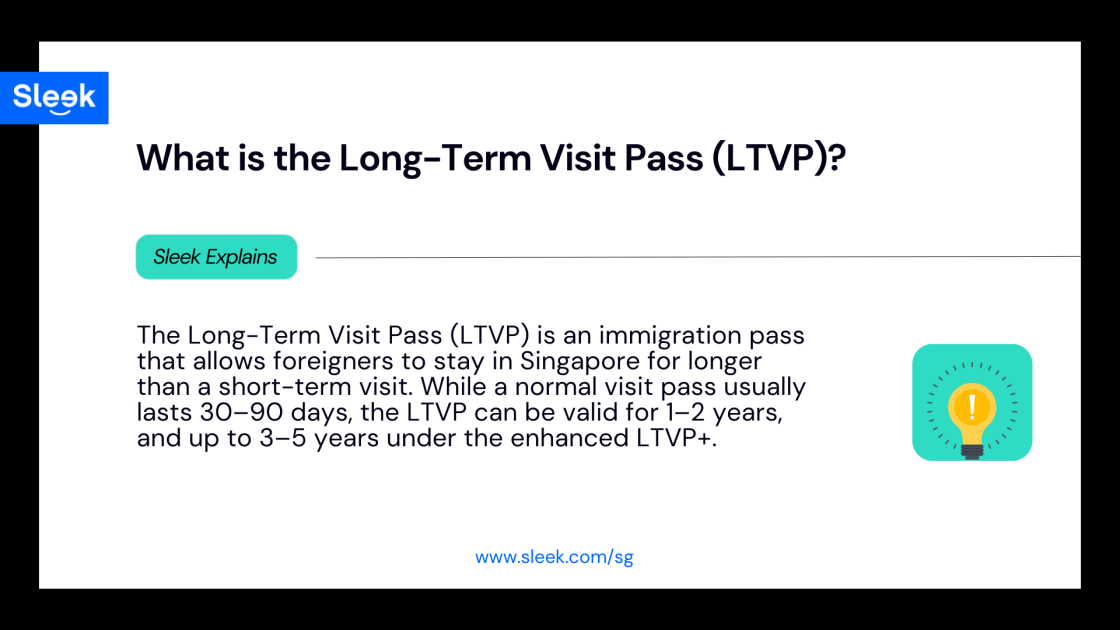
The Long-Term Visit Pass (LTVP) is a residence pass that allows eligible foreigners to stay in Singapore beyond a short-term visit. A standard visit pass lasts 30–90 days; the LTVP is valid for up to 2 years and is renewable, while the enhanced LTVP+ can extend to 3–5 years.
In Singapore, the LTVP is issued by two different authorities, depending on the sponsor:
ICA: for family members of Singapore Citizens (SCs) and Permanent Residents (PRs).
MOM: for certain family members of Employment Pass (EP), S Pass, PEP, or EntrePass holders who don’t qualify for a Dependant’s Pass.
The LTVP keeps families together. For example:
An EP holder’s common-law spouse may qualify for an MOM-issued LTVP.
A foreign spouse of a Singapore Citizen may apply for an ICA-issued LTVP or LTVP+, which can be a pathway to PR.
The issuing authority affects everything downstream: fees, the portal used, processing time, work rights, and renewal. Confirm which authority handles your case before applying.
Note: ICA does not endorse any private migration agency or commercial entity claiming to be a Singapore immigration specialist or partner for LTVP applications. Applications should go through official ICA or MOM channels.
Who can apply for a Long-Term Visit Pass Singapore?
Eligibility depends on the sponsor. It could be a Singapore Citizen (SC) /Permanent Resident (PR) or a work pass holder (EP, S Pass, PEP, EntrePass).
Eligibility is based on your relationship to the sponsor and the sponsor’s immigration status in Singapore.
1. ICA-issued LTVP (for families of SCs and PRs)
You may qualify if you are:
A foreign spouse of a Singapore Citizen or Permanent Resident
Unmarried child under 21 born within a legal marriage to, or legally adopted by, a Singapore Citizen or PR
A stepchild or handicapped child of a Singapore Citizen or PR
A parent of a Singapore Citizen or Permanent Resident (note: parents-in-law are not eligible)
Graduated from an approved Institute of Higher Learning, seeking employment in Singapore
Parent or grandparent of a child studying in Singapore on a Student’s Pass (only one applicant may apply)
A visitor seeking permission to give birth in Singapore
ICA assesses each application individually. Factors considered include family ties, economic contributions, qualifications, age, and commitment to settling in Singapore. Approval is not guaranteed even for spouses of Singapore Citizens. Strong documentation of the relationship and the sponsor’s financial stability meaningfully improves outcomes.
2. MOM-issued LTVP (for families of work pass holders)
You may qualify if you are:
A common-law spouse of an Employment Pass or S Pass holder
A stepchild or handicapped child of an EP or S Pass holder
Parent of an EP holder (if applying under sponsorship)
For EP holders sponsoring dependants, the minimum fixed monthly salary is S$6,000. To sponsor parents for an LTVP, EP holders must earn at least S$12,000 per month. Applications that fall near these thresholds attract tighter scrutiny from MOM and are among the most common reasons for rejection.
LTVP vs LTVP+: What is the difference?
Feature
LTVP
LTVP+
Who qualifies
Family members of SCs, PRs, or work pass holders (depending on authority)
Foreign spouses of Singapore Citizens only
Validity
ICA: 1–2 years · MOM: tied to main pass validity (up to 2 years)
Up to 3 years initially; renewable for up to 5 years
No automatic right to work. Employer must apply for a Letter of Consent (LOC)
May qualify for a Pre-approved LOC (PLOC), allowing work without securing a job first
Healthcare & benefits
Basic
Access to selected MediShield Life and social support schemes
PR pathway
Possible, not guaranteed
Stronger pathway — LTVP+ is commonly treated as a stepping stone to PR
Renewal stability
Subject to ICA/MOM review each time
More stable renewal process
If you are the foreign spouse of a Singapore Citizen, pursuing LTVP+ rather than a standard LTVP is generally worth doing. It offers more stability, better benefits, and a clearer route toward Permanent Residence.
How to apply for an LTVP in Singapore
Long-term visit pass applications are submitted online via the issuing authority’s portal.
How to apply for an LTVP in Singapore
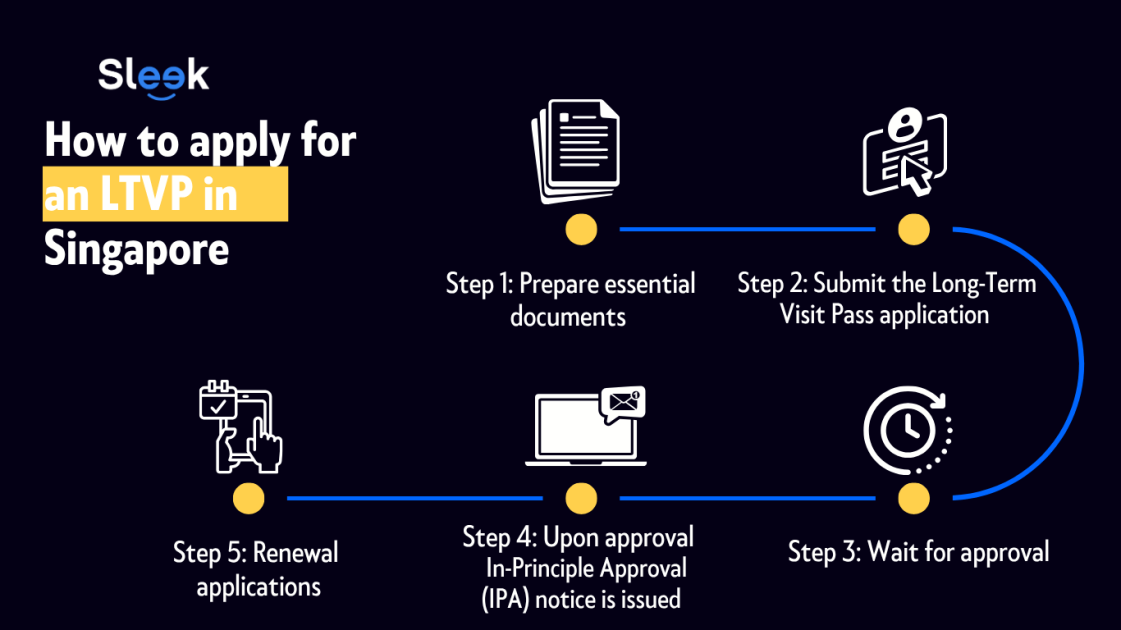
Step 1: Prepare documents
Sponsor’s NRIC, PR card, or EP details
Marriage or birth certificates (certified; non-English documents must be translated by a certified translator)
Proof of relationship: joint bank accounts, lease agreements, photographs, correspondence
Sponsor’s financial documents: recent payslips or bank statements
Passport copy of the applicant (main particulars page)
Medical report, if requested by ICA or MOM during processing
Step 2: Submit the Long-Term Visit Pass application
MOM-issued LTVP: Applied through MOM’s EP Online by the employer, main pass holder, or local sponsor. Submission fee: S$105. Issuance fee: S$225. Optional Multiple Journey Visa: S$30. Total: S$330–S$360. All fees are non-refundable.
Step 3: Wait for approval
MOM LTVP: approximately 3 weeks for EP/S Pass dependants; up to 8 weeks for PEP/EntrePass/EP Sponsorship cases.
ICA LTVP: Most applications take about 6 weeks. However, applications by the foreign spouse of a Singapore Citizen can take up to 6 months, unless the couple completed the Pre-Marriage LTVP Assessment (PMLA) before marriage, which shortens processing to approximately 6 weeks.
Step 4: Upon approval
MOM LTVP: S$225 (plus S$30 Multiple Journey Visa if needed)
ICA LTVP: S$60 (plus S$30 Multiple Journey Visa if needed)
Upon approval, an In-Principle Approval (IPA) notice is issued by email. The LTVP card is accessible via the Singpass app within 3 working days of payment, or through FileSG. If an in-person appointment is needed, book an e-Appointment at an ICA Services Centre. The applicant must be in Singapore when the pass is issued.
Step 5: Renewal
Renewal applications should be submitted at least 3 months before the pass expires. Any remaining validity on the current pass is not carried forward. MOM-issued LTVPs must be renewed before the main pass holder’s pass expires. If the main pass is cancelled, all associated LTVPs are cancelled simultaneously, and the family member must leave Singapore or secure an alternative pass.
Insights
What is the PMLA?
The Pre-Marriage LTVP Assessment is an ICA programme for couples where one party is a Singapore Citizen intending to marry a foreign national. Completing it before the marriage not only shortens processing time significantly, but also signals to ICA that the relationship has been assessed early. If PMLA applies to your situation, check ICA's website before proceeding with the standard LTVP application.
LTVP holders cannot work in Singapore automatically. Work authorisation is separate, and the rules differ significantly depending on your pass type.
ICA-issued LTVP/LTVP+ (spouses and children of SCs/PRs)
LTVP or LTVP+ holders who are the spouse or unmarried child under 21 of a Singapore Citizen or PR can apply for a Letter of Consent (LOC) to take up employment. The prospective employer makes the application. The LOC for this category is not tied to qualification or salary thresholds, does not count towards foreign-worker quotas, and is generally renewable alongside the LTVP.
LTVP+ holders may additionally qualify for a Pre-approved LOC (PLOC), which allows them to seek work before having a confirmed job offer; a meaningful advantage over the standard LOC route.
MOM-issued LTVP (families of work pass holders)
A prospective employer must apply for an LOC before the LTVP holder can begin work. The LOC is employer-specific: if employment ends, a new LOC is required for the next role.
Important distinction
LTVP holders can become directors and shareholders of a Singapore company without a Letter of Consent. However, drawing a salary or director’s fee from that company does require authorisation, a distinction that catches families out at renewal.
Parents of EP holders
LTVPs issued to parents of EP holders generally do not carry employment rights. Working would require a separate work pass.
Benefits and limitations of the LTVP
Benefits:
Live with family in Singapore on a stable, renewable basis
Access to MOE schools for children (subject to place availability)
Access to private healthcare
For LTVP+ holders: access to selected MediShield Life schemes and a clearer pathway to PR
Can be a director or shareholder of a Singapore company (without LOC)
Pathway to Permanent Residence, particularly for spouses of Singapore Citizens on LTVP+
Limitations:
No automatic right to work. LOC required and is employer-specific
Approval and renewal are at the discretion of ICA, and MOM is not guaranteed
If the main pass holder’s work pass is cancelled, the associated LTVP is cancelled simultaneously
Strong and ongoing documentation of the relationship is required at each renewal
Parents of EP holders face a higher sponsorship threshold (S$12,000/month) and do not have work rights on the LTVP
How Sleek helps with Long-Term Visit Pass Singapore
Immigration paperwork in Singapore is detailed, and small documentation gaps are one of the most common reasons LTVP applications are delayed or rejected. At Sleek, our immigration specialists support individuals and families at every stage:
Confirming whether ICA or MOM is the right pathway for your situation
Reviewing your documents for completeness before submission, so nothing gets missed
Submitting and tracking your application on your behalf
Advising on renewals, pass conditions, and next steps if you receive a rejection
We handle LTVP, LTVP+, Dependant’s Passes, Employment Passes, and more. So whether you’re bringing a spouse, a parent, or a child, you don’t have to figure it out alone.
Bring your family to Singapore with confidence. Apply for LTVP with Sleek!
The standard LTVP is valid for 1–2 years and is renewable. The LTVP+, available only to foreign spouses of Singapore Citizens, can be granted for up to 3 years initially and renewed for up to 5 years. Validity for MOM-issued LTVPs is typically tied to the main pass holder’s pass duration.
Can I apply for Permanent Residence (PR) while on an LTVP in Singapore?
Yes. Being on an LTVP does not disqualify you from applying for Singapore PR through ICA. Spouses of Singapore Citizens on LTVP or LTVP+ are among the more common PR applicants. PR is not guaranteed, and the process typically takes several months. Holding an LTVP+ generally strengthens a PR application compared to a standard LTVP.
Is the LTVP guaranteed for foreign spouses of Singapore Citizens?
No. ICA assesses each application individually based on factors including family ties, economic contributions, qualifications, age, and commitment to settling in Singapore. Even for spouses of Singapore Citizens, approval is not automatic. Applications with strong relationship documentation and complete paperwork have better outcomes. Completing the PMLA before marriage can also improve processing speed.
What is the difference between an LTVP and a Dependant’s Pass in Singapore?
The Dependant’s Pass (DP) is for legally married spouses and children under 21 of EP or S Pass holders earning at least S$6,000/month. The LTVP covers family members who don’t qualify for a DP, such as common-law partners, stepchildren, or parents. The key practical differences: DP holders had access to employment via LOC (discontinued in 2021 for new DP holders), while eligible LTVP holders issued by ICA can still obtain an LOC. ICA-issued LTVPs are generally for families of Singapore Citizens and PRs; MOM-issued LTVPs serve families of work pass holders.
How much does the LTVP cost in Singapore in 2026?
ICA-issued LTVP: S$45 (submission) + S$60 (issuance) = S$105 total, plus an optional S$30 for a Multiple Journey Visa. MOM-issued LTVP: S$105 (submission) + S$225 (issuance) = S$330 total, plus an optional S$30 MJV. All fees are non-refundable regardless of outcome.
What happens to my LTVP if the main pass holder loses their job?
If the main pass holder’s EP or S Pass is cancelled, the associated LTVP is cancelled simultaneously. The LTVP holder must leave Singapore or secure an alternative pass. Families in this situation should act quickly. The window to arrange an alternative is limited. ICA-issued LTVPs tied to Singapore Citizens or PRs are not affected by employment changes.