Chee Koon has 13 years of experience handling visa applications to Singapore. He is Sleek's in-house expert to assist and advice businesses and foreigners with their Singapore Immigration issues.
Chee Koon's certifications include:
Singapore State Award: National Day Award "The Commendation Medal, 2020"
Certificate of Employment Intermediaries (CEI)
Bachelor of Economics (First Class Honors), Nanyang Technological University
For Chee Koon, there is no greater work satisfaction than to successfully obtain work passes approval for his clients, for them to work and stay in Singapore.
During his free time, Chee Koon enjoys cycling around and exploring the country.
A Letter of Consent (LOC) is MOM approval allowing an existing pass holder to work or run a company without a separate work visa, whereas an Employment Pass (EP) is a standalone work visa tied to an employer and a minimum salary.
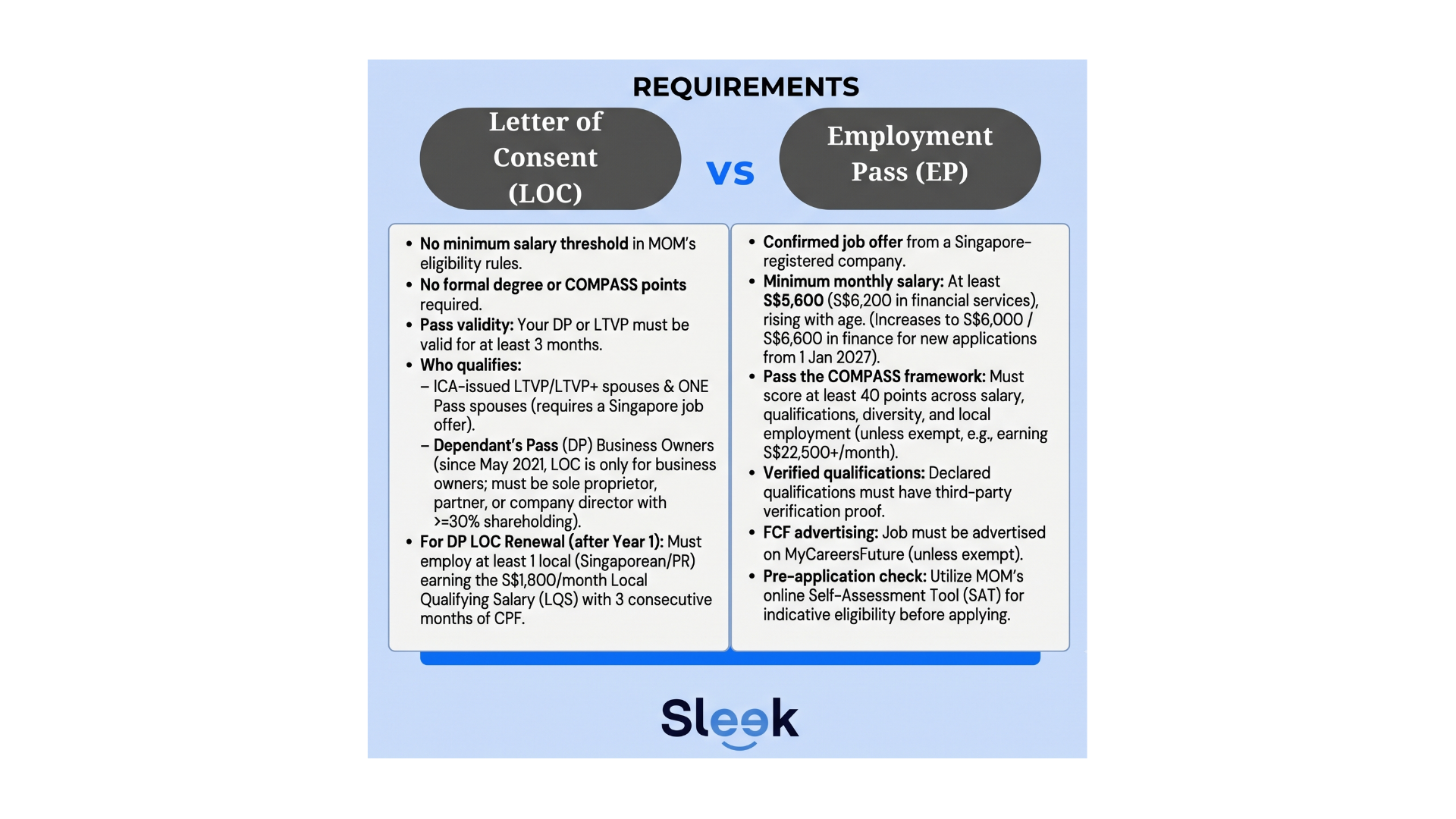
Who qualifies for an LOC: ICA-issued LTVP/LTVP+ spouses, ONE Pass spouses, and Dependant's Pass (DP) business owners (minimum 30% shareholding).
Who qualifies for an EP: Foreign professionals and salaried DP holders earning at least S$5,600/month.
What is LOC in Singapore? A Letter of Consent (LOC) is MOM permission that lets certain foreigners work or run a business here without a separate work pass. Which route you use depends on your pass: a Long-Term Visit Pass (LTVP), a Dependant’s Pass (DP) or a ONE Pass.
Since 1 May 2021, DP holders who want a salaried job can no longer use an LOC and need their own work pass, which Sleek’s Employment Pass application service can prepare. DP holders who own a business can still apply for an LOC, and so can eligible LTVP spouses.
An LOC in Singapore is a Letter of Consent from MOM that lets a foreigner work, or run a business, without a standard work pass such as an Employment Pass. The LOC meaning depends on your pass: LTVP holders use it to work for an employer, while DP holders can generally use it only to run their own business. It ends when the underlying pass expires or is cancelled.
An LOC is not the same as a Pre-approved Letter of Consent (PLOC). LTVP holders can request a PLOC when they apply for or renew the LTVP, so they can work without finding a job first.
Who can still get an LOC after the 2021 change?
Three groups can still get a Letter of Consent in Singapore: ICA-issued LTVP or LTVP+ holders who are spouses or children of Singapore Citizens or PRs, DP holders who own an ACRA-registered business, and spouses of ONE Pass holders. DP holders who want a salaried job cannot, because since 1 May 2021 they need their own work pass (MOM’s 2021 announcement).
LTVP or LTVP+ holder issued by ICA: you are eligible if you are married to a Singaporean or PR, or are their unmarried child under 21 and hold an LTVP. The LTVP Letter of Consent needs a job offer and your employer applies for it, and our Long-Term Visit Pass guide covers the pass itself (see MOM’s LOC eligibility for LTVP holders).
DP holder: if you want to work for an employer, your employer applies for an EP, S Pass or DP Work Permit instead (MOM guidance on DP holders working). If you own a business, you can apply for an LOC for Dependent Pass holders who are business owners. If your sponsor holds a ONE Pass, a spouse can get an LOC to work or run a business (MOM on ONE Pass dependants).
Anyone else: if you do not hold an ICA-issued LTVP or LTVP+, you cannot work on an LOC. You need an EP, S Pass or Work Permit on your own merit.
Letter of consent vs employment pass: what is the difference?
A Letter of Consent lets certain pass holders work or run a business without a work pass, while an Employment Pass is a work pass for foreign professionals with a job offer. An LOC has no qualifying salary in MOM’s eligibility rules, whereas an EP needs a minimum salary and, for most candidates, a COMPASS pass.
The table sets out the main differences, based on MOM’s key facts for each pass.
Criterion
Letter of Consent (LOC)
Employment Pass (EP)
Who it is for
ICA-issued LTVP/LTVP+ spouses and children of Singaporeans and PRs; DP holders who own a business; spouses of ONE Pass holders
Foreign professionals, managers and executives with a job offer
Who applies
Your employer (LTVP route); you or an agent (DP business owner)
Your employer or an appointed employment agent
Salary threshold
None in MOM’s eligibility rules
S$5,600 a month (S$6,200 in financial services), rising to S$6,000 (S$6,600) for new applications from 1 Jan 2027
Levy or quota
None for the LTVP LOC and the PLOC
No foreign worker levy or quota
Tied to
Your LTVP or DP; it ends when that pass expires or is cancelled
Your employer
Duration
LTVP route: set by your employer’s application, up to LTVP expiry. DP business owner: first LOC up to 1 year, renewals up to DP expiry
First pass up to 2 years, renewals up to 3 years
The core distinction is dependency. An LOC is anchored to your LTVP or DP and the status behind it, while an EP is anchored to a job offer from a Singapore employer.
What does an Employment Pass require?
An Employment Pass needs a job offer, a fixed monthly salary of at least S$5,600 (S$6,200 in financial services) and, unless exempt, 40 points on the COMPASS framework. The salary floor rises with age and moves to S$6,000 (S$6,600) for new applications from 1 January 2027 (MOM’s EP eligibility page).
Candidates earning at least S$22,500 a month are exempt from COMPASS, and your employer must advertise the job on MyCareersFuture first. A first EP lasts up to 2 years and renewals up to 3 years, with no foreign worker levy or quota (MOM’s EP key facts). See how to apply for an Employment Pass for the full process.
Can a Dependant’s Pass holder start or run a business?
Yes. A DP holder can apply for an LOC if they are a sole proprietor, a partner, or a company director with at least 30% shareholding in an ACRA-registered business (MOM’s eligibility rules). This LOC for Dependent Pass holders is separate from the rule that stops DP holders working as employees on an LOC.
The steps for a first application are:
Register your business with ACRA.
Check that your DP has at least 3 months of validity left, and renew it first if not.
Submit an online request to MOM, which replies within 1 week.
If approved, apply for the LOC through the EP eService or an employment agent, with your business turnover information up to date.
For an ICA-issued LTVP or LTVP+ holder, the employer or its appointed agent applies for the LOC once you have a job offer. Your LTVP must have at least 3 months of validity, and you can start work only after your employer has received the LOC (MOM’s LTVP LOC eligibility). You can also request a Pre-approved LOC when you apply for or renew the LTVP.
A PLOC lets you work without finding a job first, but it does not allow self-employment, and some occupations such as journalist or editor still need an employer-applied LOC (MOM’s PLOC key facts, MOM’s LTVP work guidance).
The LTVP Letter of Consent stops when you leave the employer, and neither it nor the PLOC attracts a foreign worker levy or quota (MOM’s LTVP LOC key facts).
Wondering how to apply for a Letter of Consent in Singapore as a DP business owner? The steps are in the section above. If you later want an Employment Pass instead, read our guide to switching from an LOC to an EP.
Which pass do you need: LOC or Employment Pass?
Choose an LOC if you hold an eligible LTVP or DP, or are a ONE Pass spouse, and want to run a business or take a job in the cases above. Choose an Employment Pass if you are a foreign professional with a Singapore job offer and meet the salary and COMPASS rules. In a letter of consent vs employment pass decision, your current pass usually settles it, and the LOC meaning above tells you whether you qualify.
You want to run your own business: if you hold a DP, register the business with ACRA first, then apply for the business-owner LOC. No job offer is needed.
You have a job offer and hold a DP: your employer applies for an EP, S Pass or DP Work Permit. A DP Work Permit has no minimum qualifying salary, but it is subject to the Work Permit quota and levy.
You hold an ICA-issued LTVP or LTVP+: you can work through a PLOC or an employer-applied LOC, so you do not need an Employment Pass.
What can go wrong with an LOC or EP application?
Most LOC problems come from renewal conditions or a lapsed underlying pass, while most EP problems come from salary, COMPASS points or documents. Check each condition before you apply, because each pass has its own failure points.
LOC pitfalls
No qualifying local employee at renewal: a DP business owner’s LOC renewal needs at least one Singaporean or PR earning at least the Local Qualifying Salary of S$1,800 a month, with 3 consecutive months of CPF contributions (see MOM on the LQS).
The DP lapses first: the LOC stops being valid when the DP is cancelled or expires, so renew the DP before the LOC.
The business becomes inactive: the LOC also stops being valid, and you must still cancel it within 1 week.
The wrong role: MOM’s business-owner rules cover sole proprietors, partners and directors with at least 30% shareholding, not salaried roles.
EP pitfalls
Salary below the age-adjusted floor: the S$5,600 minimum rises with age, up to S$10,700 at age 45 and above (S$6,200 up to S$11,800 in financial services).
Too few COMPASS points: unless exempt, an application needs 40 points.
Skipping the job advertisement: employers must meet the Fair Consideration Framework advertising rule on MyCareersFuture before a new EP application.
Missing verification proof: if you claim COMPASS points for a qualification, you must submit verification proof for it.
What LOC and EP changes apply from 2026?
Two changes matter for current and future applicants. The Local Qualifying Salary is now S$1,800 a month, which affects LOC renewals for DP business owners. EP qualifying salaries rise to S$6,000 (S$6,600 in financial services) for new applications from 1 January 2027.
LQS at S$1,800: any local employee you rely on for a DP business-owner LOC renewal must earn at least this amount, so check payroll before you renew.
EP salary floors in 2027: the higher floors also apply to renewals of passes expiring from 1 January 2028, so founders paying themselves close to S$5,600 should plan ahead.
How can Sleek help with your LOC or Employment Pass?
Which pass fits comes down to one question: are you running your own business, or joining someone else’s? For DP holders who want to be founders, the LOC route is open. For foreign professionals with a job offer, the Employment Pass is the standard route.
Sleek is a licensed MOM employment agency (Licence No. 17S8937) and handles both the company registration and the work pass application. Our LOC service is S$450 for a new application or a renewal, with no MOM fees, and our EP service starts at S$1,088 for a new application, which includes the S$330 MOM fee.
Yes, for the business-owner LOC. You can renew it when you renew your DP, up to 6 months before it expires, if your DP has at least 3 months of validity left. Your business must also have hired at least one Singaporean or PR earning at least the Local Qualifying Salary, now S$1,800 a month, with 3 consecutive months of CPF contributions (MOM’s renewal rules, MOM on the LQS).
Does an LOC holder need a foreign worker levy or quota?
No. MOM states that no foreign worker levy or quota is required for the LOC for ICA-issued LTVP or LTVP+ holders and for the Pre-approved LOC, and the same applies to the Employment Pass. For employer CPF obligations on a particular worker, check with the CPF Board.
Can my spouse work on my Employment Pass?
No. An Employment Pass does not give a spouse the right to work, although it lets you bring eligible family members on a Dependant’s Pass. To work, your spouse needs their own pass, or an LOC if they run a business or you hold a ONE Pass.
Can I apply for an LOC if my spouse holds an S Pass?
Yes, if you hold a DP and own an ACRA-registered business as a sole proprietor, partner or director with at least 30% shareholding. MOM’s business-owner eligibility rules do not depend on which pass your sponsor holds. You still cannot use an LOC to work as an employee.
RELATED READS
Hey! I'm Jaslyn.
Tell us what you need and an advisor will reach out shortly
Hey! I'm Jaslyn.
Leave our friendly team a message and we'll be in touch in no time