From 9 June 2025, stricter rules come into effect for Corporate Service Providers (CSPs) in Singapore. If your business uses services like incorporation, nominee directors, secretarial support, or registered addresses, these changes directly affect you.
The goal? Close loopholes, increase transparency, and curb financial crimes like money laundering.
If you’re thinking, “I already have a company secretary, I should be okay”, read on. Because if your CSP isn’t registered, your filings, nominee arrangements, and even your company’s legal standing could be at risk. Importantly, your business may also be held liable for engaging an unregistered provider, even if the compliance lapse wasn’t your fault.
What is the Corporate Service Providers (CSP) Act?
The CSP Act requires businesses providing corporate services in or from Singapore to register with ACRA. This includes incorporation, nominee appointments, secretarial services, registered address, and admin or accounting support. Companies hiring CSPs must ensure compliance, as non-registered providers face penalties such as fines or imprisonment for breaches.
New compliance obligations for Corporate Service Providers
CSP Compliance Deadlines
1. Mandatory ACRA registration
All entities offering corporate services in or from Singapore must register as CSPs with ACRA.
Non-registration penalties: Up to S$50,000 or 2 years’ imprisonment, with an additional S$2,500/day for continued offence after conviction.
Using an unregistered CSP may expose your business to compliance risks, enforcement actions, and delays in filings.
2. Anti-money laundering (AML/CFT/PF) compliance
Registered CSPs must meet stringent obligations to combat illicit activity:
Conduct Customer Due Diligence (CDD) before delivering services
Monitor ongoing risks and report suspicious transactions
Maintain internal AML/CFT/PF policies and staff training
Face fines up to S$100,000 per breach, including on senior management
3. Nominee director and shareholder rules
Nominee appointments are now under the spotlight. If your CSP helps with nominee directors or shareholders:
They must assess nominees as “fit and proper” (no criminal past, not bankrupt, etc.)
They must disclose the nominee status to ACRA
The identity of nominators must be recorded, and will be available to public authorities (though not visible to the public)
4. Statutory register maintenance
While the legal responsibility for maintaining statutory registers lies with the company, foreign company, or LLP, CSPs often assist clients in keeping the following records accurate and up to date:
Register of Registrable Controllers (RORC)
Registers of Nominee Directors and Shareholders
Entities must now confirm and update these registers annually, starting from the date of incorporation or registration.
Penalties: Non-compliance could attract fines up to S$25,000 per offence.
What happens if you ignore the new CSP rules?
Think it’s your CSP’s job to worry about compliance? If you’re using an unregistered Corporate Service Provider after 9 June 2025, your business could be on the hook, even if you’re not the provider.
Risks for your business if your CSP is unregistered:
Your nominee appointments and registers may not be legally compliant if managed by an unregistered CSP
Persistent non-compliance may trigger regulatory scrutiny and potential enforcement action by ACRA
You may face delays in filings or audits
Banks and regulators may flag you as high-risk
You might have to redo KYC/AML checks or resubmit compliance documents
Investors or partners may lose confidence due to reputational risk
Risks for CSPs (and why it still affects you):
CSPs operating without ACRA registration face fines up to S$50,000 and up to 2 years’ jail
Even registered CSPs may be penalised for breaching AML/CFT/PF obligations, including their senior management
Bottom line: If your CSP is non-compliant, you still bear the consequences. Always verify their registration and understand what they’re responsible for.
How to stay compliant with the Corporate Service Providers (CSP) Act
Here’s the short version: Check your CSP. Fix any gaps. Stay out of trouble. Find out how:
1. Verify your CSP’s registration
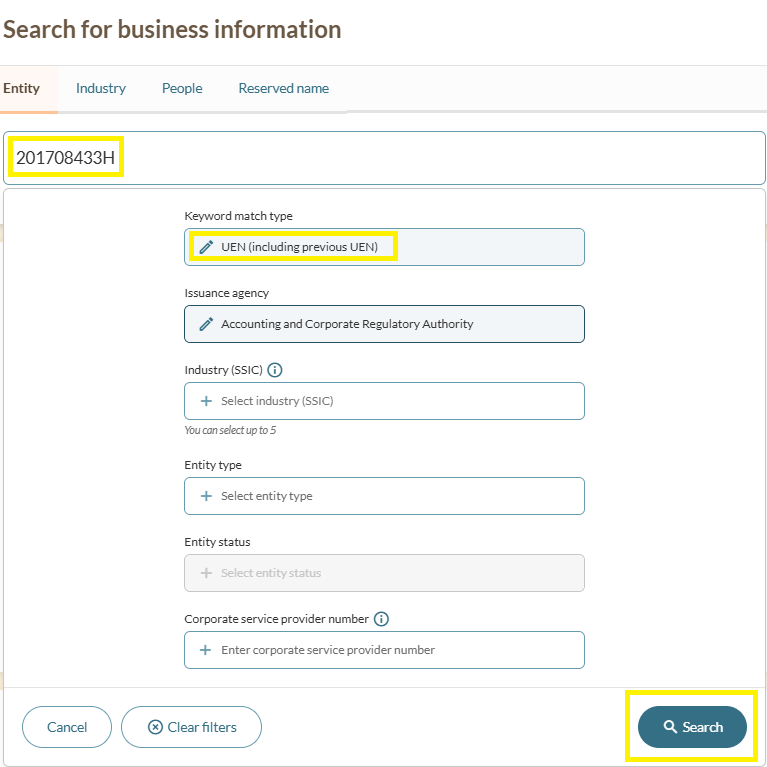
Visit www.bizfile.gov.sg to check the registration status of your corporate service provider.
Bizfile check csp – step 1
Use your provider’s business name or UEN.
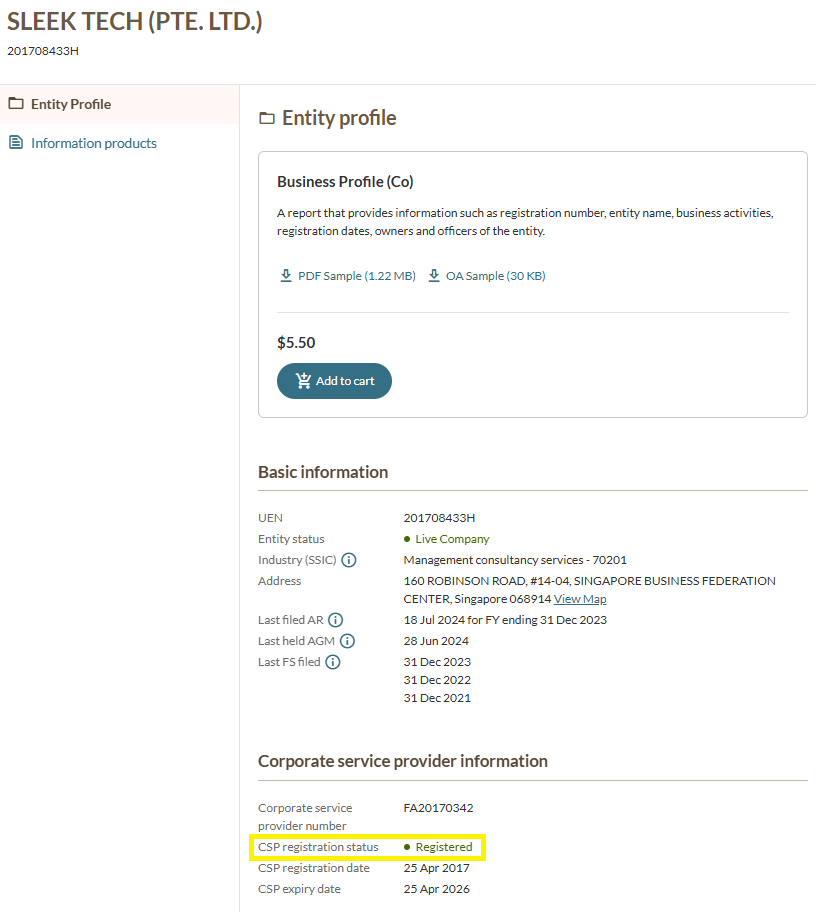
bizfile check csp – step 2
On the search results page, click “More information”.
bizfile check csp – step 3
Check that they’re:
Marked as “Registered”
Not suspended or penalised
bizfile check csp – step 4
Note: If they’re not listed, that’s your red flag.
2. Review your contracts
If your provider is unregistered, update or exit the arrangement. You don’t want to be held accountable for their non-compliance.
3. Submit your Customer Due Diligence (CDD) info
Providing full and timely CDD information is mandatory under Singapore’s AML/CFT/PF laws. Your CSP cannot proceed with services until this is completed, so be prepared to submit valid ID, ownership details, and business purpose documentation when requested.
4. Ask about their AML policies
Quiz your CSP on their processes:
How do they flag suspicious activity?
What’s their risk-rating system?
Who monitors compliance?
If they fumble the answers, you’re absorbing risk by association.
5. Keep registers updated
Confirm with your CSP that RORC and nominee registers are maintained annually.
Bonus tip: Don’t just comply, help clean up the industry
If you spot an unregistered CSP, report them to ACRA. It helps protect your own business and raises compliance standards across the board.
CSP compliance checklist
Requirement
Ask Yourself
What to Do
ACRA Registration
Is my CSP registered?
Search the ACRA CSP directory
Nominee Services
Are nominees involved?
Confirm due diligence and nominee filings
CDD Done
Have I submitted full ID and info?
Provide documents upfront
Registers Updated
Are our RORC and nominee registers updated?
Check with CSP and confirm annually
AML Policies
Has my CSP shown proof of AML compliance?
Ask for their internal policy or declaration
Contract Review
Do we have a clear service agreement?
Confirm coverage, risks, and termination
How Sleek helps you stay compliant
This isn’t just another regulatory update. It’s a line in the sand for compliance in Singapore. Businesses that stay ahead will run smoothly. Those that don’t? Risk fines, rejections, and reputation damage.
If you’re unsure where your business stands, don’t wait, talk to your CSP or reach out to Sleek today.
At Sleek, we’re an ACRA-registered CSP, and we’ve built our systems to keep you compliant at every step:
We run full AML/CFT/PF checks on all clients
We only appoint fit and proper nominee directors
We keep your statutory registers up to date
We manage all your ACRA filings for you
Already with Sleek? You’re good to go.
Not with us yet? Talk to us.
We’ll help you clean up any issues before they become penalties.
Any business providing corporate services (e.g., incorporation, nominee appointments, registered office) in or from Singapore, even without filing documents, must register.
No, there is no grace period. All businesses offering corporate services must already be registered as of 9 June 2025. Operating without registration may lead to fines of up to S$50,000 or imprisonment.
Yes, nominee status will appear in the company’s BizFile business profile. However, the identity of the nominator will only be accessible to public agencies, not the general public.
You may face penalties of up to S$25,000 per offence. There are no grace periods or leniency provisions. ACRA now expects full compliance from the outset. Incomplete or outdated RORC or nominee registers could lead to enforcement actions, audits, or reputational damage.