Ismarina is the Head of Country at Sleek Singapore, where she leads strategic growth, operational excellence, and service delivery. With over 20 years of experience across finance, compliance, and business leadership, she oversees Sleek’s full range of services. These include CFO advisory, accounting, tax, GST, payroll, corporate secretarial, immigration, and client support.
She is known for her clarity in leadership and strength in execution. Ismarina has led large, cross-functional teams in both in-person and virtual settings. She has delivered strong P&L outcomes, scaled operations, and built trusted relationships across businesses of all sizes.
Ismarina combines practical insight with academic depth. She holds an MSc (Hons) in Management, is a Fellow CPA, an ASEAN CPA, and a CIMA-qualified Chartered Global Management Accountant. Her expertise covers project management, construction and nonprofit accounting, judicial management, and liquidation. Her experience running an accounting firm and offering CFO services gives her a sharp understanding of what clients need to grow and stay ahead.
She is also a committed mentor who supports her team’s growth with care and purpose. Before Sleek, she held senior roles at the Project Management Institute and the Football Association of Singapore. She played a key role in leading digital transformation and shaping regional strategy.
Outside of work, you’ll find her immersed in books, sewing projects, and knitting, or cheering on her family at sporting events. She brings the same passion for excellence to everything she does, both professionally and personally.
Cloud accounting in Singapore runs your books on internet-based software like Xero instead of spreadsheets or a desktop program. You get real-time figures, automatic bank feeds, multi-user access and a full audit trail, all reachable from any browser. For a growing local business, it also keeps your GST records tidy and makes you InvoiceNow ready for IRAS e-invoicing.
What it is
Accounting software hosted online and reached through a browser
Typical cost
Sleek accounting from S$75 a month (list price), priced by annual expenses
Setup time
A few days to set up the software, connect bank feeds and import opening balances
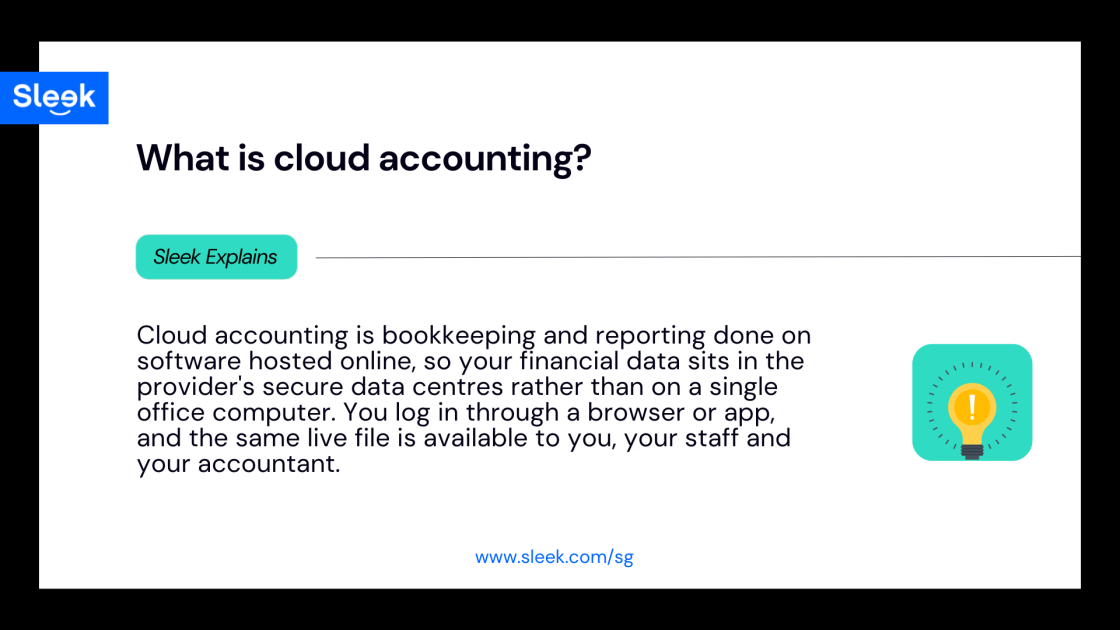
Cloud accounting is bookkeeping and reporting done on software hosted online, so your financial data sits in the provider’s secure data centres rather than on a single office computer. You log in through a browser or app, and the same live file is available to you, your staff and your accountant.
Sleek runs client books on Xero, where it holds Xero Platinum partner status, alongside its own SleekBooks platform.
How is cloud accounting different from spreadsheets and desktop software?
The difference is where the data lives and how it updates. A spreadsheet is a static file that someone enters and reconciles by hand, and desktop software ties your records to one machine with manual backups.
Cloud accounting updates in real time, syncs transactions automatically and lets several people work in one file at once. The table below shows how the three approaches compare.
Feature
Spreadsheets
Desktop software
Cloud accounting
Real-time figures
No
Limited
Yes
Automatic bank feeds
No
Sometimes
Yes
Multi-user access
Hard
No
Yes
Access from anywhere
No
No
Yes
Audit trail
Manual
Limited
Built in
InvoiceNow ready
No
Varies
Common
What are the benefits of cloud accounting for a Singapore business?
The main benefit is current numbers you can trust, without the manual entry that eats a founder’s week. Bank feeds automatically pull transactions, so reports like your balance sheet and cash flow statements update as money moves.
Take a month-end close. On spreadsheets, you wait for statements, then key in and reconcile every line. On cloud software, the entries are already there, GST is applied at 9% as you invoice, and IRAS-ready records build themselves.
Multi-user access means your accountant works in the same file as you, and a built-in audit trail records who changed what and when.
Tip
Connect your bank feeds before importing months of history. Once the feed is live, most transactions reconcile themselves, and you avoid double entry.
Is your software InvoiceNow ready, and why does it matter now?
InvoiceNow readiness matters now because e-invoicing through IRAS is no longer optional for new GST registrants. Since November 2025, newly incorporated companies that register for GST voluntarily must transmit invoice data to IRAS through the InvoiceNow network.
From April 2026, that requirement covers all new voluntary GST registrants, regardless of incorporation date, as a condition of registration. InvoiceNow runs on the international Peppol standard, and most cloud platforms, including Xero, are already InvoiceNow ready.
Still piecing together your numbers from spreadsheets and bank statements every month-end?
What should you look for in a cloud accounting platform in Singapore?
For a Singapore company, pick a platform that handles local compliance, not just generic bookkeeping. The essentials are:
GST support and Form 5 (F5) reporting at the 9% rate.
CPF and payroll handling if you hire local staff.
InvoiceNow and Peppol connectivity for IRAS e-invoicing.
Automatic bank feeds for your Singapore business bank account.
Multi-currency, if you sell or buy overseas.
It also helps to plan around tax early. Our corporate tax calculator gives a quick estimate at the 17% corporate rate so you can budget before year-end.
How do you move to cloud accounting?
Moving over is a short project: choose the software, connect your bank feeds, then import opening balances so your history carries across cleanly. Pick a plan based on transaction volume rather than headcount.
The smoothest cutover point is the start of a new financial year, which keeps each year’s records in one place. Have an accountant verify the migration so opening figures reconcile to your last set of accounts.
When should you add an outsourced accountant?
Add an outsourced accountant once the software handles the data capture but you still need someone to own GST filing, tax and the year-end accounts. A very small or dormant company can self-manage for a while.
As transactions grow, or when you are switching your accountant, pairing cloud software with a provider gives you both the live file and professional review. It also keeps you on the right side of audit-exemption rules, which apply when a company meets two of three tests: revenue under S$10 million, assets under S$10 million, and fewer than 50 employees, per ACRA. A dedicated outsourced-accounting guide covers the service decision in more depth.
How Sleek helps you move your books to the cloud
Sleek sets up your cloud accounting on Xero, connects your bank feeds and keeps your GST and InvoiceNow obligations on track, with a dedicated accountant reviewing the numbers. Plans start from S$75 a month based on your annual expenses.
Cloud accounting is accounting software hosted online, so your financial data updates in real time, syncs with bank feeds and can be reached by you and your accountant from anywhere. The records sit in the provider’s secure data centres rather than on one office PC, which means no manual backups and no file trapped on a single machine.
Is cloud accounting worth it for a small Singapore business?
For most owners, yes. It removes manual data entry, keeps your GST records ready and supports InvoiceNow e-invoicing, though the right fit depends on transaction volume. Even a business below the S$1 million GST registration threshold benefits, because clean books make voluntary GST registration and year-end filing far simpler when growth comes.
How do I switch from spreadsheets to cloud accounting?
You set up the software, connect bank feeds, import opening balances and, ideally, have an accountant verify the migration so historical figures carry over cleanly. The smoothest cutover is the start of a new financial year, which keeps each year’s records in one system and avoids splitting a single year across spreadsheets and software.
What accounting software does Sleek use?
Sleek works on Xero and its own SleekBooks platform, using API bank feeds that pull transactions in automatically to cut manual entry and errors. As a Xero Platinum partner, it connects your business bank account directly to the software for real-time tracking and faster preparation of management accounts.
Is cloud accounting safe, and is my data secure?
Reputable cloud platforms encrypt your data in transit and at rest and store it in audited data centres, which is usually safer than a laptop that can be lost or fail. Providers like Sleek operate under ISO 27001:2022 certification, and access to your file is controlled by logins and permissions you set for staff and advisers.