Chester Cheung is the Content Marketing Specialist for the Hong Kong market at Sleek, crafting localized, high-conversion bilingual content that empowers entrepreneurs to make confident business decisions.
Drawing on a background in finance and digital marketing, including roles at HSBC and in the digital agency space, Chester combines commercial rigor and performance-driven storytelling to every piece he ships. His focus is on translating complex business and compliance concepts into clear, actionable insights for busy founders.
Having worked across both structured corporate environments and agile teams, Chester knows what business owners value most: reliable information without the jargon. At Sleek, he leverages this perspective to produce insightful, accessible content that drives customer acquisition and fosters long-term value.
When he’s not writing, Chester is an active runner and an amateur photographer.
97% customer satisfaction from 16,000+ survey responses.
In this article
Share this post
Facebook
LinkedIn
WhatsApp
Copy to clipboard
Key takeaways
Setting up a company in Hong Kong from the UAE is fully remote. You do not need to fly in, and you do not need a Hong Kong resident director or shareholder.
Many UAE founders keep both entities: a UAE company for MENA-facing operations, and a Hong Kong company for Asia-facing sales, supplier contracts, and banking.
Hong Kong offers an English common law system, a currency pegged to the USD since 1983, and a practical base for Asia-facing trade and banking.
Incorporation itself can be completed in about three working days. End to end, including a business bank account, usually takes three to four weeks.
This setup works best when there is a real Asia strategy behind it. It is not a shortcut around compliance, substance, or transfer pricing.
Setting up a company in Hong Kong from the UAE has become a practical move for founders who already operate across borders and want a stronger Asia base. It gives you a company in a globally recognised jurisdiction with English common law, access to Asian banking and suppliers, and a structure that can sit neatly alongside an existing UAE business.
This is not about replacing the UAE. Most founders who do this well are not moving from one jurisdiction to the other. They are running both, with each entity doing a different job.
In this guide, you’ll learn:
Why UAE founders are adding a Hong Kong entity in 2026
What Hong Kong offers that the UAE doesn’t
How the dual-jurisdiction structure usually works
The step-by-step setup process
Costs, timelines, and common mistakes
Why are UAE founders adding a Hong Kong entity in 2026?
Two themes come up repeatedly. In many cases, founders want both at the same time: a second jurisdiction with a different risk profile, and a cleaner operating base in Asia.
A stable second jurisdiction
Hong Kong offers several things that the UAE founders often value when they expand east:
English common law: Hong Kong’s legal system is separate from Mainland China’s and remains protected under the Basic Law until at least 2047. Contracts, IP, and court procedures follow a framework that many international counsel already understand.
A currency tied to the USD: The Hong Kong dollar has traded within HK$7.75 to 7.85 against the USD since 1983. For businesses invoicing in USD, that removes one source of volatility.
A strong credit profile: S&P maintained Hong Kong’s AA+ sovereign credit rating in 2025.
None of this means the UAE is unstable. It means that if you’re already building an international business, adding a second company in a jurisdiction with a different legal and commercial profile can make sense.
At the institutional level, the corridor is also well developed. Hong Kong and the UAE have a Double Taxation Convention, signed on 11 December 2014, and an Investment Promotion and Protection Agreement signed on 16 June 2019. Those frameworks help support longer-term cross-border planning.
Better access to Asia and Mainland China
For Asia-facing operations, Hong Kong is often easier to use than a UAE entity.
Many suppliers in Mainland China are comfortable dealing with Hong Kong entities, especially for invoicing, contracting, and cross-border payments. Hong Kong banking can also be more convenient for Asia-Pacific trade, and the working day overlaps much better with Mainland China, Singapore, Tokyo, and other regional markets.
Hong Kong is still a practical bridge into Mainland China. Supplier contracts, offshore RMB invoicing, and the Comprehensive Double Taxation Arrangement between Hong Kong and Mainland China all strengthen that position.
For Asia-facing businesses, Hong Kong’s advantages are practical rather than abstract.
English common law
Hong Kong operates under English common law, separately from Mainland Chinese jurisprudence. For founders dealing with investor documents, supplier contracts, licensing terms, and IP, that legal familiarity matters.
USD-pegged currency
The Hong Kong dollar’s linked exchange rate system reduces one layer of FX uncertainty for companies invoicing in USD or moving funds across Asia.
International banking depth
Hong Kong has one of Asia’s deepest banking markets. Large banks such as HSBC, Standard Chartered, Hang Seng, DBS sit alongside digital-first options such as Airwallex, Aspire, Statrys. This gives non-resident-owned Hong Kong companies a broader range of options than many founders expect.
Supply chain proximity
If your suppliers are in Mainland China, Vietnam, Bangladesh, or Taiwan, Hong Kong sits far closer to the commercial reality of that chain. In practice, a Hong Kong entity often makes supplier onboarding and invoicing cleaner.
Better time zone coverage for Asia
Running Asia from Dubai is possible, but you only catch a short overlap with East Asia. Running Asia from Hong Kong means operating during the same business day as Shanghai, Shenzhen, Singapore, Tokyo, Seoul, Bangkok, and much of the region.
Talent access
If you need finance, operations, sourcing, or regional business development hires, Hong Kong remains a familiar base for Asia-specific talent.
The UAE and Hong Kong two-company setup
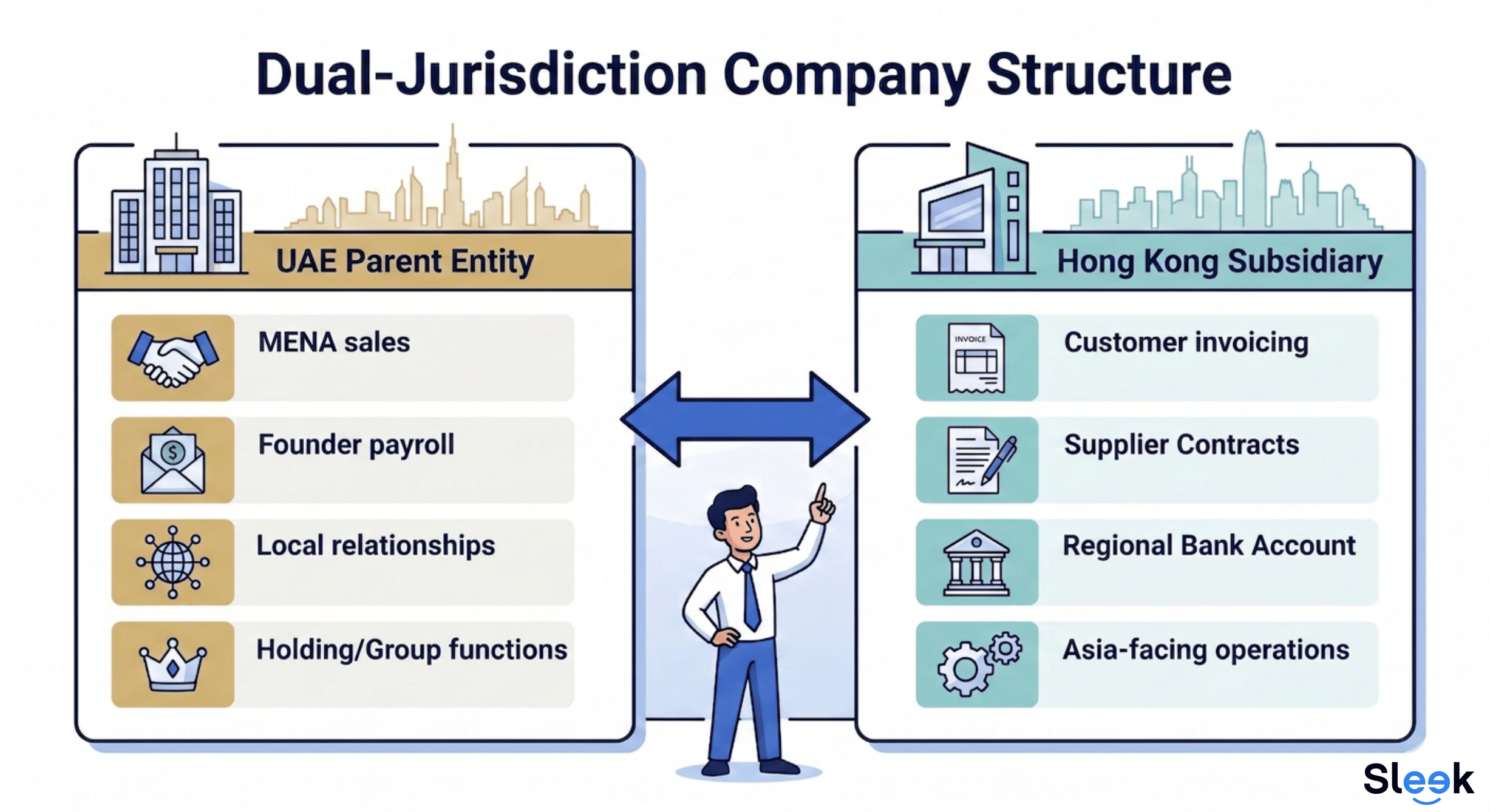
UAE and Hong Kong dual-jurisdiction structure
Most UAE founders who keep both entities split responsibilities in a fairly straightforward way:
UAE entity: MENA-facing sales, founder payroll, local relationships, and broader group or holding functions
Hong Kong entity: Asia customer invoicing, Asian supplier contracts, regional bank account, and Asia-facing operations
The Hong Kong company is often held by the UAE entity, although in some cases the founders own both directly. Either way, both companies maintain their own filings, records, and compliance obligations.
One point matters here: this is not a tax shortcut. If the UAE and Hong Kong entities transact with each other, both jurisdictions expect those arrangements to reflect real business activity and proper pricing. The value of the setup is operational. Any tax benefit should be a by-product of genuine commercial substance, not the main objective.
What are the requirements to set up a Hong Kong company from the UAE?
Before you begin incorporation, prepare:
Passport and proof of residential address for each director and shareholder
A simple banking narrative: what the company does, who the customers are, where the revenue will come from
Confirmation that your service provider holds a valid Trust or Company Service Provider (TCSP) licence
If your UAE and Hong Kong companies will trade with each other, get tax advice on both sides before you incorporate.
How to set up a Hong Kong company from the UAE
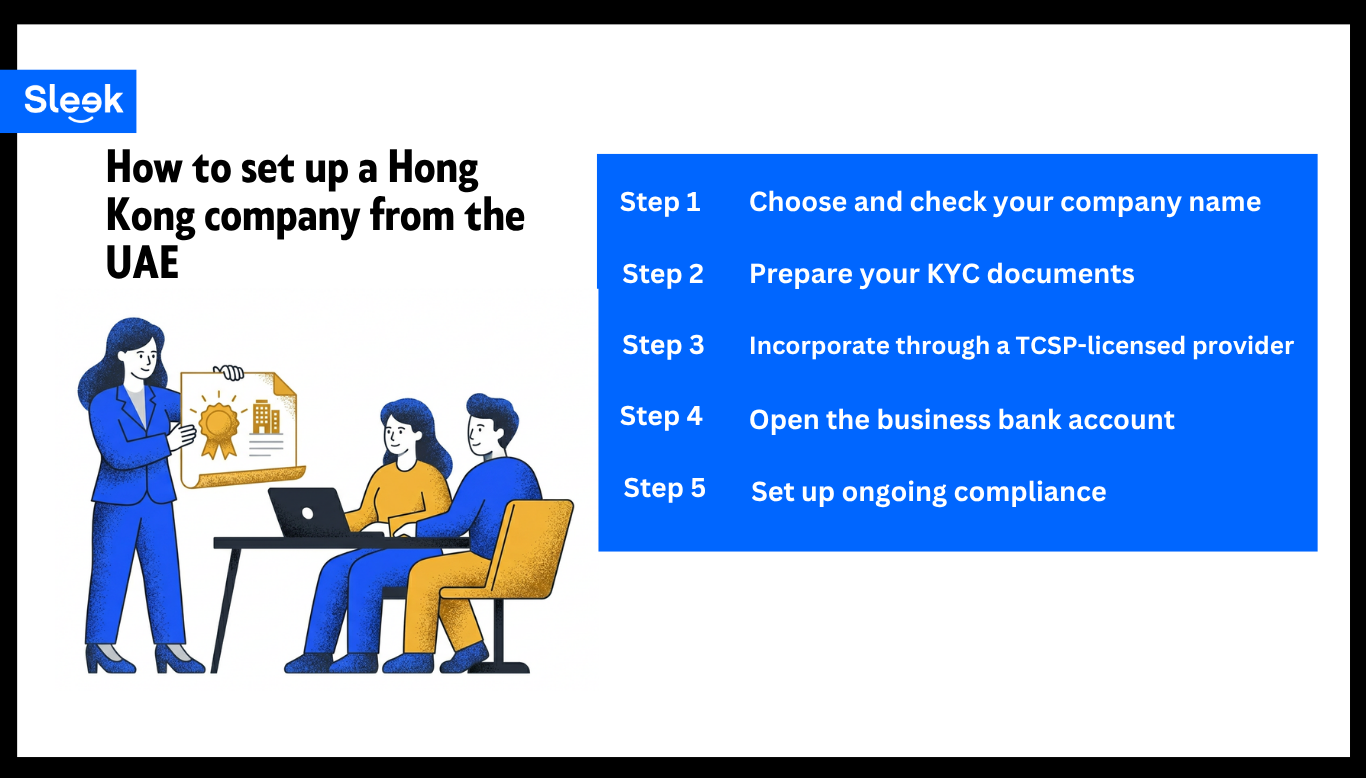
Hong Kong company setup process from the UAE: five steps
The process is simpler than many founders expect. You don’t need to visit Hong Kong, and you don’t need a local director.
To incorporate, you need:
At least one director of any nationality
At least one shareholder
A Hong Kong-based company secretary, either an individual resident or a licensed servicing provider
A registered office address in Hong Kong
An available company name
Step 1: Choose and check your company name
The name must be unique and cannot match an existing registered company. It can be in English, Chinese, or both. Most service providers will check name availability through the Companies Registry’s e-Services portal before filing.
Step 2: Prepare your KYC documents
Collect passport copies and proof of residential address for each director and shareholder. If a corporate shareholder is involved, you will also need a structure chart showing the ultimate beneficial owners. Documents in languages other than English may need translation.
Step 3: Incorporate through a TCSP-licensed provider
If your provider is offering company secretary or registered office services, it must hold a Trust or Company Service Provider (TCSP) licence under Hong Kong law.
The provider prepares the incorporation form (NNC1), the Articles of Association, and the related filings with the Companies Registry. In the same process, they usually take on the company secretary role and provide the registered office address.
Incorporation itself usually completes in about three working days. Once approved, you receive the Certificate of Incorporation and the Business Registration Certificate.
Traditional banks such as HSBC and Standard Chartered often require a clear operating history, stronger KYC, and more detailed explanations of business activity. Digital-first providers such as Airwallex, Aspire, and Statrys can be faster for newly incorporated companies.
Budget about two to four weeks for account opening, and run it in parallel with the incorporation where possible.
Step 5: Set up ongoing compliance
Once the company is live, a few obligations repeat every year:
Annual Return (Form NAR1) filed within 42 days of your incorporation anniversary
Maintenance of statutory registers, including the Significant Controllers Register
This is where a Hong Kong-based company secretary becomes important. In practice, most foreign founders rely on their service provider to manage this properly.
What does it cost to set up a Hong Kong company from the UAE?
Item
Cost
Companies Registry filing fee (NNC1)
HK$1,545 (electronic), HK$1,720 (paper)
Business Registration Certificate (1 year, from April 2026)
HK$2,350
TCSP provider incorporation fee
HK$2,000–HK$5,000
Company secretary (year 1, often included)
HK$2,000–HK$5,000
Registered office address (year 1)
HK$1,500–HK$3,000
If you incorporate electronically, the baseline government cost is HK$3,895. If you file in paper form, it is HK$4,070.
With a service provider covering government fees, company secretary, registered office, and bank account support, first-year total often lands in the HK$10,000 to HK$20,000 range.
Annual ongoing costs from year two onwards usually run about HK$5,000 to HK$10,000 before accounting and tax filing.
Typical timeline
Incorporation filing: about one to three working days in many provider-led cases, faster for straightforward e-filings
Bank account opening: about two to four weeks
Fully operational setup: about three to four weeks in straightforward cases
Tip
A practical route for many founders is to incorporate first, open a digital-first account, and only later add a traditional banking relationship once the company has invoice history and operating volume.
Common mistakes when setting up a Hong Kong Company from the UAE
Waiting until they urgently need the entity
Incorporation is fast, but banking isn’t. If you’re in the middle of a supplier negotiation or an investor due diligence process, you don’t have that time. Set the company up before you need it.
Expecting Hong Kong banks to behave like UAE banks
Hong Kong banks tend to ask more questions. Founders who prepare a clear business narrative, ownership structure, and transaction rationale move faster.
Choosing a company secretary without checking the TCSP license
Every firm offering company secretary or registered office services in Hong Kong must hold a TCSP licence under Hong Kong law. Using an unlicensed provider creates compliance risk. Always verify your provider’s licence number on the Companies Registry.
Treating the Hong Kong entity as a tax trick
Hong Kong only taxes profits sourced in Hong Kong, but the tax authority (Inland Revenue Department, IRD) still expects to see real operating substance: actual contracts, invoices, and business activity. Paper structures don’t hold up.
Ignoring transfer pricing between the UAE and Hong Kong entities
If both companies transact with each other through management fees, intercompany loans, or shared services, those arrangements should be documented properly from the start.
When Hong Kong might not be the right fit
Hong Kong works best when there’s a real Asia strategy behind it. If every customer, supplier, and employee is in the Middle East, you may just be adding another layer of admin.
It often makes less sense if:
Your business is 100% Middle East-facing and you’re not planning to sell into Asia.
You need a treaty outcome that Hong Kong doesn’t offer.
You can’t commit to annual filings and compliance, even through an outsourced provider.
You expect the company to remain inactive for a long period.
If any of these apply, a Hong Kong entity may not be the right tool for your situation.
When Hong Kong is likely a good fit
If several of the following already describe your business, a Hong Kong entity is usually worth considering:
You’re already paying suppliers in Mainland China, Vietnam, or wider Asia
Your bank account needs to clear payments during Asian business hours
You’re hiring, or planning to hire, staff in APAC
Mainland China partners, distributors, or clients prefer to contract with a Hong Kong entity
Asia is becoming a material share of your revenue
You want a second operating base outside MENA with a different legal and risk profile
Two or three signals usually mean the setup is worth considering. Four or more, and most founders move ahead.
How Sleek can help UAE founders set up in Hong Kong
Setting up a Hong Kong company from the UAE is fully remote, but there are still a few moving parts to get right. From incorporation and KYC to banking and annual compliance, Sleek helps you handle the process in one place.
With Sleek, you can:
Set up your company remotely: We prepare and file your incorporation documents, with no travel required.
Stay compliant after setup: We help manage your Annual Return, Profits Tax filing, and ongoing company records.
For founders building an Asia presence from the UAE, this means less back-and-forth, fewer moving parts, and a setup process that is easier to manage from start to finish.
Set up your Hong Kong company from the UAE
Book a discovery call and we’ll walk you through the setup, banking options, and the documents you’ll need.
FAQs about setting up a Hong Kong company from the UAE
Can I set up a Hong Kong company from the UAE without visiting Hong Kong?
Yes. The process is fully remote. KYC documents can be submitted digitally, and incorporation documents can be signed electronically. Some banks may ask for a video call, but incorporation itself does not require travel.
Do I need a Hong Kong resident director?
No. A Hong Kong company needs at least one director, but that person can be of any nationality and can live anywhere in the world.
Do I need a local company secretary?
Yes. Every Hong Kong company must have a company secretary who is either a Hong Kong resident individual or a Hong Kong-registered firm with a valid TCSP licence.
How long does it take to set up a Hong Kong company from the UAE?
Incorporation usually takes about three working days once KYC is complete. With banking included, a realistic end-to-end timeline is about three to four weeks.
Will I pay tax in both places?
Not usually on the same income, but it depends on the facts, how the two companies transact, and where the income is sourced. In Hong Kong, corporate assessable profits are generally taxed at 8.25% on the first HK$2 million and 16.5% above that under the two-tier Profits Tax rates regime, while the Hong Kong-UAE Double Taxation Convention is intended to prevent the same income being taxed twice. You should still get UAE-side advice before relying on treaty outcomes.
View more
Does Hong Kong have a tax treaty with the UAE?
Yes. Hong Kong and the UAE have a Double Taxation Convention, signed in December 2014. It prevents the same income being taxed in both jurisdictions and is one of the bilateral frameworks that makes the UAE + HK dual-entity structure viable.
How much does it cost to set up a Hong Kong company from the UAE?
Government fees total about HK$4,070 based on the figures above. With a service provider covering incorporation, company secretary, registered office, and setup support, the first-year total is often around HK$10,000 to HK$20,000.
Is a Hong Kong company useful for selling into Mainland China?
Yes. Hong Kong is the most common entry structure for non-Chinese businesses with Mainland China operations. Supplier relationships, RMB invoicing through offshore markets, and the Comprehensive Double Taxation Arrangement between Hong Kong and Mainland China make the HK entity the standard bridge.
What annual obligations does a Hong Kong company have?
The main recurring obligations are the Annual Return, Profits Tax Return, Business Registration renewal, and maintenance of statutory registers.