


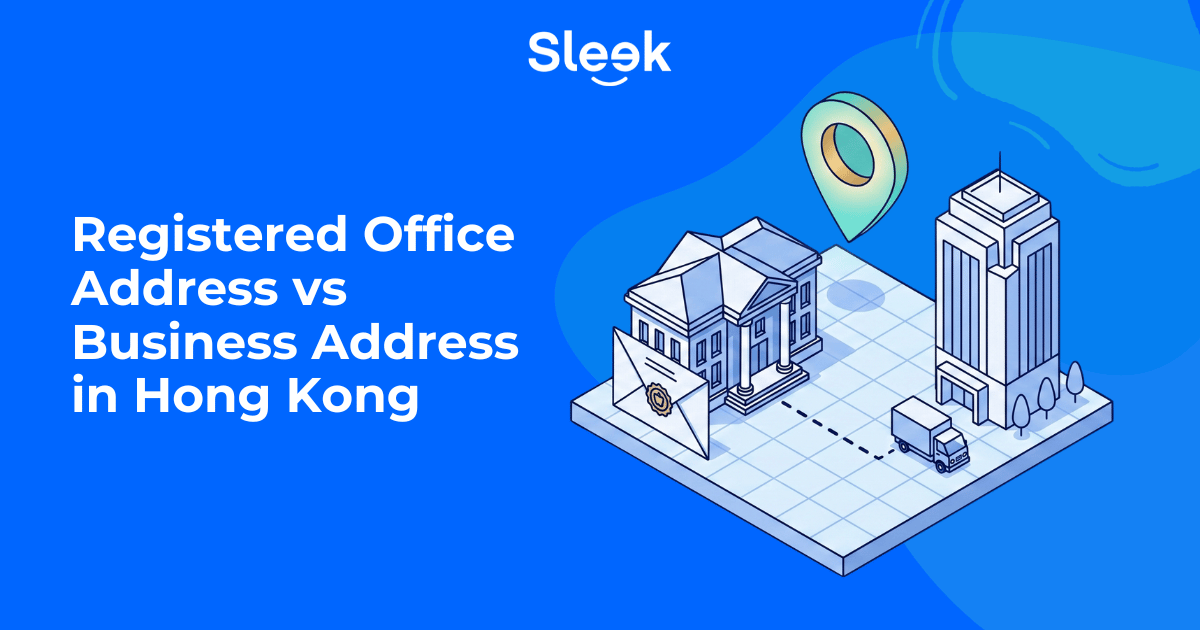






- A registered office address is your Hong Kong company’s legal address on file with the Companies Registry.
- A business address is where your company operates or receives day-to-day commercial mail.
- Every Hong Kong company must have one registered office address in Hong Kong under Cap. 622. A separate business address is only needed if you operate elsewhere.
- Your registered office address appears on the public register. Your business address usually does not, unless both are the same.
- If your registered office changes, file Form NR1 within 15 days. If your business address changes, notify the Business Registration Office within one month, usually via Form IRC3111A or the one-stop service.




Registered office address vs business address is one of the easiest things to mix up when setting up a Hong Kong company. The two addresses can be the same, but they do different jobs and are reported to different government bodies.
If you use the wrong address in the wrong place, you may miss tax letters, bank requests, Companies Registry notices, or statutory filing deadlines.
In this guide, you’ll learn:
- What a registered office address is
- What a business address is
- The key differences between the two
- When the same address can cover both purposes
- How to update each address if your company moves

What is a registered office address in Hong Kong?
A registered office address is your company’s legal address on file with the Companies Registry (CR). Every Hong Kong company must have one from the day it incorporates, and it’s the address the government uses to send anything official — annual return reminders, tax notices, court documents.
Three things to know:
- It’s a public record. The address appears on the Companies Register and is searchable by anyone.
- There can only be one. A company can’t have two registered offices simultaneously.
- It must be a physical Hong Kong address — no P.O. boxes, no “care of”, no overseas addresses.
Common uses include:
- Incorporating your company with the Companies Registry
- Receiving Companies Registry notices and official letters
- Filing your Annual Return (Form NAR1)
- Listing the address on statutory registers and company records
- Receiving formal legal correspondence
- Appointing a company secretary or changing company particulars
What is a business address in Hong Kong?
A business address is the address your company uses for day-to-day operations and commercial communication. It may be your office, shop, coworking space, warehouse, virtual office, or another address where your business can receive non-statutory correspondence.
Three things to know:
- It is not on the Companies Register. Unlike the registered office, your business address isn’t filed with the CR.
- A company can have multiple business addresses. A retail brand with five shops has five business locations.
- It is reported to the Inland Revenue Department, not the Companies Registry, because the IRD records each company’s place of business on the Business Registration Certificate.
Common uses include:
- Adding an address to your website, proposals, and email signatures
- Issuing invoices, quotations, and purchase orders
- Opening or maintaining a business bank account in Hong Kong
- Receiving supplier correspondence, client letters, and deliveries
- Registering the place of business shown on your Business Registration Certificate
- Communicating with insurers, payment providers, marketplaces, and vendors

Your registered office address is where the government finds you. Your business address is where customers, banks, suppliers, and partners can reach your business.
Registered office address vs business address: side-by-side comparison
Comparison | Registered office address | Business address |
|---|---|---|
Purpose | Legal address for government and court correspondence | Where the company actually operates day-to-day |
Required by law | Yes — mandatory under Cap. 622 from day one | Reported to IRD on the Business Registration Certificate |
Filed with | Companies Registry | Inland Revenue Department |
Public record | Yes — searchable on the Companies Register | No — not publicly searchable |
How many | Exactly one | As many as the business needs |
Can be a P.O. box? | No — must be a physical Hong Kong address | No — must be a physical Hong Kong address |
Typical use | Annual return reminders, tax notices, legal documents, statutory inspections | Marketing, invoices, deliveries, client visits, supplier records |
Update form when it changes | Form NR1 to Companies Registry within 15 days | Form IRC3111A to IRD within one month |
Typical cost (provider) | HK$1,500–HK$5,000 per year | HK$68–HK$2,000 per month, depending on services |
For a deeper cost comparison, see our guide on virtual office costs in Hong Kong.
Can the registered office address and business address be the same?
Yes, and for many small Hong Kong companies they are the same. There’s no rule requiring the registered office and business address to be different. The decision comes down to privacy versus simplicity.
Using one address means one provider, one bill, one place where mail lands. Using two addresses keeps your operating location off the public register, but adds two filings to manage and two providers to coordinate.
When using the same address for both is fine
A single address handles both roles well if:
- You operate a small or service-based business from one location
- You’re comfortable with that address being publicly searchable on the Companies Register
- The address is staffed during business hours, so government letters won’t be missed
- The provider holds a TCSP licence (if the address belongs to a service provider)
This is the common setup for founders using a TCSP-licensed registered office service that also includes mail handling. One address, one provider, both compliance roles covered.
When you should keep them separate
Two addresses are usually the better setup if:
- You operate from a location you don’t want on the public register — for example, a home, a co-living space, or a manufacturing site
- You run a customer-facing storefront or warehouse that isn’t suited for receiving statutory mail
- You’re a foreign founder with no Hong Kong staff, and your operating “location” is online or overseas
- You receive sensitive government mail and want it handled by a provider who specialises in compliance correspondence
- Your operating location changes more frequently than your registered office should
Splitting them means the registered office stays constant for compliance, while the business address can move with the business.
How to update your registered office address or business address
Each address triggers a different filing with a different government body. Confusing them is the most common error in this area.
Changing your registered office address
File Form NR1 with the Companies Registry within 15 days of the change. Filing is free if you submit through the e-Registry portal. Late filing penalties apply.
If your registered office change also affects where the company is registered for business purposes, you’ll need to file Form IRC3111A with the IRD as well — within one month.
For the full process, see our guide on updating your registered office address.
Changing your business address
If only your operating address changes — for example, you’ve moved offices but kept the same registered office service provider — you only need to notify the IRD. File Form IRC3111A within one month of the change. The Companies Registry doesn’t need to know.

If you only file with one body when both should have been notified, your two government records fall out of sync. Mail gets sent to the old address, deemed legally delivered, and you can miss filing deadlines you didn’t know existed. File both whenever both apply.
Common mistakes when choosing an address setup
Using a home address without considering privacy
The registered office becomes a public record from the day the Certificate of Incorporation issues. Anyone, including clients, journalists, and ex-employees, can search the company on the Companies Register and see the home address. By the time it’s noticed, switching means a Form NR1 filing and explaining the change to anyone who already has the wrong address.
Treating the business address as optional
Some founders skip naming a business address because it’s not on the Companies Register. The IRD still expects one on the Business Registration Certificate. If your operating location changes and the IRD isn’t notified, your tax records and your real-world location drift apart.
Treating the registered office as a parcel delivery address
A registered office address is mainly for official letters and statutory correspondence. Many providers do not accept parcels, personal mail, or bulky deliveries. Check the mailroom rules before using the address on shopping platforms or supplier delivery instructions.
Using a “virtual office” provider that isn’t TCSP-licensed
A virtual office can serve as both addresses only if the provider is TCSP-licensed under Cap. 615. Many cheap virtual office plans are not. Using an unlicensed provider for the registered office puts you on the wrong side of Hong Kong’s anti-money laundering rules, and any work the provider files on your behalf can be challenged later.
Filing only one form when both addresses change
The 15-day NR1 deadline and the one-month IRC3111A deadline are independent. Many founders file one and assume that “tells the government” — it doesn’t. The Companies Registry and the IRD share enforcement power but not real-time records.
How Sleek can cover both addresses for you
Sleek is a TCSP-licensed firm (TC006483) that can provide a registered office address, virtual mailroom service, and business address support in one package — handled entirely online.
With Sleek, you can:
- Use one Central Hong Kong address for both: Your company is on the public register at a professional commercial address, and the same address can serve as your business address on invoices and the BRC.
- Get every official letter scanned the same week: Government mail is opened, scanned, and uploaded to your portal within seven business days, so deadlines never sit in a physical inbox.
- Switch addresses without the admin: When you need to change either address, Sleek prepares and files Form NR1, Form IRC3111A, or both — within the statutory deadlines.
- Bundle with the rest of compliance: Many founders combine the address service with company secretary, accounting, and annual return filing under one provider.
That keeps the legal address compliant on day one and the business address current as the company grows.
Sleek gives you a Central Hong Kong registered office address, digital mailroom, and TCSP-licensed support for ongoing compliance.



450,000
businesses worldwide.


from 4,100+ reviews.

satisfaction rate from
16,000 surveyed clients.
FAQs about registered office address vs business address in Hong Kong
Yes, provided the provider holds a valid TCSP licence under Cap. 615 and the address is a real physical location in Hong Kong. Many basic virtual office plans aren’t TCSP-licensed and can only serve as a business address, not a registered office. Always check the licence number before signing.
Helpful read: Using a Virtual Office Address for Hong Kong Business Registration
View more