







- Most of the ideas below can start between about HK$800 and HK$25,000 if you keep tools, inventory, and ads tight.
- Every business trading in Hong Kong needs a Business Registration Certificate (from HK$2,350 for one year from 1 April 2026). You don’t always need a limited company on day one.
- Skill-based and online services usually hit revenue fastest because your main cost is time, not stock.
- Food and some premises-based models can trigger licences that wipe out a “cheap start” if you ignore them.
- Government schemes such as the BUD Fund and SFGS can help later, but they rarely replace your first few thousand dollars of setup cash.




- Budget band: Aim for ideas you can test for under about HK$25,000, not counting living expenses.
- Fastest starts: Freelance marketing, design, tutoring, virtual assistance, and social media retainers.
- Must-do first: Get a Business Registration Certificate within one month of starting (HK$2,350 for one year from 1 April 2026).
- Support later: Schemes like the BUD Fund and SFGS help expansion and lending. They don't replace day-one setup cash.
Most people searching for low investment small business ideas in Hong Kong aren’t asking “what’s the most ambitious company I can build?” They’re asking “what can I start without emptying my savings?”
Hong Kong still rewards that approach. Service and online models can launch from a laptop, a neighbourhood network, or a marketplace listing. You still need to register, keep records, and price for real margins.
In this guide, you’ll learn:
- What “low investment” actually means in Hong Kong
- How to choose an idea that matches your skills and cash
- 20 practical ideas with costs, HK market fit, and lean setup notes
- The registration minimum before you trade
- Government support schemes worth knowing as a small business
- Common budget mistakes, and when a cheap start is the wrong move
What counts as a low-investment business in Hong Kong?
A low-investment business here is one you can validate with limited cash: usually under about HK$25,000 for tools, registration, and a first marketing push, before you reinvest revenue.
That band fits most freelance services, tutoring, light local services, and asset-light online shops. It doesn’t fit a full restaurant fit-out, a warehouse, or a heavily stocked retail storefront.
If your plan needs six figures before the first sale, you’re reading the wrong article. Use our most profitable business ideas in Hong Kong piece for higher-capital options.
Two costs almost everyone underestimates:
- Government registration: sole proprietors still need a BRC. Limited companies also pay Companies Registry incorporation fees (from HK$1,545 electronic) plus company secretary and a registered office address.
- Customer acquisition: even “free” organic channels take time. Budget a small test for ads or samples if your model depends on volume.
How do you pick an idea on a tight budget?
Pick the idea that turns your existing skill or network into paid work in weeks, not the one that looks nicest on Instagram.

Use this filter:
- Can you name five people who would pay for this next month? If not, keep researching.
- What’s the smallest sellable version? One service package, one SKU, one cohort.
- What’s fixed vs variable? Prefer models where cost rises only after a sale (time, dropship, pre-orders).
- Any licence wall? Food for sale, certain premises, and regulated advice can end a cheap plan overnight.
- How will you get paid? Card, FPS, invoice, or marketplace payout. Cash-only dreams die in Hong Kong banking reality.
If you’re still weighing structure and timeline, how to start a business in Hong Kong covers the full setup path once you’ve chosen a model.

What are 20 low-investment small business ideas you can start in Hong Kong?
These 20 ideas stay inside a modest budget if you start lean. Costs are estimates for a first workable setup, not a polished brand. For each one, use the “why Hong Kong” note to decide whether local demand actually supports the model.
1. Freelance digital marketing
Startup cost: HK$2,000 to HK$6,000
Best for: Operators who already get SEO, paid ads, or content results
What it is: You sell SEO, Meta or Google ads, content, or conversion work to businesses that need growth marketing without a full-time hire. Most founders productise this as monthly retainers with clear deliverables.
Why it suits Hong Kong: The city has a dense SME base and constant competition for online attention across Google, Instagram, Xiaohongshu, and WhatsApp. Many owners know they need digital marketing, but won’t hire an in-house team until revenue is stable.
How to start lean:
- Pick one channel you can prove with case snapshots
- Build a simple site or LinkedIn offer page, rate card, and proposal template
- Set invoicing and a basic reporting format before you take the first client
Watch out for: Don’t sell “full-funnel everything” on day one. One measurable outcome beats a vague strategy pitch.
2. E-commerce dropshipping store
Startup cost: HK$3,000 to HK$8,000
Best for: Operators who can test creatives and watch unit economics
What it is: You sell products online while suppliers warehouse and ship. Your job is niche selection, storefront, creatives, customer service, and margin control.
Why it suits Hong Kong: Free-port logistics, proximity to Mainland suppliers, and strong digital payments make niche testing faster than in many markets. You can validate demand without renting storage first.
How to start lean:
- Choose one hero product niche, not a giant catalogue
- Vet suppliers on samples, shipping times, and refund handling
- Build the store, payments, and a small ad or organic test budget
For the full setup path, see how to start a dropshipping business in Hong Kong.
Watch out for: Ads can erase profit before the product does. Track contribution margin after shipping, refunds, and platform fees.
3. Online courses or coaching
Startup cost: HK$2,000 to HK$5,000
Best for: Specialists with a clear outcome (exam, language, career skill)
What it is: You package expertise into structured lessons, live cohorts, or 1-to-1 coaching. Revenue comes from course fees, retainers, or corporate workshops.
Why it suits Hong Kong: Upskilling culture is strong across language, finance, tech, and career switching. Professionals will pay for practical outcomes, especially bilingual or Asia-market skills.
How to start lean:
- Validate the topic with a paid live cohort before filming everything
- Outline a curriculum with a clear before-and-after promise
- Host on a simple course platform and keep bookings friction-light
Watch out for: Broad “become successful” courses struggle. Niche + proof of results wins.
4. Freelance design or copywriting
Startup cost: HK$1,000 to HK$4,000
Best for: Creatives with a portfolio and a niche
What it is: You produce brand identity, web, ads, packaging, or long-form copy for businesses that need frequent creative refresh.
Why it suits Hong Kong: High brand density, constant F&B and retail launches, and event-driven campaigns create repeat creative demand. Bilingual work (English and Chinese) is especially useful for cross-border brands.
How to start lean:
- Build a niche portfolio (F&B, property, tech, or beauty)
- Publish a rate card, discovery-call script, and simple contract
- Offer fast-turnaround packages with limited revisions
Watch out for: Respect IP and licensing for fonts and stock. Scope creep kills freelance margins.
5. Social media management
Startup cost: HK$1,500 to HK$4,000
Best for: Organised creators who can ship content on a calendar
What it is: You plan, create, schedule, engage, and report on social content for SMEs that lack in-house bandwidth.
Why it suits Hong Kong: Local businesses live on Instagram, Facebook, Xiaohongshu, and WhatsApp status-style updates. Owners often know content matters, then fall behind because operations eat the week.
How to start lean:
- Create a content calendar template and approval workflow
- Sell tiered retainers tied to posting cadence and simple KPIs
- Keep an asset library so you’re not redesigning from scratch every week
Watch out for: Disclose sponsored content where required. Sell outcomes you can influence, not vanity metrics you can’t control.
6. Virtual assistant or remote admin
Startup cost: HK$800 to HK$2,500
Best for: Reliable organisers who like recurring admin work
What it is: Remote support for scheduling, inbox triage, research, travel booking, and light bookkeeping for founders or consultants.
Why it suits Hong Kong: Many solo operators and small agencies juggle client work and admin in the same long day. They’ll pay for responsive help without committing to a full-time hire or office seat.
How to start lean:
- Define a service list and response-time SLA
- Set secure password-sharing and confidentiality rules
- Specialise by industry (recruiters, coaches, agencies) to raise rates
Watch out for: Client data handling is the job. One leak ends the business faster than a missed email.
7. Cleaning and home maintenance
Startup cost: HK$4,000 to HK$12,000
Best for: Operators who can build trust through consistency
What it is: Residential or small-office cleaning, minor maintenance, or post-renovation tidy-ups, often sold as one-off jobs plus recurring subscriptions.
Why it suits Hong Kong: Dense housing, dual-income households, and compact offices create steady demand for reliable cleaners who show up on time and don’t create estate drama.
How to start lean:
- Buy core supplies and write a room-by-room checklist
- Price per session or per square footage, then add deep-clean upsells
- Use a simple booking and feedback loop in one neighbourhood first
Watch out for: Budget for liability considerations and basic safety training before you scale a team.
8. Tutoring and education support
Startup cost: HK$1,000 to HK$3,000
Best for: Teachers and subject specialists
What it is: One-to-one or small-group lessons in English, coding, music, STEM, or exam prep, delivered at home, online, or in a borrowed space.
Why it suits Hong Kong: Academic pressure and enrichment spending stay high. Parents pay for progress they can see, and referrals move faster than ads in many estates.
How to start lean:
- Outline a trial lesson and parent update template
- Start online or at home before renting a centre
- Offer small groups once your 1-to-1 calendar fills
Watch out for: Running a centre or food/childcare premises can trigger extra licences. Home or online tutoring is usually the leaner path.
9. Event or party planning
Startup cost: HK$2,000 to HK$6,000
Best for: Coordinators with vendor relationships
What it is: Planning small corporate gatherings, brand launches, birthdays, or private celebrations, usually by coordinating venues and vendors rather than owning them.
Why it suits Hong Kong: Compact venues, frequent brand activations, and a strong gifting/celebration culture create a steady flow of mid-size events that don’t need a giant agency.
How to start lean:
- Build a trusted vendor list and package menus
- Use timeline templates and a budget tracker on every job
- Collect deposits only after venue and insurance basics are clear
Watch out for: Public-space permits and venue rules can change the plan overnight. Don’t take money before you know the constraints.
10. Translation and localisation
Startup cost: HK$1,500 to HK$5,000
Best for: Bilingual professionals with domain knowledge
What it is: Translating and adapting content between English, Chinese, and other languages so it fits local tone, not just dictionary meaning.
Why it suits Hong Kong: The market is bilingual by default and sits between Mainland, ASEAN, and global clients. Marketing, product UI, and corporate communications all need cultural fit as well as accuracy.
How to start lean:
- Set up a CAT tool, glossary process, and QA checklist
- Publish turnaround SLAs by content type
- Keep client termbases to raise quality and retention
Watch out for: Legal and medical texts need confidentiality discipline. Speed without QA creates expensive rework.
11. Handmade crafts or small product line
Startup cost: HK$3,000 to HK$10,000
Best for: Makers who can sell story and scarcity
What it is: Small-batch goods such as candles, stationery, accessories, or homeware, sold online, at pop-ups, or through craft fairs.
Why it suits Hong Kong: Gift culture is strong, and shoppers often prefer distinctive local makers over generic imports for personal and corporate presents. Pop-ups and weekend markets give low-rent distribution.
How to start lean:
- Prototype two to three hero SKUs, not twenty
- Sort branding, packaging, and photo standards early
- Test Instagram and one pop-up before committing to heavy stock
Watch out for: Skin-contact products need labelling and safety care. Limited runs help cash flow and create urgency.
12. Home bakery or specialty food delivery
Startup cost: HK$6,000 to HK$20,000
Best for: Cooks who already have demand from friends or offices
What it is: Baked goods or niche foods sold by pre-order for delivery or pickup, often starting through social media and corporate gifting.
Why it suits Hong Kong: Food gifting, office treats, and artisanal niches travel well on Instagram and WhatsApp. Delivery culture makes a kitchen-based model possible without a storefront.
How to start lean:
- Lock a short signature menu and shelf-life testing
- Use pre-orders so you don’t bake into dead stock
- Price delivery windows and packaging into every order
Watch out for: Treat licensing as part of startup cost, not an afterthought. If the licence path doesn’t fit your budget, pick another idea from this list.

Selling food in Hong Kong usually means a food business licence from the Food and Environmental Hygiene Department (FEHD), and often a licensed commercial kitchen. Instagram orders from an unlicensed home kitchen can become an expensive compliance problem, not a cute side hustle.
13. Pet services
Startup cost: HK$1,500 to HK$6,000
Best for: Animal-caregivers with neighbourhood reach
What it is: Dog walking, pet sitting, home visits, or grooming at the client’s premises, usually sold as recurring local routes.
Why it suits Hong Kong: Pet ownership and spend are high relative to living space. Long work hours and estate living create demand for trusted helpers who can handle building access and owner updates.
How to start lean:
- Map one to two estates and build service routes
- Use pet profile forms and emergency vet contacts
- Sell multi-visit bundles with photo updates for owners
Watch out for: Building management rules and animal welfare standards matter as much as your Instagram presence.
14. Photography or videography
Startup cost: HK$8,000 to HK$25,000
Best for: Shooters who can productise packages
What it is: Content creation for events, products, menus, and short-form social video, sold as fixed packages rather than open-ended day rates.
Why it suits Hong Kong: Retail and F&B compete visually every week. Brands need vertical video, menu refreshes, and campaign assets faster than many in-house teams can produce them.
How to start lean:
- Start with a usable kit, not the most expensive body
- Publish packages with deliverables and turnaround times
- Build presets and a delivery gallery workflow
Watch out for: Model releases and location permissions are easy to skip and hard to fix later.
15. Personal fitness trainer or yoga instructor
Startup cost: HK$3,000 to HK$8,000
Best for: Certified trainers with a local or online following
What it is: Personalised training in parks, homes, rented studios by the hour, or online, plus small-group or corporate wellness sessions.
Why it suits Hong Kong: Health spending stays high, and space is scarce. Outdoor, home, and virtual sessions let you earn without carrying a studio lease.
How to start lean:
- Keep certifications current and use basic health screening forms
- Productise programmes (fat loss, desk-worker mobility, exam-season stress)
- Add small groups once private slots fill
Watch out for: Safety and insurance matter when you train in public spaces or client homes.
16. App or software micro-startup
Startup cost: HK$5,000 to HK$15,000
Best for: Builders who can ship a narrow MVP
What it is: A focused digital tool that solves one workflow problem, usually charged as a monthly subscription or setup-plus-subscription mix.
Why it suits Hong Kong: The B2B services scene is full of process gaps in booking, invoicing, inventory, and client reporting. SMEs will pay for simple tools that save staff time without a custom enterprise build.
How to start lean:
- Interview users before writing features
- Ship a narrow MVP with usage analytics and a support channel
- Price monthly and iterate from real usage, not feature envy
Watch out for: Data protection and clear terms of service belong in version one, not version five.
17. Eco-friendly packaging or reusables
Startup cost: HK$6,000 to HK$18,000
Best for: Operators who can sell to cafés and online sellers
What it is: Sourcing or creating sustainable mailers, takeaway packaging, or reusable items for SMEs that want greener options without reinventing procurement.
Why it suits Hong Kong: Cafés, bakeries, and online sellers face customer pressure on plastic, and many prefer a local supplier who can deliver samples quickly and explain material specs in plain language.
How to start lean:
- Vet suppliers and build sample kits for one category only
- Set minimum-order and storage rules before taking B2B clients
- Keep claims honest and document specifications
Watch out for: Greenwashing kills trust. Corporate buyers check specs.
18. Online thrift store or sustainable fashion
Startup cost: HK$2,000 to HK$7,000
Best for: Curators with taste and sourcing discipline
What it is: Curating pre-loved or upcycled fashion and selling through Instagram, marketplaces, or your own storefront.
Why it suits Hong Kong: Small living spaces encourage resale, and fashion-conscious buyers still want curated finds. Local pickup and fast courier options make second-hand commerce practical.
How to start lean:
- Define sourcing, cleaning, and grading standards
- Photograph consistently and write truthful condition notes
- Validate on Instagram or a marketplace before building a custom site
Watch out for: Authenticity disputes and vague condition descriptions destroy repeat business.
19. Subscription box of local products
Startup cost: HK$4,000 to HK$12,000
Best for: Curators who can lock supplier terms
What it is: A monthly curated box of snacks, crafts, or wellness goods from local makers, sold on subscription with optional gifting plans.
Why it suits Hong Kong: Residents like discovery and gifting, and small makers want exposure without building their own subscription ops. Recurring billing helps once renewals hold.
How to start lean:
- Choose one theme and secure supplier partnerships in writing
- Test a sample batch before opening prepaid plans
- Build packing SOPs and renewal reminders from month one
Watch out for: Food boxes need clear allergen and origin labelling. Cash gets trapped in inventory if renewals slip.
20. AI and automation consulting for SMEs
Startup cost: HK$2,000 to HK$6,000
Best for: Operators who can implement tools, not just talk about them
What it is: Helping SMEs set up practical AI assistants, document automation, and workflow integrations that cut admin time without a custom software build.
Why it suits Hong Kong: Labour costs are high and many SMEs still run on WhatsApp, Excel, and email. Owners want efficiency gains they can see in a two-week pilot, not a six-month digital transformation speech.
How to start lean:
- Build a discovery template and a shortlist of reliable tools
- Sell fixed-price pilots with a measurable time-saved target
- Include training materials so the client isn’t dependent on you for every click
Watch out for: Data handling, privacy, and vendor terms are part of the service. Don’t connect tools you haven’t stress-tested.
How do the startup costs compare?
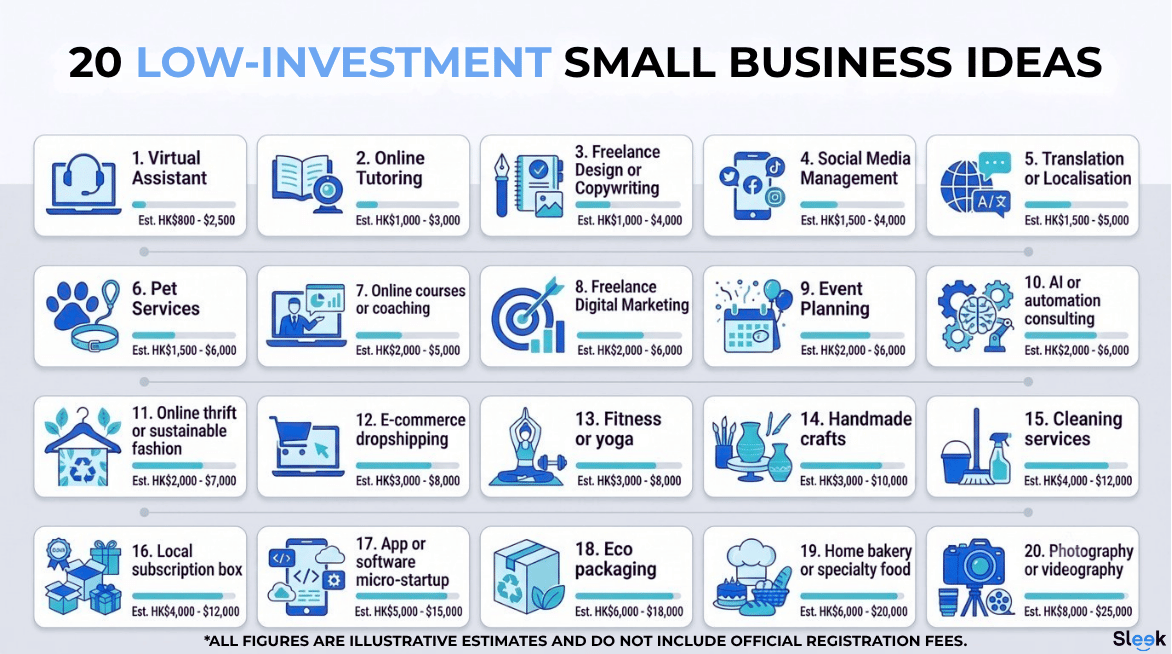
| Business idea | Estimated initial cost (HK$) | Cost profile | Typical path to first revenue |
|---|---|---|---|
| Virtual assistant | 800 to 2,500 | Low | Weeks |
| Tutoring | 1,000 to 3,000 | Low | Days to weeks via referrals |
| Freelance design or copywriting | 1,000 to 4,000 | Low | Days to weeks |
| Social media management | 1,500 to 4,000 | Low | Weeks |
| Translation / localisation | 1,500 to 5,000 | Low | Weeks |
| Pet services | 1,500 to 6,000 | Low | Weeks in one neighbourhood |
| Online courses or coaching | 2,000 to 5,000 | Low after build | Weeks for live cohorts |
| Freelance digital marketing | 2,000 to 6,000 | Low recurring tools | Weeks, if you have a network |
| Event planning | 2,000 to 6,000 | Project-based | Depends on booking cycle |
| AI / automation consulting | 2,000 to 6,000 | Low | Weeks if you can demo ROI |
| Online thrift / sustainable fashion | 2,000 to 7,000 | Inventory turns | Weeks |
| E-commerce dropshipping | 3,000 to 8,000 | Ads can climb fast | Weeks to a few months |
| Fitness / yoga | 3,000 to 8,000 | Low | Weeks |
| Handmade crafts | 3,000 to 10,000 | Materials scale with sales | Weeks to months |
| Cleaning services | 4,000 to 12,000 | Supplies replenish | Weeks with local outreach |
| Local subscription box | 4,000 to 12,000 | Cash tied in batches | After first renewal cohort |
| App / software micro-startup | 5,000 to 15,000 | Hosting ongoing | Months for a real MVP |
| Eco packaging | 6,000 to 18,000 | Stock risk | Weeks to months (B2B sales) |
| Home bakery / specialty food | 6,000 to 20,000 | Plus licence risk | Only after compliance is clear |
| Photography / videography | 8,000 to 25,000 | Gear heavy | Weeks with a portfolio |

If two ideas score the same on cost, pick the one where you already have distribution: WhatsApp groups, a LinkedIn niche, estate neighbours, or past colleagues. Cheap customer acquisition beats a cheaper Shopify theme every time.
What registration do you need before you start trading?
You need a Business Registration Certificate if you’re carrying on business in Hong Kong for profit. From 1 April 2026, a one-year BRC is HK$2,350 (HK$2,200 fee plus the reinstated HK$150 Protection of Wages on Insolvency Fund levy), per the Inland Revenue Department. A three-year certificate is HK$6,170.
You don’t always need a limited company on day one. Many of the ideas above can start as a sole proprietorship while you test demand. A private limited company makes more sense when you want limited liability, stronger credibility with suppliers or payment providers, or a cleaner path to company registration cost planning as you scale.
If you incorporate, budget for:
- Companies Registry incorporation fee (from HK$1,545 electronic)
- BRC (bundled under the one-stop service for limited companies)
- A company secretary (legal requirement for every Hong Kong company)
- A Hong Kong registered office address
- Bookkeeping habits that won’t panic you at Profits Tax time
Online sellers should also map tax and platform rules early. Hong Kong has no GST or VAT, but you still need clean records for e-commerce taxes in Hong Kong and your Profits Tax Return.
What government support schemes can small businesses in Hong Kong use?
Hong Kong has useful funding and financing schemes for small businesses, but most of them help after you’re registered and trading, not before you’ve tested an idea. Treat schemes as acceleration, not seed money for your first toolkit.
The shortlist that matters most for low-investment founders:
Scheme | What it is | Typical support | Best fit for low-investment founders |
|---|---|---|---|
BUD Fund | Matching grant for branding, upgrading, and market development in covered markets | Up to HK$7 million cumulative per enterprise; government funds up to 25% of approved project cost (1:3 matching for applications from 14 March 2025; earlier applications were 1:1, up to 50%) | Online sellers, exporters, and service firms expanding into Mainland or ASEAN |
SME Financing Guarantee Scheme (SFGS) | Government-backed loan guarantee via participating lenders | 80% / 90% guarantee products | Founders who need working capital or equipment finance and can repay a loan |
NITTP | Training subsidy for eligible technology and new industrialisation courses | Up to HK$250,000 per enterprise per financial year (1:1 matching from 1 August 2025) | Teams upskilling staff once the business has employees |
Cyberport / HKSTP programmes | Incubation and startup support for tech founders | Project grants and programme benefits (e.g. Cyberport Creative Micro Fund commonly associated with HK$100,000) | App, AI, fintech, and deep-tech ideas, not every freelance service |
Enterprise Support Scheme (ESS) | Matching funding for in-house R&D | Up to HK$10 million per approved project; up to 50% matching | Genuine product or process R&D, not ordinary marketing spend |
A few practical rules before you get excited:
- Register first. Most schemes expect a Hong Kong business with a valid BRC, and many prefer a limited company with clean records.
- SFGS is not free money. It helps you borrow. The bank still underwrites repayment ability.
- Don’t plan around TVP. The Technology Voucher Programme is closed to new applications in 2026 based on current scheme status.
- Match the scheme to the stage. A freelance marketer testing retainers doesn’t need BUD on week one. An e-commerce seller entering ASEAN might.
For the full comparison of eligibility, amounts, and preparation steps, use our guide to Hong Kong business grants. Scheme ceilings and rules can change mid-year, so verify figures on the official pages before you apply.
What common mistakes drain a small startup budget?
Spending on brand before demand
Logo, packaging, and a custom site feel productive. They’re often premature. Sell a plain offer first, then dress it up when customers already pay.
Ignoring licences that aren’t optional
Food, certain premises, and regulated advice can require approvals before your first sale. A cheap model that can’t trade legally is not a bargain.
Mixing personal and business money
One bank trail and a simple ledger save hours later. It also makes tax time less painful if revenue grows faster than expected.
Underpricing “because it’s a side hustle”
Low investment is about capital, not about giving your time away. Price for materials, platform fees, transport, tax set-aside, and your hours.
Scaling ads before unit economics work
Dropshipping and product businesses die when CAC stays above contribution margin. Fix the offer and creative on a small budget first.
When is a low-investment start not the right path?
A budget launch is a poor fit when:
- You need licensed commercial premises before you can legally sell (many food models)
- Clients expect a limited company, insurance, and formal contracts from day one (some B2B and corporate work)
- Your idea only works with heavy inventory or a physical storefront
- You’re building a regulated financial, medical, or childcare service and treating licences as optional
- You can’t afford even the BRC and basic tools without putting rent or essentials at risk
In those cases, either raise the capital honestly, partner with someone who already has the licence or premises, or pick a different idea from the list above.
How Sleek helps you turn a small idea into a real business
Once you’ve validated an offer, Sleek helps you formalise without stitching together four providers. That covers company incorporation, company secretary, registered office, and ongoing accounting services in Hong Kong when you’re ready for cleaner books.
With Sleek, you can:
- Incorporate cleanly: Company setup with the statutory pieces bundled, not left as afterthoughts
- Stay compliant: Company secretary and filing reminders so deadlines don’t sneak up
- Keep money clear: Bookkeeping and accounting support when invoices and expenses outgrow a spreadsheet
- Plan the next step: Advice on when sole prop testing should graduate to a limited company
The Companies Registry incorporation fee starts from HK$1,545 (electronic), and Sleek bundles that with the statutory pieces rather than leaving them as add-ons.
Talk to an incorporation advisor first if you’re unsure whether you need a company yet.



450,000
businesses worldwide.


from 4,100+ reviews.

satisfaction rate from
16,000 surveyed clients.
FAQs about low-investment small business ideas in Hong Kong
View more