Dharini Jegadeesan, ACS, ACIS, is a seasoned Company Secretarial and Compliance professional with over 10 years of experience navigating Singapore’s regulatory landscape. As Co-Head of Corporate Secretary at Sleek, she brings a pragmatic, solutions-focused approach to help founders stay compliant and scale with confidence at every stage of growth.
She holds an ICSA qualification from the Chartered Secretaries Institute of Singapore and a Master’s degree in International Commerce. She is also a proud member of the Singapore Institute of Directors (SID) and the Singapore Business and Professional Women’s Association, where she continues to advocate for good governance and women’s leadership in business.
Dharini is known for her people-first leadership and pragmatic style. It’s this approach that fuels her commitment to helping founders scale with confidence. She also supports startups through fundraising, from seed to Series G, guiding them through due diligence, cleaning up cap tables, and ensuring they are investor-ready when it counts.
Dharini believes the company secretarial function shouldn’t be a burden for founders. She’s committed to making it clear, organized, and scalable.
The audit fees Singapore firms publish start at about S$1,000 for dormant companies and reach S$12,000 or more for larger, more complex ones (Excellence Singapore, June 2026), but you may not need an audit at all. Whether you do depends on whether your company qualifies for ACRA’s small company exemption, which many private companies do. If you are exempt, you need accounting and unaudited financial statements instead.
Many small private companies do not. ACRA exempts a private company from audit if it meets at least two of three tests for the two immediately past consecutive financial years: revenue of S$10 million or less, total assets of S$10 million or less, and 50 or fewer full-time employees at year end. The exemption does not change the duty to prepare and file financial statements.
A company under two years old tests the current year, then tests again in its second year if it did not qualify. A company in a group must also pass at group level, using the holding company’s consolidated figures and counting foreign entities.
Find your situation in the table below. Every row comes from ACRA’s guidance.
Your situation
Audit needed?
What to prepare
Source
Private company meeting two of three tests for two consecutive years
No, exempt
Financial statements and annual return
ACRA audit exemptions
Private company in a group with foreign entities
Exempt only if the whole group also meets two of three tests
Holding company’s consolidated figures
ACRA audit exemptions
Company under two years old
Tested on the current year, then again in year two if it did not qualify
Audit firms publish ranges from about S$1,000 for a dormant company to S$20,000 or more for a listed company or large group. These are firm-published figures, not a market rate, because fees are negotiated, not regulated. Each firm sets its own bands, so the table names the publisher and date for every row.
Company type
Published range
Dormant or near-dormant
S$1,000 to S$2,000
Very small, straightforward
S$1,500 to S$3,000
Small company, simple operations (revenue under S$5m)
S$2,500 to S$5,000
More complex SME
S$3,000 to S$8,000 or more
Larger SME (revenue S$5m to S$10m)
S$5,000 to S$12,000
Complex or multi-entity
S$12,000 and above
Listed company or large group
S$20,000 and above, often a Big 4 firm
Treat any audit cost in Singapore you find online, including these, as a prompt for questions to put to a firm, not a price to budget against.
Factors That Influence Audit Costs in Singapore
Because statutory audits in Singapore are priced on billable hours and assurance risk rather than a government fee schedule, quotes vary widely across SMEs.As a general market benchmark, Singapore companies typically see the following annual ranges:
Company Profile
Typical Annual Audit Fee (SGD)
Primary Scope
Dormant or micro entity (if voluntary/required)
S$1,000 – S$2,500
Minimal transactions, no inventory, single entity
Small company with simple operations (under S$5M revenue)
S$2,500 – S$5,000
Single entity, clean cloud bookkeeping, straightforward revenue
Growing SME (S$5M – S$10M revenue)
S$5,000 – S$12,000
Higher transaction volume, physical stock, or one subsidiary
Complex or multi-entity group
S$12,000+
Group consolidation, multi-currency, or regulated sector
When an audit firm scopes your engagement, six variables shape the final quote:
Business Complexity and Group Structure: A standalone private limited company with domestic operations is the fastest to audit. Adding subsidiaries that require consolidated financial statements, holding physical inventory across warehouses, or managing complex fixed-asset schedules increases the required audit procedures.
Revenue Scale and Transaction Density:Higher revenue increases the financial materiality of the audit, while high transaction counts expand the sample sizes auditors must test. High-volume businesses (such as F&B, retail, or e-commerce) require more testing hours than low-volume, high-ticket B2B service firms at the exact same revenue level.
Industry-Specific Compliance: Sectors with strict regulatory rules or complex accounting treatments, such as financial services, construction, charities, and healthcare—require specialized audit verification, which raises the baseline fee.
Audit Firm Tier:Big Four and large mid-tier networks price for multinational complexity and institutional investor sign-off.For most private companies in Singapore, a qualified small-to-medium ACRA-registered public accounting practice delivers full statutory compliance at a fraction of the cost.
First-Year Setup and Deadline Pressure:First-time audits (or switching from a previous auditor) require extra hours to verify opening balances.Leaving the appointment until the final weeks before your AGM deadline can also add peak-season rush fees.
Bookkeeping Readiness (The Lever You Control): Disorganized ledgers are the fastest way to inflate an audit bill. Maintaining reconciled monthly accounts, clear audit trails, and complete supporting schedules means your auditor spends time verifying, not reconstructing, your numbers.
How do audit fees differ by firm type?
One firm publishes a split by firm type: AG Singapore (September 2026) puts Big 4 audits from S$15,000, mid-tier firms at S$5,000 to S$15,000, and boutique firms at S$1,500 to S$5,000 for very simple engagements. Treat this as one firm’s view, not a market survey.
A bigger name does not mean a better fit for a small company, so match the firm to your size and complexity. For how an accounting provider compares with the large firms, see Sleek vs Big 4 accounting.
What should an audit quote include?
A quote should state what is in scope, who prepares which schedules, how long the work takes and what triggers extra fees. Without those four, you cannot compare two quotes fairly, and a written audit fee Singapore firms give you is only as good as its assumptions.
Scope: audit only, or also draft financial statements, tax schedules, group packs and a management letter.
Assumptions: who prepares the trial balance and supporting schedules.
Timing: when fieldwork starts, how long it runs and when you receive the signed report.
Extra fees: what triggers them, such as late records or added entities.
Fee basis: a fixed fee or an hourly rate, since auditing services fees quoted as one number can hide either.
What if your company is exempt?
An exempt company skips the audit but not the paperwork. It still prepares financial statements, files its annual return with ACRA and files its tax return with IRAS. For most exempt companies that means unaudited financial statements instead of an audited set.
Tax: file with IRAS as usual, because the audit exemption does not change it.
If the table says you are exempt, the cost to plan for is preparing the accounts, covered in our guide to the cost of accounting services.
A dormant company has its own route under section 205B of the Companies Act, and our guide to dormant companies covers what it still files.
Is the audit exemption changing?
ACRA published a consultation on 26 February 2026 on reviewing the audit exemption framework. It proposes raising the revenue and total assets thresholds and exploring exemptions for some subsidiaries of groups that fail the group test, without stating new amounts. This guide describes the rules as they stand today.
ACRA asked for feedback by 17 April 2026, and the status of the review was unclear when this page was written on 26 October 2026. Check ACRA’s website before you rely on any threshold.
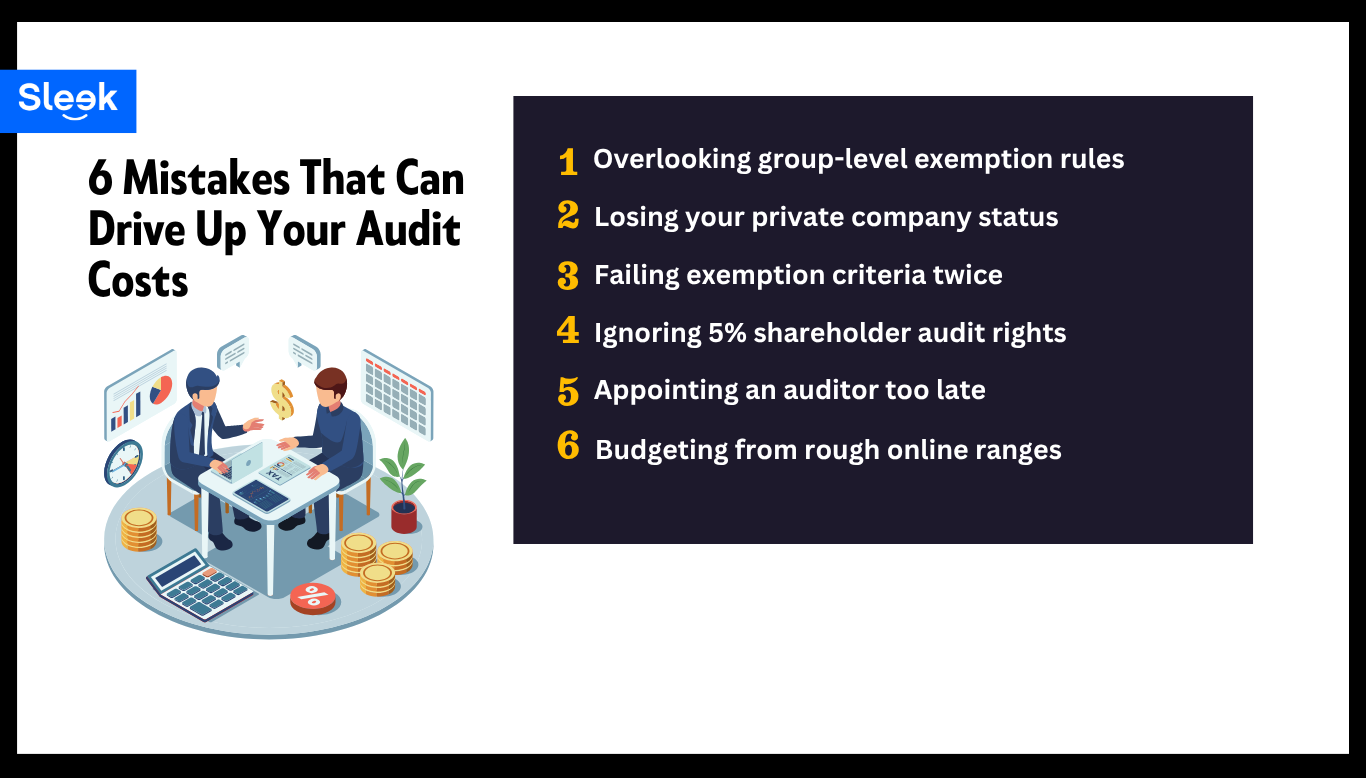
6 Mistakes That Can Drive Up Your Audit Costs
Most problems come from assuming the exemption applies when it does not, or from leaving the audit until it is urgent. These are the common ones:
Assuming a subsidiary is exempt when the group test fails, because the whole group, including foreign entities, must also meet two of three tests.
Ceasing to be a private company during a financial year, which ends the exemption for that year.
Failing two of three tests for two consecutive years, which also ends it.
A shareholder with at least 5% of issued shares asking for an audit, a right ACRA says it keeps, which is how an audit fee for private companies can arrive unexpectedly.
Appointing an auditor late, which narrows your choice of firms and can raise the fee through deadline pressure.
Using a firm’s published range as your budget instead of a written quote.
How Sleek helps with unaudited financial statements
Sleek does not provide statutory audits. Within its accounting and unaudited financial statements service, Sleek prepares year-end and unaudited financial statements for companies that are exempt from audit. If you do need an audit, clean books make the auditor’s job easier.
This page is general information, not accounting or legal advice. Audit fees are negotiated, ACRA’s rules may change, and every figure above comes from the publisher named beside it. Browse the Sleek resources hub for related guides.
What is the difference between an audit and unaudited financial statements?
An audit is an independent examination of your financial statements by a public accountant, who then gives an opinion on whether they are fairly presented. Unaudited financial statements are prepared without that examination and opinion. A company that qualifies for the audit exemption can file unaudited financial statements.
Who can audit a Singapore company?
Audit services in Singapore are provided by public accountants registered with ACRA, and a public accountant issues the audit opinion. To register, ACRA requires prescribed qualifications, audit experience, continuing education and membership of the Institute of Singapore Chartered Accountants. Confirm that your auditor is registered before you appoint them.
How long does a statutory audit take?
AG Singapore says an audit takes about 4 to 8 weeks, which is one firm’s estimate rather than a rule. The time depends on how complete your records are and how quickly you answer the auditor’s questions. Agree the timetable in writing when you accept a quote.
Can a company with corporate shareholders be exempt from audit?
Yes. ACRA says a company can qualify for the audit exemption even if it has corporate shareholders. It must still be a private company that meets two of the three size tests, and the group test applies if it is part of a group.