Think you’re claiming every possible deduction on your investment property? You might be missing one of the biggest. Most investors overlook how to claim depreciation on investment property, one of the valuable deductions left on the table.
We’ll walk you through what it is, how it works, and how to claim it the right way, so your tax return works harder for you.
Think of property depreciation as a tax allowance for the natural wear and tear on your building and its assets over time. As a building gets older, its structure and the various property items inside it lose value. The Australian Taxation Office (ATO) lets property investors claim this loss of value, which is known as investment property depreciation.
Unlike other property expenses, you don’t actually spend money to claim it, making it a non-cash deduction. This makes it a powerful tool for reducing your taxable income without directly affecting your bank balance. These claims are known as depreciation deductions, and they help reduce your taxable income over time.
The government permits this because it acknowledges that assets used to produce income have a limited effective life. The deduction encourages investment in properties and helps owners maintain their residential property portfolio.
Types of depreciation claims for investment property
When you look at depreciation, it is not just one single claim. It is actually broken down into two different categories. Understanding these two types helps you see where the value in a depreciation claim on your investment properties comes from.
What are Capital Works Deductions (Division 43 explained)
This category of tax depreciation applies to the building’s structural elements and any permanent improvements made to the property. Also known as building write-off. Capital works deductions include items that are affixed to the property and not easily removed.
Capital works depreciation deductions are calculated at a standard rate of 2.5% per year over 40 years , provided the property was constructed after 15 September 1987 . If construction began before this date, you may not be eligible to claim capital works unless significant renovations have been carried out after that date.
You can claim capital works deductions for:
The building’s original structure: walls, concrete slabs, roofing, doors, windows, and electrical wiring.
Renovation work: replacing floors, updating kitchens or bathrooms, or extending the building, all may be eligible as long as you have documentation or cost estimates for the work.
Investment property depreciation claims apply to residential rental properties that are used to generate income. If the property was previously owner-occupied, capital works deductions can only be claimed for the period after it became a rental.
To maximise your claim, your quantity surveyor will itemise all qualifying structural components and improvements in your tax depreciation schedule . These figures can then be used by your accountant to apply consistent deductions over the eligible life of the property.
What are Plant and Equipment Assets (Division 40 explained)
Plant and equipment assets are the depreciating assets within your investment property. These are otherwise not part of the structural framework but essential to its function and operation. These assets generally have a shorter effective life than the building itself, and may qualify under instant asset write-off rules for small businesses.
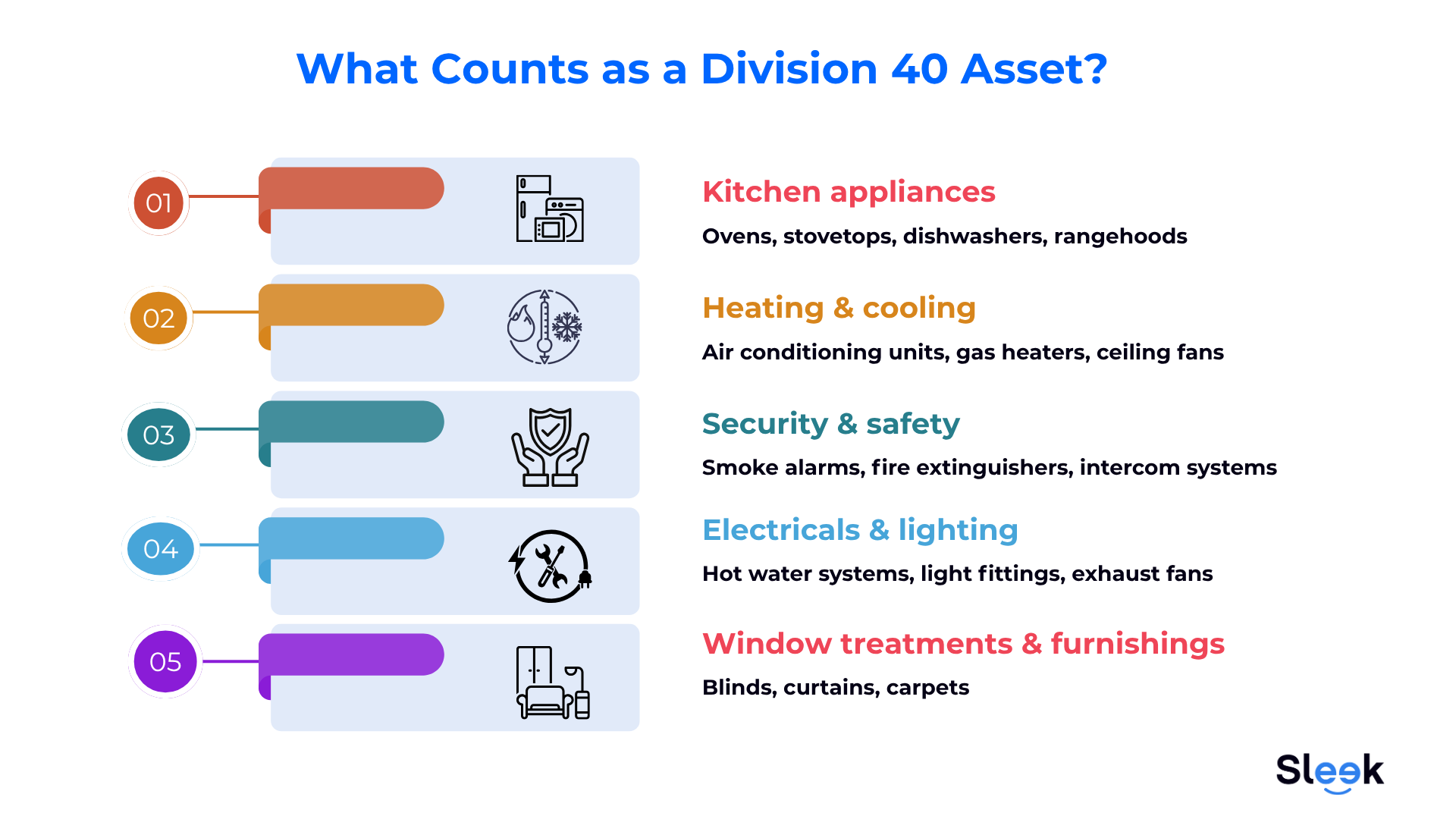
Common examples of Division 40 depreciating assets include:
What counts as Division 40 depreciating assets
Each item’s effective life is set by the ATO and determines the amount you can claim as part of your tax depreciation schedule annually.
To claim correctly and maximise your return, your quantity surveyor will list all plant and equipment items eligible for deduction in your investment property depreciation schedule , including their purchase dates, costs, and effective lives.
How to claim depreciation on investment property
Now that you know what it is, let’s get into the practical steps. The process is quite straightforward if you follow a clear path. It is something you only need to set up once for the lifetime of your property ownership.
Step 1: Check your eligibility
First, your property must be used to generate income, meaning it is tenanted or genuinely available for rent. If you live in the property, you cannot claim depreciation for that period. You must also consider the construction date for capital works and the purchase date for plant and equipment assets, as mentioned earlier.
Step 2: Hire a Quantity Surveyor
This is the most critical step. A qualified professional will assess your property, identify all depreciating assets, and provide a compliant tax depreciation schedule.
They have the specific industry expertise recognised by the ATO to estimate construction costs when the original figures are unknown.
Do not try to estimate these costs yourself, as you will likely miss items and leave money on the table. A good surveyor will inspect the property, identify all eligible assets, and provide specialist solutions in a detailed report. Best of all, the fee you pay for this service is 100% tax deductible.
Step 3: Obtain a tax depreciation schedule
The quantity surveyor will produce a document called a tax depreciation schedule. This report is your roadmap for claims over the property’s 40-year life.
The schedule separates the capital works deductions from the plant and equipment assets. It details the value of each item and calculates the annual depreciation claim for you. This document becomes the proof you need to support your claims at tax time.
Step 4: Choose a depreciation method that works for you
For your plant and equipment assets, you have a choice of two methods for claiming depreciation. Your schedule will usually show the calculations for both, letting you decide which is better for your situation. Your accountant can also help you choose.
Method
How it works
Best for
Diminishing value method
Calculates the deduction based on the asset’s remaining value. It gives you larger claims in the first few years.
Investors who want to maximise their tax return and cash flow in the early years of owning a property.
Prime Cost Method
Calculates the deduction as a percentage of the original cost. It provides an even, predictable claim each year over the asset’s life.
Investors who prefer a consistent and steady tax deduction over a longer period.
Once you select a method, such as the prime cost method, for a specific asset, you must stick with it. Your depreciation schedule will show the annual claims for both methods. This lets you and your accountant make the best choice for your financial strategy.
Step 5: Submit your tax return
With your depreciation schedule in hand, the final step is simple. You just give the schedule to your accountant when they prepare your annual tax return. They will use the figures from the report to fill in the rental property schedule section of your return.
If you do your own taxes, you will find the spot to enter your total capital works deduction and your total plant and equipment depreciation. The schedule does all the hard work for you. It is a one-off setup that delivers powerful tax deductions year after year.
RELATED ARTICLE
Your Simple Guide to Australian Tax Returns
Managing your property’s cash flow and finances
Part 1: What is the cash flow impact? Comparison table on before vs after claiming depreciation.
Scenario
Before claiming depreciation
After claiming depreciation
Tax savings
Missed tax deductions
Claim tax depreciation and reduce your taxable income
Cash flow
Slower debt reduction
Free up cash to pay down mortgage or loans faster
Wealth growth
Limited reinvestment
Accelerated ability to reinvest
Loan readiness
Disorganized records can delay loan approval
Cleaner records improve loan eligibility
Part 2: Pro tips to manage investment property finances
Managing your investment property like a business is the key to better returns, easier tax prep, and stronger borrowing power. Here’s how to do it right:
1. Think like a business owner
Treat your investment property as a standalone business. This helps you stay financially organised and make insightful decisions that drives growth.
2. Separate your banking
Keep your property finances completely separate from personal spending
Have a separate rental income account to keep rent deposits and track income
Set aside funds for repairs and emergencies by maintaining a buffer account
This simplifies expense tracking, improves clarity, and shows lenders you run a tight ship.
3. Use smart banking and accounting tools
Stay in control with digital tools that streamline financial management:
Regularly track expenses, rental income, and loan repayments
Make tax season hassle-free with clear documentation
Strengthen your chances of getting approved for refinancing or new loans
Maintain compliance in case of audits or ATO queries
Bonus Tip:
Explore industry-specific banking solutions designed for property investors, they may include features like rental yield reporting and portfolio tracking.
P.S.: Want to stay on top of your property’s running costs? Keep your investment finances accurate and tax-ready all year round by managing accrued expenses effectively.
Is a tax depreciation schedule worth it? A cost-benefit breakdown
This is a fair question to ask. A quality tax depreciation schedule can cost between $500 and $800, depending on the property. Is the return worth this initial, tax-deductible expense?
Let’s look at a simple example. Say you purchase a property for $700,000, and your new schedule identifies a first-year deduction of $11,000. This is a mix of capital works and new plant and equipment assets you installed.
If your marginal tax rate is 32.5%, that $11,000 deduction would give you a tax saving of $3,575 in the first year alone. You have more than paid for the cost of the report in just one year. Over the first five years, total claims could easily exceed $40,000, resulting in a tax benefit of over $13,000, all from a single, one-off report.
Conclusion
Depreciation is a perfectly legal and smart way for property investors to improve their financial position. It helps lower your taxable income, which means you pay less tax and can use that money for other goals, like building a term deposit. Although the concepts can seem a little dry, the outcome for your bank account is anything but.
By following a clear process, getting a professional tax depreciation schedule is a simple action that delivers a great return. Managing your finances with dedicated bank accounts and using tools like a modern banking app can further enhance your control. Properly implemented corporate governance is also essential if your portfolio is held within a company structure.
Ultimately, understanding how to claim depreciation on investment property is a fundamental part of being a savvy investor. It gives you more power over your financial future and the performance of your assets. Taking this step is key to maximising the returns from all your hard work.
How Sleek can help you maximize property tax deductions?
Sleek helps property investors navigate tax compliance easily and confidently; from depreciation schedules to full tax reporting. Here’s how we support your success:
Get set up with a professional tax depreciation schedule
Ensure full compliance with ATO rules
Maximise your tax savings with strategic filing and reporting
Get complete property accounting support. From rental income tracking to expense categorisation and reporting, we handle the numbers so you can focus on growing your portfolio.
Ready to boost your cash flow and reduce tax? Schedule a consultation call with our experts and start claiming what you’re owed.
Yes, it is often still worthwhile. Even if the property was built before the 1987 cut-off for capital works, it might have undergone renovations by previous owners. These renovations could qualify for their own capital works claims.
Additionally, any new plant and equipment you install, like a new air conditioner or stove, can be depreciated. A quantity surveyor can assess the property to find every available deduction. You might be surprised at what they find in an older residential property.
You can only claim depreciation for the periods your property is genuinely available for rent. If you live in it for a portion of the year, you must apportion your claims accordingly. Your accountant can help you calculate the correct pro-rata amount based on the number of days it was income-producing.
Yes, if your Self-Managed Super Fund (SMSF) owns the investment property, it can and should claim depreciation. The tax deductions reduce the fund’s taxable income, which helps grow the retirement savings within your super fund. The same rules for getting a depreciation schedule apply.
Not necessarily. If you replace an old appliance or install a new fixture, like a dishwasher paid for with your debit card or one of your credit cards, you can often have your existing schedule updated. Some investors prefer to have their accountant add the new asset and track its depreciation separately.
For large-scale renovations, however, getting a new or updated report from your quantity surveyor is a good idea. They can ensure everything is calculated correctly from the start. This makes tax time much simpler for you and your accountant.
Sleek is the preferred partner of entrepreneurs
Expertise in company incorporation, accounting, tax services, and compliance.
Trusted by over 450,000 businesses worldwide.
4.8/5
on Google from 4,100+ reviews.
95% satisfaction rate from 16,000 surveyed clients.