Portfolio Lead, Accounting & Tax Operations – Australia
Colin Lua is a seasoned accounting professional with over 15 years of experience, including the past two years as Portfolio Lead in Accounting & Tax Operations at Sleek Australia. A trusted expert in SME accounting and taxation, Colin specialises in supporting businesses across retail, investment management, and professional services.
He holds multiple professional accreditations, including being a CPA Australia member, NTAA Fellow, and Registered Tax Agent. His academic credentials include a Bachelor of Business, Master of Accounting, and an Executive MBA—underscoring his strong foundation in business and finance.
At Sleek, Colin works closely with small and medium businesses, helping them navigate financial and tax compliance with confidence and clarity. He finds deep satisfaction in achieving successful outcomes for clients, from accurate bookkeeping to timely tax lodgements—believing that it’s the small victories that make a big impact.
Beyond his professional life, Colin enjoys reading history and business books, and recharging on nature hikes. As a child, he aspired to be a business person—something he now fulfills by supporting others on their entrepreneurial journey.
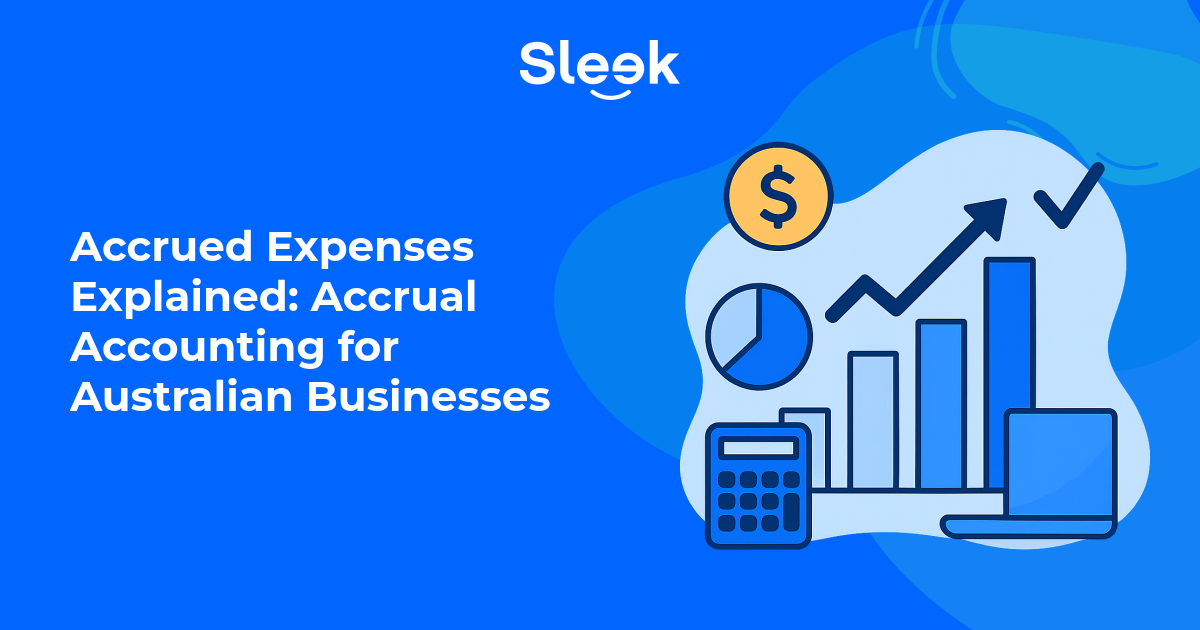
Accrued expenses is one of those accounting terms that sounds far more complicated than it is. If your business has ever used electricity in June but only received the bill in July, you have already met one. Getting these right is what keeps your monthly numbers honest, and it is where accrual accounting quietly earns its keep. This guide explains what an accrued expense is, why it exists, how it is recorded with a worked Australian example, and how it differs from accounts payable. If you would rather not track this yourself, bookkeeping handles it at month-end for you.
What are accrued expenses?
An accrued expense is a cost your business has incurred but not yet paid or been invoiced for, for example wages earned but not yet paid, or electricity used but not yet billed. Under accrual accounting, you record the expense in the period it relates to, not when cash changes hands, and it sits as an accrued liability on your balance sheet until settled. In Australia, businesses with an aggregated turnover under $10 million can generally choose cash or accrual accounting, while most larger businesses must use the accrual (non-cash) method.
The idea is to match the cost to the period that benefited from it. If you used a service in one month, that month should carry the cost, even if the payment lands later.
Why do accrued expenses exist? The accrual principle
Accrued expenses exist because of the matching principle, which sits at the heart of accrual accounting. The principle says expenses should be recognised in the same period as the revenue or activity they relate to.
Without accruals, your reports would swing around based on when bills happened to arrive rather than when costs were actually incurred. A quiet month with lots of unpaid bills would look artificially profitable, and the following month would look worse than it was. Accruals smooth this out so each period reflects what genuinely happened, which is why accrual-based reports give a truer picture for a growing business.
Cash vs accrual accounting in Australia: which applies to you?
Accrued expenses only appear under accrual accounting, so it helps to know which method applies to you. For GST, the ATO lets many smaller businesses choose their basis.
Feature
Cash basis
Accrual (non-cash) basis
Who can use it (GST basis)
Aggregated turnover under $10 million may choose
Available to all; required for most over $10 million
When expenses are recognised
When you pay
When the cost is incurred
Accrued expenses appear?
No
Yes
In short, if your aggregated turnover is under $10 million you can generally account for GST on either basis, while most larger businesses must use the non-cash (accrual) method. We have kept this brief on purpose; for the full comparison, see cash vs accrual accounting.
What does an accrued expense look like? Example and journal entry
Take a fictional business whose June electricity comes to A$1,200, but the bill only arrives and is paid in July. The figures are illustrative.
Because the electricity was used in June, accrual accounting records the cost in June, before any invoice or payment. At 30 June, the business raises an accrual:
Date
Account
Debit (A$)
Credit (A$)
30 Jun
Electricity expense
1,200
30 Jun
Accrued expenses (liability)
1,200
This puts the A$1,200 cost into June’s profit and loss and shows A$1,200 owing on the balance sheet. When the bill is paid in July, the accrual is reversed and the cash goes out, so July is not charged twice.
TIP
The reversal step is where owners most often trip up. If you accrue a cost but forget to reverse it when the invoice arrives, the expense can end up counted twice. Consistent month-end routines prevent this.
Accrued expenses vs accounts payable: what’s the difference?
These two are easy to confuse because both are amounts your business owes. The difference is whether an invoice exists yet.
Feature
Accrued expenses
Accounts payable
Trigger
Cost incurred, no invoice yet
Invoice received
Timing
Estimated at period end
Recorded when the bill arrives
Documentation
Based on your own estimate
Backed by a supplier invoice
Accrued expenses are costs you know you have incurred but have not been billed for, so you estimate them. Accounts payable are confirmed bills you have received and not yet paid. Both are usually current liabilities, sitting alongside longer-term items covered in non-current liabilities.
What are common examples of accrued expenses?
Accrued expenses show up across most businesses. The usual suspects are:
Accrued wages: staff have worked days that fall before payday.
Interest: interest has built up on a loan but is not yet due.
Utilities: electricity, gas or water used before the bill arrives.
Professional fees: an accountant or lawyer has done work not yet invoiced.
Each follows the same pattern: the cost belongs to this period, but the paperwork or payment lands in the next one.
How do accruals affect your profit and loss and balance sheet?
An accrued expense touches two statements at once, which is what makes it useful.
On the profit and loss statement, the accrual increases expenses in the period the cost was incurred, lowering that period’s profit to a truer figure. On the balance sheet, it appears as a current liability, showing the amount still owed. When the bill is finally paid, the liability clears and cash reduces. You can find both statement guides, and more, in the accounting and tax resources hub.
How Sleek helps you get your accruals right
Accruals are simple in theory and fiddly in practice, especially the month-end estimates and reversals. Sleek runs bookkeeping and accounting on Xero and handles accruals as part of the monthly close, so your reports reflect what you have actually spent, not just what has been invoiced.
That means accurate monthly numbers you can rely on for decisions, BAS and year-end, without you chasing the timing yourself.
Get accurate accrual accounting done monthly, with fixed-fee bookkeeping from A$130 a month
Fixed-fee bookkeeping from A$130 a month, with accruals handled at every monthly close.
An accrued expense is a cost your business has already incurred but not yet paid or been billed for. A common example is electricity used in one month where the bill only arrives the next. Under accrual accounting, the cost is recorded in the period it relates to.
Is an accrued expense a liability?
Yes. An accrued expense sits on your balance sheet as a current liability, usually called accrued expenses or accrued liabilities, because it represents money your business owes. The liability clears once the amount is paid.
What is the difference between accrued expenses and accounts payable?
Accrued expenses are costs you have incurred but not yet been invoiced for, so you estimate them at period end. Accounts payable are confirmed supplier invoices you have received but not yet paid. The presence of an invoice is the main dividing line.
Do Australian small businesses have to use accrual accounting?
Not always. Businesses with an aggregated turnover under $10 million can generally choose cash or accrual accounting for GST, while most larger businesses must use the non-cash (accrual) method. Your choice affects whether accrued expenses appear in your accounts.
Are accrued expenses tax deductible?
Whether and when a cost is deductible depends on ATO rules and your accounting method, so this is general information rather than advice. Accrual-based businesses often recognise the deduction when the expense is incurred, but you should confirm your position with a registered tax agent.
How do I record an accrued expense in Xero?
In Xero you typically post a manual journal at period end to recognise the expense and the matching liability, then reverse it when the invoice or payment is processed. Many businesses have their bookkeeper handle these journals as part of the monthly close to keep them consistent.
What happens if I forget to reverse an accrual?
If an accrual is not reversed when the actual bill is recorded, the same cost can be counted twice, understating your profit. This is a common bookkeeping error and is caught by reconciling accrued liability accounts each month.














 TIP
TIP