








-
A resident director is legally required for every Australian company, at least one director must ordinarily reside in Australia.
-
Failing to meet the resident director requirement can lead to compliance action from ASIC, including fines and potential deregistration.
-
Resident director services can help companies meet this requirement while ensuring ongoing ASIC and governance compliance.
You’ve got the idea, the funding, and the drive to expand your business into Australia, but there’s a catch no one tells you about. You can’t even register your company without an Australian resident director. It’s the hidden hurdle that stops many foreign founders mid-launch.That’s where resident director services come in, your secret sauce to legal compliance and peace of mind.
In this guide, you’ll learn why this rule exists, who qualifies, the risks of getting it wrong, and how to meet the requirement confidently.
If you’re setting up an Australian company from overseas, the easiest way to stay compliant is to secure your resident director before registering the business. This ensures your company meets ASIC’s requirements from day one and avoids delays, rejected applications, or gaps in governance.
You can appoint a resident director yourself if you have someone qualified and compliant, or you can use Sleek’s resident director services; we provide an experienced, locally based director who meets ASIC’s requirements and helps ensure ongoing governance and reporting obligations are fulfilled without stress.
Why every foreign founder needs an Australian resident director
Most overseas founders don’t have anyone in Australia who can legally act as a director for their business.
Under Australian law, every proprietary limited (Pty Ltd) company must have at least one director who “ordinarily resides” in Australia. It’s mandatory as it defines how the government ensures there’s a locally accountable individual for compliance, tax, and regulatory communication.
Here’s why this role matters:
- Legal accountability: A resident director acts as the company’s local representative before ASIC and the ATO, ensuring statutory deadlines and reporting obligations are met.
- Business legitimacy: Having a local director demonstrates that your company is genuinely carrying on business in Australia.
- Risk management: The resident director can be personally liable if the company breaches certain obligations, which is why appointing a qualified professional is crucial.
- Incorporation requirement: Without an Australian-resident director, your company cannot be incorporated under ASIC, the system simply won’t allow you to proceed.
For foreign founders, this raises big questions:
- Who can I appoint?
- What if I don’t know anyone locally?
- Can I use a service instead?
That’s where resident director services come in, providing a secure, compliant, and professional solution so you can launch your business with peace of mind.
What is an Australian resident director, and why is it legally required?
Under the Corporations Act 2001, every Australian company must have at least one director who ordinarily resides in Australia. This rule ensures that ASIC and the ATO always have a locally accountable representative for compliance, communication, and official correspondence.
In simple terms, a resident director is a person who:
- Is at least 18 years old
- Ordinarily resides in Australia (citizen or permanent resident)
- Is not disqualified from managing a company
This requirement applies even if your company is 100% foreign-owned, you cannot complete ASIC registration without appointing a qualified Australian resident director.
Who qualifies as an Australian resident director (and who doesn’t)
To qualify, a person must:
- Be an Australian citizen, permanent resident, or hold a valid long-term visa that allows them to ordinarily reside in Australia
- Be legally eligible (not disqualified under ASIC rules)
Who doesn’t qualify:
- Anyone living overseas full-time, even if they make short visits to Australia
- Anyone without a valid Australian residency status
While you could ask a local acquaintance to take on the role, it’s a high-responsibility position with legal duties. Many foreign founders prefer using a professional nominee director service like Sleek to ensure compliance and avoid personal risk.
How many directors do you need for an Australian company?

The number of directors your company needs depends on the type of business structure you register in Australia. Here’s a quick breakdown:
- Proprietary Company (Pty Ltd): One of the most common choices for small to medium-sized businesses. By law, every Pty Ltd must have at least one director who ordinarily resides in Australia. You can appoint additional directors including foreign nationals but one must be a local resident to satisfy ASIC’s requirement.
- Public Company: Typically used by larger organisations or businesses planning to list or raise capital from the public. A public company must have a minimum of three directors, and at least two must be Australian residents.
For most foreign founders, a proprietary limited (Pty Ltd) company is the preferred and most practical option, simple to manage, flexible in structure, and fully compliant for expansion into Australia.
Can a non-resident be a director of an Australian Company?
Yes, absolutely. Non-residents can be directors, and in fact, many Australian subsidiaries and startups have a mix of local and overseas directors.
However, the resident director requirement is non-negotiable:
- Proprietary companies must have at least one resident director
- Public companies must have at least two resident directors
Non-resident directors can still participate in board meetings, vote, and contribute to decision-making remotely, the key is ensuring local representation for compliance.
If you don’t personally know anyone in Australia who can take on this role, consider appointing a professional resident director service. It’s a secure and compliant way to meet ASIC requirements while maintaining full control of your business.
Tip: Make sure to choose a reputable, insured provider, as your resident director holds significant responsibility on behalf of your company.
What are the legal duties and responsibilities of directors in Australia?
A resident director plays a crucial legal role in ensuring a company’s compliance with the Corporations Act 2001 and other regulatory obligations. Here’s a breakdown of their key legal duties and responsibilities:
1. Duty of care and diligence
Directors should act carefully and thoughtfully like any reasonable person in the same role. That means reading the financials, understanding the risks, and doing your homework before deciding
2. Duty of good faith and proper purpose
They must act in good faith in the best interests of the company, and only for proper corporate purposes, not for personal gain or to benefit another entity.
3. Duty to avoid improper use of position
They’ll not use their role to gain an advantage for themselves or someone else, and don’t use it in a way that harms the company.
4. Duty to avoid improper use of information
They’ll not misuse any confidential or company information for personal benefit or to the detriment of the company.
5. Duty to prevent insolvent trading
If the company is insolvent or likely to become insolvent, they’ll not take on new debts. Breaching this can expose you to penalties and personal liability.
Failing to meet the duties can lead to civil penalties, compensation orders, disqualification and in serious or dishonest cases, criminal liability.
What are the Australian tax implications for non-resident directors
Director fees paid to non-resident directors are subject to PAYG withholding under Australian tax law. The company must withhold the correct amount and report it to the ATO. Tax treaties may adjust the final tax payable, but the withholding obligation still applies:
- Company-level registration: The company’s ABN and Tax File Number (TFN) remain linked to the business, not individual directors.
- Personal tax residency: Non-resident directors must assess their personal tax residency and understand how their director income is taxed, this can be complex and may depend on double tax agreements.
- Resident director requirement: If a company fails to meet this requirement, ASIC can issue penalties or take enforcement action. You must appoint a new qualified director immediately and notify ASIC within 28 days.

Having a resident director safeguards your company’s ASIC compliance and credibility, especially if your business is overseas-owned or you travel frequently. Using a trusted local director service helps you avoid penalties and ensures filings like annual statements and director updates are submitted accurately and on time.
What if you don’t have an Australian resident director?
Not every overseas founder has a ready-made contact in Australia. If you find yourself in this situation, you have three practical paths forward.
- Appoint an Australian-based partner or co-founder If you have a trusted local business partner, senior employee, or co-founder who meets the residency requirements, they can be appointed as the resident director. This is a viable option, but it’s important that this person fully understands the significant legal duties and personal liability they are accepting under the corporations act 2001
- Relocate to Australia For founders who plan to move and run their business from within the country, relocating and establishing residency is a long-term solution. This is a major personal and financial commitment that requires careful planning around Australian visas and tax laws.
- Engage a professional resident director service This is the most common, secure, and efficient solution for non-resident founders. Specialist firms provide a qualified professional to act as your company’s resident director.
Crucially, the director serves in a non-executive capacity. Their role is to ensure your company meets its statutory obligations with ASIC, not to get involved in the day-to-day management of your business. A formal service agreement guarantees that you retain full operational control, while they handle the legal formality.
Whichever option you choose, remember that resident director is not a one-time requirement. Your company must maintain a qualified resident director at all times to remain legally compliant in Australia.
What legal documents are required when appointing a director?
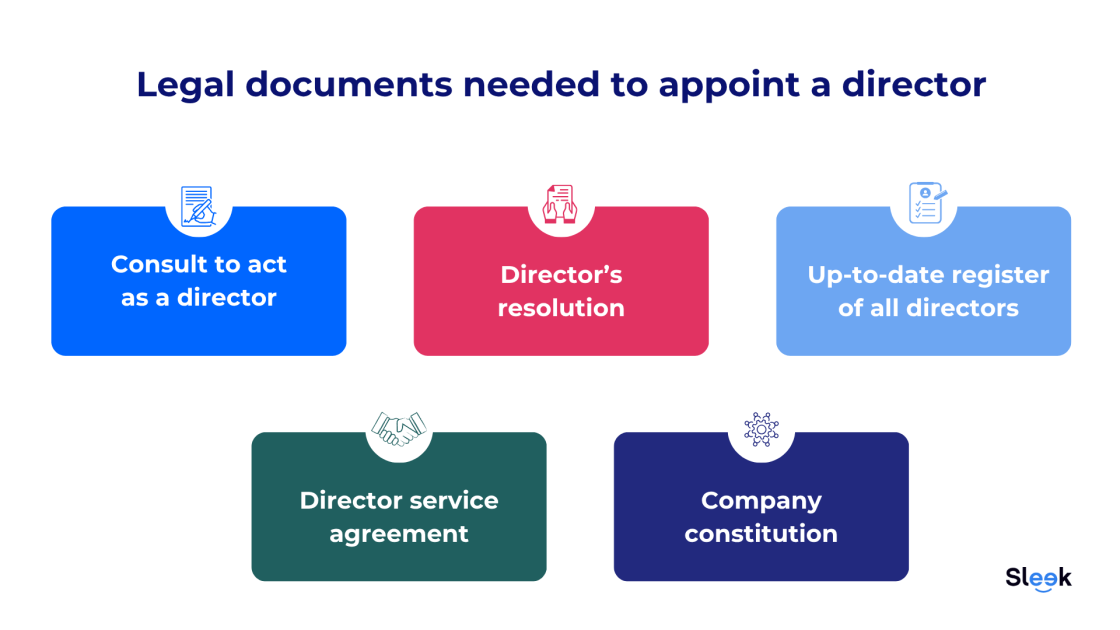
Appointing a director, whether they’re a resident or non-resident, involves more than simply listing their name with ASIC. You’ll need several key documents and governance records to stay compliant:
- Consent to act as director: Every appointed director must provide written consent before taking up the role.
- Directors’ resolution or meeting minutes: A formal resolution or meeting record approving the appointment should be prepared and securely retained.
- Register of directors: Your company must maintain an up-to-date register listing all current and former directors, along with their residential addresses.
- Director service agreement: For directors who aren’t shareholders, a service agreement outlining their responsibilities, compensation, and expectations helps prevent future misunderstandings.
- Company constitution: If your company has a constitution, review and update it to reflect any changes in directorship. It should also clearly define each director’s powers and appointment process.
For founders, ensuring these documents are properly prepared and tailored to your company’s structure is essential for smooth governance, and offers protection if disputes arise later.

Can a nominee director fulfil the resident director requirement?
Not always. A nominee director is typically appointed to represent the interests of a specific shareholder or parent company, often in cases where a business has foreign ownership. Their main purpose is to ensure that the shareholder’s voice is heard at the board level.
However, the resident director requirement under Australian law is entirely separate. The law focuses on where the director actually lives, not whom they represent. To meet ASIC’s requirement, your company must have at least one director who “ordinarily resides in Australia.”
This means that:
- A nominee director can only fulfil the resident director role if they genuinely live in Australia and meet the legal residency test.
- If your nominee director is based overseas, they cannot satisfy this requirement, you’ll still need to appoint a separate Australian resident director.
In short, a nominee director represents ownership interests, while a resident director ensures local oversight and compliance. For many foreign-owned companies, these are two distinct roles, though in some cases, one person may legally hold both positions.
A resident director isn’t just a legal formality, they carry real responsibilities, including being accountable for the company’s tax obligations, ASIC filings, and compliance with Australian law. Even if shareholders are overseas, the resident director can still be held personally liable for breaches, unpaid taxes, or inaccurate reporting, so choosing someone who understands their duties is critical.
How Sleek helps foreign founders register and stay compliant with ASIC
Setting up a company from overseas can feel overwhelming, different laws, local director rules, and tax registrations. At Sleek, we remove the roadblocks so you can focus on growing your business and not juggling with admin.
- Fast company setup:
Register your company with ASIC, secure your ACN, and get your ABN, TFN, GST, and PAYG sorted so you can start trading right away. - Stay compliant with local rules:
Fulfill residency rules with a compliant nominee director, and establish credibility using our registered office address and ASIC agent service. - Ongoing compliance made simple:
We take care of the essentials, from maintaining company records and lodging ASIC changes, to preparing BAS, bookkeeping, and tax filings, so you stay compliant year-round. - Transparent pricing: Fixed-fee packages with no hidden surprises.
From setup to ongoing compliance, Sleek keeps your company organised, accurate, and fully aligned with ASIC, so you can focus on growing your business.
Ready to get started? Schedule a call now!
Answer a few quick questions and get a personalised recommendation.
450,000
businesses worldwide.
from 4,100+ reviews.
satisfaction rate from
16,000 surveyed clients.
Frequently Asked Questions
What if my resident director leaves Australia?
If your sole Australian resident director resigns or relocates overseas, your company will no longer meet ASIC’s residency requirements. To stay compliant, you should:
- Appoint a new director immediately to maintain continuous compliance and notify ASIC within 28 days. Late fees may apply after that.
- Notify ASIC immediately about any changes in your director structure.
- Confirm eligibility, ensure the new appointee genuinely qualifies as “ordinarily resident” in Australia.
How to stay compliant with resident director requirements
Maintaining compliance is an ongoing responsibility. Here are key practices to follow:
- Review your board regularly to confirm residency requirements are met at all times.
- Report any director changes to ASIC without delay.
- Keep accurate company records, including your register of directors, consent forms, resolutions, and meeting minutes.
- Educate your directors, both resident and non-resident, about their legal obligations.
- Consider offering compliance training or induction sessions to ensure everyone understands their responsibilities.
Can a resident director live temporarily overseas and still meet ASIC’s residency requirement?
Yes, but only if Australia remains their primary place of residence and they are considered “ordinarily resident” under ASIC guidelines. Short overseas trips or temporary relocations (e.g. for business or family reasons) may be acceptable. However, if the director permanently moves abroad or no longer maintains significant ties to Australia (such as a home or family base), they may no longer qualify. In that case, you must appoint a new resident director within 28 days to stay compliant.
What’s the difference between a resident director and a nominee director?
A resident director is a legal requirement under the Corporations Act 2001, every Australian company must have at least one director who ordinarily resides in Australia. This person can be an owner, shareholder, or anyone qualified under ASIC’s rules.
A nominee director is often appointed to represent a shareholder’s interests, but they are still a full director under the law. This means they owe the same duties and liabilities as any other director, they must act in the company’s best interests, not just the appointing shareholder.
They can only satisfy the resident director requirement if they ordinarily reside in Australia.