If you’re keen to launch an online store but worried about upfront costs, inventory risks, or managing fulfillment, dropshipping could be the low-barrier model you’re looking for.
This guide breaks down what is dropshipping, how it works, how to get started in Australia, and what to watch out for so you don’t lose money on common mistakes.
By the end, you’ll know whether this model is right for you and how to build a lean, profitable ecommerce store from day one.
Set up a dropshipping company in Australia confidently
Dropshipping is a retail fulfillment method where an online store sells products without holding inventory. Instead, when a customer places an order, the store passes the order details to a third-party supplier like a manufacturer or wholesaler, who ships the product directly to the customer. This approach reduces upfront costs for the seller, since they don’t manage stock or handle shipping, and allows them to focus on areas like marketing and customer service.
Dropshipping relies on a strong connection between your store and your supplier. This connection is what makes the whole model work so well for many people looking to start dropshipping.
Your role is that of a middleman or a curator. You find the products, create a brand around them, and market them to the right audience. You handle the “front end” of the business through your website and social media presence.
Meanwhile, your supplier handles the “back end,” including inventory and fulfillment. Much of this can be streamlined with technology. Many platforms offer automated integration, using dedicated dashboards to sync orders and stock levels effortlessly.
How the dropshipping business model works (step-by-step)
Thinking about how dropshippers work can seem a bit tricky at first. The process is quite straightforward once you break it down. It involves a simple flow of information and products between three key people.
Here’s the basic journey of a dropshipping order from start to finish. You’ll see that your main job is marketing and customer service. The physical side of the business is left to your partner.
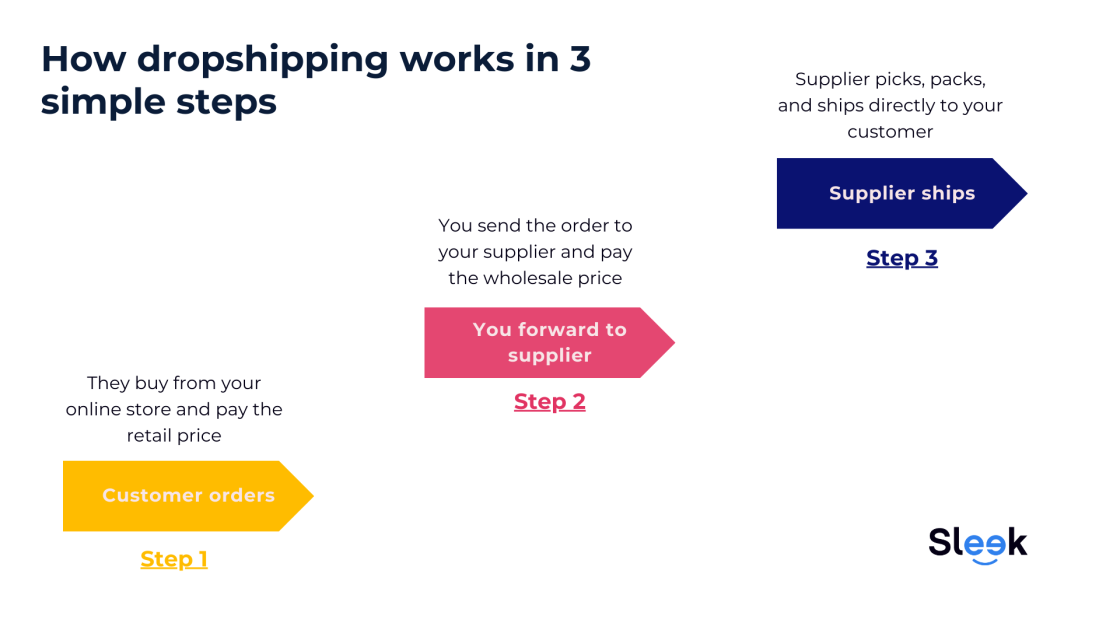
A customer finds your online store and places an order for a product. They pay you the retail price that you set on your site.
You then forward this order information directly to your dropshipping supplier. You pay the supplier their wholesale price for the product as part of the ordering process.
The supplier takes over from here, as the physical shipping is the supplier’s job. They pick, pack, and handle the shipping, that’s their responsibility, sending the product directly to your customer’s address. Your branding can even be on the package, so the customer thinks it came from you.
Who are the key players in the dropshipping chain
Every successful dropshipping operation has three essential players. Each one has a distinct role in the process. Understanding these roles helps clarify how everything fits together.
First, there is the dropshipping supplier.
Their job is to maintain inventory, manufacture or source quality products, and manage the warehouse.
They are also responsible for processing orders and shipping products to the end customer when an order comes through.
Next is you, the retailer.
You manage your online storefront, market your products, and set prices.
You are also the primary point of contact for all customer service questions.
Finally, there is the customer.
They browse your website, make a purchase, and receive the product at their doorstep.
From their perspective, they are buying directly from you and your brand.
RELATED ARTICLE
Launching an Ecommerce Business: The Ultimate Guide
How money and products move in a dropshipping business
The movement of money is a critical part of the process.
Step 1: A customer places an order
A customer buys a product (e.g. a $50 water bottle) from your online store
They pay the full retail price via your website’s payment gateway
Step 2: You place the order with the supplier
You forward the order to your dropshipping supplier
Then you pay the wholesale price (for example: $20)
Step 3: Supplier fulfills the order
The supplier picks, packs, and ships the product directly to the customer
Top 5 benefits of dropshipping for Australian entrepreneurs
Many entrepreneurs are drawn to dropshipping for its clear advantages. The model removes many traditional barriers to starting a retail business. This makes it an attractive option for those with limited funds or space.
The benefits extend beyond just low costs. You also get incredible flexibility in what you sell and how you run your business. Here are some of the biggest upsides.
Low startup costs: This is easily the biggest appeal, as the initial investment is much smaller. You don’t need thousands of dollars in inventory before you even make a sale. Your main costs are building a website and marketing.
Wide product selection: You can offer a huge variety of products to your customers. If you want to test a new item, you just add it to your site without the financial risk of buying stock that might not sell.
Reduced overhead: Forget about paying for a warehouse or dealing with packing and shipping. You also don’t have to struggle with complex inventory management or handle returns to a physical location.
Flexibility and location independence: You can run a dropshipping business from anywhere with an internet connection. This freedom is a major draw for many aspiring business owners.
Easy to scale: As your business grows, you won’t need to change much about your operations. You’ll just be processing orders more frequently, but the fulfillment work is still handled by your suppliers, which is great for scaling.
Dropshipping challenges you should know before starting
It’s important to look at this business model with open eyes. Although it has many benefits, dropshipping also comes with its own set of challenges. Knowing these ahead of time can help you prepare for them.
These potential problems can affect your profits and your brand’s reputation. Being aware of them is the first step toward finding smart solutions. Let’s explore some of the common hurdles that dropshippers face.
Lower profit margins: Because the supplier is doing a lot of the work, your profit margins are smaller. There is intense competition, which often leads to price wars that squeeze your profits even more. You need to keep prices competitive while covering your costs.
Shipping complexities: If you use multiple suppliers, shipping can get complicated and costly. A customer might order three items from three different suppliers, leading to three separate shipping costs and delivery times. Ensuring reliable shipping from all partners is vital.
Supplier errors: When your supplier makes a mistake, it’s your problem to fix. A low-quality product or a botched order reflects badly on your business, not theirs, so vetting for quality products is essential.
Inventory management: You have to sync your website with your supplier’s stock levels. If a customer orders an out-of-stock item, you have to break the bad news and give a refund, which can damage customer trust.
Building a strong brand: You have little control over product quality and packaging. This can make it hard to create a unique customer experience and build a memorable brand unless you find a supplier with a white-labelling service.
How to choose a profitable dropshipping niche and products
To choose a profitable dropshipping niche and products, focus on markets with strong demand, passionate customers, and good profit margins. Start by researching trends and competitors, then validate product demand using tools like Google Trends or keyword data. Avoid picking random items. Look for niches where customers have recurring needs, are willing to spend, and face limited competition.
This means doing your research before you even think about building a website. It is the foundation of your entire business.
Choosing a niche
A niche is a specialised segment of a larger market. Instead of selling “clothes,” you might sell “eco-friendly baby clothes.” A focused niche helps you stand out from the competition.
How to choose it:
Think about problems you can solve or hobbies that people are passionate about.
Products for activities like camping, gardening, or pet care often do well.
You can use free tools like Google Trends to see what people are searching for and if a niche is growing.
Look for products that are hard to find in local shops. Also, consider accessories or items that people buy repeatedly. This can help you get more repeat customers over time.
Best places to find trustworthy dropshipping suppliers
Your supplier is your most important partner. A great supplier can make your business run smoothly, while a bad one can ruin it. Finding trustworthy dropshipping suppliers is a critical step in the process.
Start by looking at online supplier directories and platforms.
Some connect directly with e-commerce platforms, which can simplify how you add products to your store.
Make sure you check reviews and ratings for any supplier you consider.
It’s important to compare prices online to find partners who offer competitive prices. However, the cheapest option isn’t always the best. You need to balance cost with reliability and product quality.
How to vet dropshipping suppliers for quality and support?
Before you commit, always order a few test products for yourself. Why?
This lets you check the product quality, actual shipping times, and the quality of the packaging.
Strong communication and good customer support from the supplier are also very important signs of a good partner.
Ask potential partners for accurate product specs and high-quality images for your website.
You must provide detailed descriptions for your customers.
Establishing clear terms from the beginning about return policies, potential restocking fees, and communication methods is non-negotiable.
Some suppliers offer a white-labelling service, they’ll add your branding to packages and invoices. This service is a fantastic way to build your brand and create a professional customer experience. They’ll add your logo, creating branded versions of products that appear to come directly from you.
How to set up a dropshipping store in Australia
Once you’ve chosen your niche and found a supplier, it’s time to build your online home. This is where your customers will find you and make purchases. Making this process smooth for them is very important.
There are also some business and legal steps you need to take in Australia. Getting these right from the start will save you a lot of trouble later. Let’s go through the key things you need to do.
Choosing an ecommerce platform: Shopify vs. WooCommerce
You need a platform to build and manage your online store. There are many options available, each with its own pros and cons. Two of the most popular choices for beginners are
Shopify
WooCommerce.
Let’s compare both these platforms:
Feature
Shopify
WooCommerce
Set up
Shopify is a subscription-based service. All-in-one platform with built-in hosting and payment solutions
Easy to use, ideal for beginners with no technical background
WooCommerce is a free WordPress plugin. Needs separate hosting setup
Requires technical setup and familiarity with WordPress
SEO
No SEO included
SEO tools are included
Customer support
24/7 support from Shopify team
Ticket and forum support.
Customizable
Closed platform. You can only modify to the extent that Shopify allows
Open source. You can modify your store freely without any limitations
Themes and designs
More than 50 themes or store designs are available, of which few are free.
Thousands of store designs are available with WordPress themes and page builders.
Hosting
Included
Not included
SSL certificate
Free SSL certificate
Free SSL certificate but through hosting provider
Payment gateways
Accepts all well-known payment gateways, like Stripe, Shopify Payments, and more
Accepts all well-known payment gateways, like Stripe, Mollie, Adyen, WooCommerce Payments etc
Best for
New sellers wanting a plug-and-play experience
Users who already have a WordPress site or want full design control
How do you legally set up a dropshipping business in Australia?
Operating a dropshipping business in Australia means following local laws and regulations.
1. Register for an ABN (Australian Business Number)
Required for operating any business in Australia
It’s a unique 11-digit number used to identify your business to the government
ABN Registration is free, you can do via Australian Business Register
RELATED ARTICLE
What is an ABN Number and Why Does Your Business Need It?
A qualified ecommerce accountant can help you plan for tax from the start, protect from legal issues, and ensure you’re meeting legal obligations.
How to calculate dropshipping profits
The core question for any business is about profit. The dropshipping profit model is based on the margin between the wholesale price and your retail price. It’s a simple calculation, but one you must manage carefully.
1. Understand the profit formula
At the heart of dropshipping is a simple equation: Retail Price – (Wholesale Cost + Shipping) = Gross Profit
Example:
You sell a product for $200
Supplier charges $120 + $10 shipping
Your gross profit = $70
But that’s just the starting point.
2. Factor in real costs
Your gross profit isn’t your final take-home. You’ll also need to subtract:
Any subscription tools you use for automation or analytics
That means your net profit might look like this:
Item
Cost/Revenue (Example)
Product Retail Price
+$200.00
Supplier Wholesale Cost
-$120.00
Supplier Shipping Cost
-$10.00
Gross Profit
=$70.00
Average Marketing Cost Per Sale
-$25.00
Website and App Fees
-$5.00
Net Profit
=$40.00
Managing these numbers closely is key to a profitable business. You have to balance your pricing with your advertising spend. You must make sure each sale brings in enough to cover all your costs and leave a profit.
3. Keep tracking and adjusting
The key to sustainable profit:
Monitor every cost regularly
Test different pricing or marketing channels
Optimize for customer acquisition costs (CAC) and lifetime value (LTV) This ongoing analysis is what separates hobby stores from scalable businesses.
Is dropshipping still profitable in Australia today?
You might see talk online about dropshipping being too saturated or that it is dead. The truth is that the landscape has certainly become more competitive. Some believe it’s easy, but the days of selling generic products for a quick profit are largely over.
But this does not mean the opportunity is gone. It just means that success today requires a smarter approach. You have to build a real brand, not just a store, by leveraging tools like social media to connect with an audience.
Focusing on the Australian market can give you an edge. You can offer faster customer support in the local time zone. You can also build a community around your brand that connects with Australian customers, creating a loyal following that bigger, international stores can’t match.
Conclusion
So, we’ve broken down the question of what is dropshipping. It’s a fulfillment model that lets you enter the e-commerce space with less risk and a lower initial investment. You act as the storefront, connecting customers with products from suppliers who handle the shipping.
This model has clear benefits, like low startup costs and flexibility. But it also has real challenges, such as tight profit margins and reliance on your suppliers. Success depends on careful planning, hard work, and building a brand that people trust.
Dropshipping isn’t a shortcut to instant wealth. It’s a legitimate business model that can be rewarding for those who treat it like one. With the right strategy and a focus on customer experience, it remains a powerful way to build an online business in Australia.
How Sleek can help your dropshipping business
Running an online store? Don’t let accounting slow you down.
Sleek makes it easy for Australian ecommerce founders to stay on top of tax, compliance, and finances, so you can focus on growing your business.
Ecommerce experts: Our experts know ecommerce inside and out, handling refunds, returns, and foreign tax rules to keep your books clean and your profits on track.
Stay tax-ready all the time: Let us handle your reconciliations, GST, and tax deadlines, so you never miss a deadline, avoid ATO penalties, and stress.
All-in-one accounting for ecommerce: From setting up your ABN to lodging your BAS and managing GST, our dedicated accountants handle all of your ecommerce accounting.
Transparent pricing: No hidden fees. Only pay for the services you need.
Spend less time on admin and more on sales. Let Sleek handle your ecommerce accounting. Schedule a call now!
If your total business turnover (including dropshipping revenue) exceeds $75,000 AUD per year, you must register for GST. This applies even if your supplier is overseas. If you’re under the threshold, registration is optional, but claiming GST credits won’t be possible.
Most small online stores start with cash-based accounting due to its simplicity, you only report income and expenses when money actually changes hands. However, as your store scales, switching to accrual accounting can offer better financial insights, especially if you’re running promotions or handling pre-orders.
Read our complete guide on Cash vs accrual accounting methods and understand which one suits your business more.
Yes. Most costs associated with running your dropshipping business, like Shopify/WooCommerce fees, advertising spend (Meta, Google), subscription tools (e.g. Oberlo, inventory apps) are tax-deductible. But your bookkeeping needs to clearly separate business from personal use.
Sleek is the preferred partner of entrepreneurs
Expertise in company incorporation, accounting, tax services, and compliance.
Trusted by over 450,000 businesses worldwide.
4.8/5
on Google from 4,100+ reviews.
95% satisfaction rate from 16,000 surveyed clients.