










In Australia, you register a business name only if you trade under a name different from your personal or company name, while a company name is registered automatically when you set up a company, there is no separate “trade name” registration.
Business name registration costs are fixed by ASIC at $45 for one year or $104 for three years, and the fee applies per name, per registration or renewal, not per business.
Many unnecessary costs come from registering the wrong name type, such as registering both a company name and a business name when only one is required, or registering a business name under the wrong ABN and having to cancel and re-register.
If you’re setting up a business, one of the first things you’ll want to know is how much it costs to register a business name in Australia. The answer isn’t always obvious, especially when business names, company names, and trade names are often confused.
Registering the wrong name or choosing the wrong structure can lead to unnecessary fees and extra admin later. Knowing what needs to be registered and what doesn’t makes a real difference.
This guide explains the cost of registering a business or company name, how each registration works in Australia, and how to choose the right option based on how you plan to operate.
Before registering, decide whether you’ll trade under your full company name (including “Pty Ltd”) or a separate business name.
This choice determines whether you need to register one name or both and helps you avoid paying for unnecessary business name or company name registrations.
What’s the difference between a business name, company name, and trade name in Australia?
Before looking at costs, it’s important to understand what you’re actually registering. Business names, company names, and trade names are often used interchangeably, but they are not the same and they come with different registration requirements.
Name | What it means | Do you register it? | Who registers it? |
Business name | The name you trade under if it’s different from your personal or company name | Yes | ASIC |
Company name | The legal name of a company (e.g. Pty Ltd) | Yes (when registering a company) | ASIC |
Trade name | An informal term for the name a business trades under | No separate registration | N/A |
The name you need to register depends on how your business operates.
- If you’re a sole trader trading under your own personal name, you usually don’t need to register a business name.
- If you trade under any other name, registering a business name is required.
- If you register a company, the company name is registered automatically as part of the company setup.
- There is no separate process to register a trade name in Australia, registering a business name covers this.
This distinction is important because many business owners end up paying more than they need to. Common reasons include:
- Registering both a company name and a business name when only one is required
- Or searching for “trade name registration” without realising that a business name is the correct registration.
Understanding the difference upfront helps you register only what’s necessary, avoid duplicate fees, and keep your setup costs as low as possible.
How much does it cost to register a business name in Australia?
Registering a business name in Australia is relatively affordable, but the exact cost depends on how long you choose to register the name for. Business names are registered with ASIC and can be set up for either one year or three years.
You can only register a business name if you already have an Australian Business Number (ABN) (sole trader, company, partnership, or trust). The name cannot exist without an underlying business structure.
ASIC business name registration fees:
Registration period | Cost to register business name |
1 year | $45 |
3 years | $104 |
The registration fee applies per business name, not per business or per ABN. These fees apply when you register a new business name, re-register a name after a transfer, or renew an existing one.
A few other things to keep in mind:
- There’s no fee to check name availability
- You don’t pay a separate fee to cancel a business name
- An ABN is required, but applying for one is free
- You won’t pay again unless you register another name, renew it, or transfer it to a new entity
If a business name isn’t renewed on time, it can be cancelled and may need to be re-registered, which means paying the registration fee again. For businesses planning to trade long term, registering for three years can be more cost-effective and reduces the risk of missing a renewal.
How do you register a business name in Australia?
Registering a business name is a critical step when you want to trade under a name that is different from your legal entity’s name. In Australia, all business names are registered with ASIC, and the process can be completed online with the right details and an active ABN.
What you need to know before starting the business name registration
Before registering a business name, make sure you:
- Have a valid Australian Business Number (ABN), ASIC requires an ABN to link the business name to your entity.
- Decide the entity that will hold the name (sole trader, company, partnership, trust).
- Confirm the name meets ASIC naming rules (no prohibited or misleading terms).
If you don’t already have an ABN, you can apply for it at the same time using the Australian Government’s Business Registration Service.
Step-by-step guide to registering a business name with ASIC
Step 1: Check Name Availability
Use the business name checker toolto check if your desired name is available and not identical (or nearly identical) to an existing name.
Step 2: Log In or create an ASIC Connect account

- Go to ASIC Connect and log in
- If you don’t already have an account, create one using your email address
- This account will be used to manage registrations, renewals, and updates
Step 3: Select “Register a Business Name”
Once logged in to ASIC Connect:
- Choose “Register a business name” from the available transactions
- Start a new application

This begins the formal registration process.
Step 4: Enter the ABN and entity details
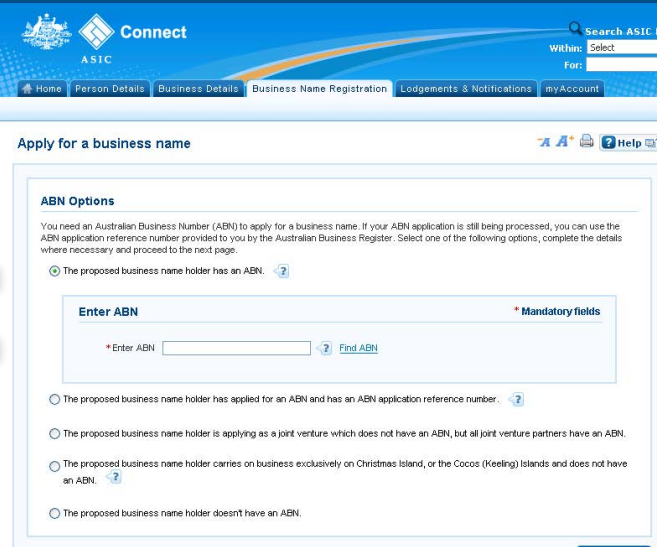
ASIC requires the business name to be linked to a legal entity.
- Enter the ABN that will hold the business name
- Confirm the entity type (sole trader, company, partnership, or trust)
The business name will be registered under this ABN.
Step 5: Enter the business name and addresses
Provide the registration details exactly as required:
- Enter the business name exactly as you want it to appear on the register
- Provide the address for service of documents (this appears publicly)
- Enter the principal place of business
Incorrect details at this stage may require cancellation and re-registration.
Step 6: Choose the registration period
Select the registration duration:
- 1 year, or
- 3 years
The fee depends on the period selected. Choosing three years reduces how often renewals are required.
Step 7: Review, pay, and submit the application
Before submitting:
- Review all details carefully (name spelling, ABN, addresses)
- Confirm the registration period
- Pay the registration fee
Once submitted, ASIC processes the application.
Step 8: Receive confirmation and start trading
After approval:
- A record of registration is sent to your email
- The business name appears on the Business Names Register
- You can start trading under the business name immediately
ASIC does not issue a physical certificate, the confirmation email and register listing are sufficient.
How long does it take to get a business name in Australia?
Once you submit your application through ASIC Connect and pay the registration fee, the process is usually quick:
- Fast processing in many cases: Applications that meet all requirements and don’t need manual review are often processed soon after submission.
- Short waiting time if reviewed: If ASIC needs to review your application (for name similarity or eligibility checks), processing may take a few business days.
- No required waiting period: There is no mandatory delay, you can generally start trading under your business name as soon as it is registered.
Important:
- If your application has errors or missing details, approval can be delayed.
- ASIC does not issue a separate physical certificate, your confirmation email and ASIC Connect record are sufficient proof of registration.

The real cost of registering a business name isn’t the ASIC fee; it’s registering the wrong name. How you plan to trade determines whether you need a business name, a company name, or both, and getting this wrong often leads to duplicate fees and avoidable rework later.
How much does it cost to register a company name in Australia?
In Australia, a company name cannot be registered on its own. The company name is registered only when you register a company, because the name belongs to the company as a legal entity.
This means you must first decide on and register a company structure (such as a proprietary limited company) before a company name can exist.
Cost component | Cost to register a company name | What it covers |
Company registration fee (proprietary company with share capital) | $611 | Registers the company and its company name, and allocates an ACN |
ABN registration | $0 | Applying for an ABN is free |
- There is no separate fee just to “register a company name”, the name is included in the company registration process.
- You must register a company structure before a company name can be registered.
- Registering a company name does not automatically register a business name.
- If the company trades under a different name, a separate business name registration (with its own fee) is required.
How do you register a company name in Australia?
In Australia, you don’t register a company name on its own. A company name is registered automatically when you register a company with ASIC, because the name belongs to the company as a legal entity.
This means the process of registering a company name is the same as registering a company.
What you need to know before company name registration
Before registering a company name, you need to have these decisions and details ready:
- The company structure (most commonly a proprietary limited company – Pty Ltd)
- The proposed company name, or a decision to use an Australian Company Number (ACN) as the company name
- At least one director (with a Director ID)
- A registered office address in Australia
- Details of shareholders and share structure
If any of these are missing or incorrect, ASIC may delay the registration.
Step-by-step guide to registering a company name in Australia
Step 1: Choose a company name
The name must be available and comply with ASIC naming rules, including required words like “Pty Ltd” and restrictions on misleading or sensitive terms.
Step 2: Check name availability
Search the ASIC register to ensure the company name is not identical or nearly identical to an existing name.
Step 3: Prepare company details
This includes director details, addresses, share structure, and shareholder information.
Step 4: Register the company with ASIC
Submit the company registration application online. When ASIC approves the application:
- The company is created
- The company name is registered
- An Australian Company Number (ACN) is issued
Step 5: Apply for an ABN
An ABN can be applied for at the same time or immediately after company registration. Applying for an ABN is free.
Important things to know
- You cannot register a company name without registering a company
- The company name is owned by the company, not the directors or shareholders
- Registering a company name does not register a business name
- If the company trades under a different name, a business name must be registered separately
When do you need a business name in addition to a company name?
Use the table below to check whether your company needs to register a separate business name based on how it trades.
How your company presents itself to customers | Is a business name required? | What you should do |
Trades using the full registered company name, including “Pty Ltd” | No | You can trade under the company name without registering a business name |
Uses the same company name on invoices, contracts, website, and marketing | No | No additional registration needed |
Trades under a shortened version of the company name | Yes | Register the shortened name as a business name |
Uses a brand or trading name different from the company name | Yes | Register the brand name as a business name |
Does not use “Pty Ltd” publicly when trading | Yes | Register the trading name as a business name to stay compliant |
Common business and company name registration mistakes that increase costs

Registering business and company names is simple, but small missteps often lead to unnecessary fees or rework. These are the most common (and avoidable) ones.
- Registering a company before deciding how you’ll trade
Many businesses register a company when a business name would have been enough, locking themselves into higher setup and ongoing costs. - Registering both a company name and a business name when only one is needed
If a company trades under its full registered name (including “Pty Ltd”), a separate business name registration isn’t required, registering both leads to duplicate fees. - Treating “trade name” as a separate registration
There is no standalone trade name registration in Australia. Misunderstanding this often results in registering the wrong name or registering unnecessarily. - Registering a business name under the wrong ABN
Business names must be linked to the correct legal entity. Registering under the wrong ABN usually means cancelling and paying to register again. - Skipping trademark checks
A registered business or company name doesn’t protect your brand. Discovering a trademark conflict later can force a costly rebrand. - Missing renewal deadlines
Letting a registration lapse can mean paying to re-register or losing the name entirely.
Should you register a business name yourself or get help?
You can register a business or company name yourself through ASIC, but whether that’s the best option depends on how simple or connected the registration is to other decisions.
Situation | What works best |
Straightforward business name registration with a clear ABN and no structure change | Doing it yourself is usually sufficient |
Registering a company and company name together | Getting help can save time and prevent setup errors |
Unsure whether you need a business name, company name, or both | Professional guidance helps avoid duplicate registrations |
Registration tied to future growth, branding, or restructuring | Support reduces the risk of costly changes later |
Want clarity on compliance and next steps after registration | Getting help provides end-to-end certainty |
Important to note:
- Name registration decisions tend to look simple on the surface, but they often connect to bigger choices around structure, branding, and compliance.
- When those pieces aren’t aligned from the start, the cost usually shows up later in the form of re-registrations, changes, or delays.
- Getting the setup reviewed or handled properly upfront helps ensure you register once and don’t have to undo or repeat it as the business grows.

Registration costs usually rise due to avoidable mistakes, like registering under the wrong ABN, paying for unnecessary name registrations, or re-registering after errors. Getting your structure and trading name right upfront helps avoid duplicate fees, rework, and delays.
How Sleek can help with business name registration
Business and company name registration works best when handled as part of a complete setup, not as isolated steps. Sleek supports the full process, ensuring everything is registered correctly and in the right order.
- End-to-end setup: Expert support helps identify the right business structure and handles the full name registration process, including ABN and tax registrations where required.
- Dedicated ASIC agent for ongoing compliance: Access to a dedicated ASIC agent ensures official lodgements, updates, and notifications are managed correctly, reducing the risk of missed obligations or incorrect filings as details change over time.
- Ongoing tax and compliance support as the business operates: Assistance extends beyond registration to tax return preparation, filings, and regulatory requirements as the business grows.
- Transparent pricing with no hidden fees: Clear, upfront pricing provides full visibility of costs before proceeding, with no surprise charges during or after setup.
Answer a few quick questions and get a personalised recommendation.
450,000
businesses worldwide.
from 4,100+ reviews.
satisfaction rate from
16,000 surveyed clients.
Frequently Asked Questions
If I change my company name later, do I need to re-register my business name?
It depends. If your business name is different from the new company name, it can usually remain registered. However, if the business name is meant to match the company name, you may need to cancel or transfer the business name to align with the new structure.
What are the real benefits of registering a business name (beyond compliance)?
Registering a business name helps establish a formal trading identity that supports how your business operates and grows.
Creates a recognised trading identity that can be used consistently across contracts, invoices, and banking
Makes it easier to open business bank accounts and set up payment gateways
Improves credibility with customers, suppliers, and partners
Simplifies future changes such as restructuring, adding partners, or selling the business
Helps maintain continuity of the trading name as the business grows
For businesses planning to scale or evolve, registering the business name early provides clarity and flexibility down the line.
How can I protect my business or company name beyond registration?
Registering a name allows you to trade under it, but it does not protect it as a brand.
Business and company name registration does not give exclusive brand rights
To protect the name, you need to register a trademark with IP Australia
A trademark gives you exclusive rights to use the name or logo in selected classes
Trademark protection helps stop others from using identical or confusingly similar names
Many businesses register the name first, then trademark it once the brand proves value
Checking trademarks early reduces the risk of forced rebranding later