







- Choosing the right structure, accounting system, and tax registrations from day one makes it far easier to scale, hire staff, sell online, and stay compliant as your clothing brand grows.
- Most clothing brands don’t need a specific licence, but must meet ASIC registration rules, GST thresholds, Fair Work obligations, and mandatory labelling and consumer law requirements, especially for online stores and children’s clothing.
- Starting a clothing business in Australia in 2026 can range from a few thousand dollars for an online store to $50,000+ for a physical boutique, depending on structure, manufacturing, marketing, and compliance setup, planning these costs early avoids cash-flow shocks later
Turning your fashion ideas into a real business can feel daunting, from finding manufacturers and building your brand to meeting Australia’s company registration and tax requirements. If you’re wondering how to start a clothing brand in Australia, this guide walks you through every step with clarity and confidence.
In this guide, you’ll learn everything you need to go from idea to your first client, including:
- How to research your market
- Register your business
- What licenses and permits are required for opening a clothing brand
- Manage finances
- Stay compliant with local laws
Whether you’re launching an online store or opening a boutique, this roadmap helps you do it right from day one.
If you’re confident handling registrations and compliance, you can register your ABN, business name, and even a company yourself through ASIC and the Business Registration Service but clothing businesses often hit complexity quickly with GST, inventory, online sales, and payroll.
Sleek lets you set up your structure, registrations, tax, and accounting in one place, so your clothing brand launches legally, tracks costs correctly from day one, and stays compliant as you grow, without getting stuck in admin when momentum matters most.
10 steps to start a clothing brand in Australia
From choosing your niche to registering your business and sourcing manufacturers, these 10 steps will guide you through everything you need to start a clothing brand in Australia.
Step 1: Do market research and define your niche
Before investing in fabrics, designs, or marketing, you need a deep understanding of the Australian clothing market. The fashion industry here is fast-growing and highly competitive, so defining a clear niche is what separates profitable brands from short-lived trends.
Start by researching what’s already working:
- Identify your audience: Who are you designing for: men, women, kids, or a specific lifestyle like activewear or streetwear?
- Analyse competitors: What do they do well? Where are the gaps?
- Spot emerging trends: Buyers are leaning into sustainable or locally made pieces, inclusive sizing, and limited-edition drops. Note which trends align with your capabilities, not all belong in your brand.
- Validate demand: Use Google Trends, marketplace searches, and social media insights to confirm there’s real interest in your niche before producing stock.
Choosing a niche helps you focus your branding, pricing, and marketing strategy, making every dollar of investment more effective. For example, a label focused on eco-friendly fabrics or minimalist workwear will attract a specific, loyal audience and give you a clearer brand story to tell retailers later on.
Step 2: Create a robust business plan for your clothing brand
A well-crafted business plan is the foundation of any successful clothing business. It serves as a roadmap for your venture and is essential if you’re seeking funding, partnerships, or loans. It helps you set clear goals, allocate resources effectively, and measure progress as your clothing brand grows.
Your business plan should include:
- Executive summary
- Company description
- Market analysis
- Organisation and management structure
- Product line description
- Marketing and sales strategies
- Financial projections
Be sure to outline your short-term and long-term goals, and explain how your brand will stand out from competitors. .
Financial projections are particularly important.
- Estimate your costs for design, production, marketing, and operations, and forecast revenue for at least the first three years.
- This helps you understand how much capital you’ll need and when you can expect to turn a profit.
For example, if you’re launching an online clothing rental business, you’ll need to include:
- How much customers will pay per rental
- How much you’ll spend on initial inventory
- How long it will take to recover those costs.
Include details like your expected return on investment (ROI) and the timeline for achieving profitability.
Step 3: Register your clothing brand in Australia
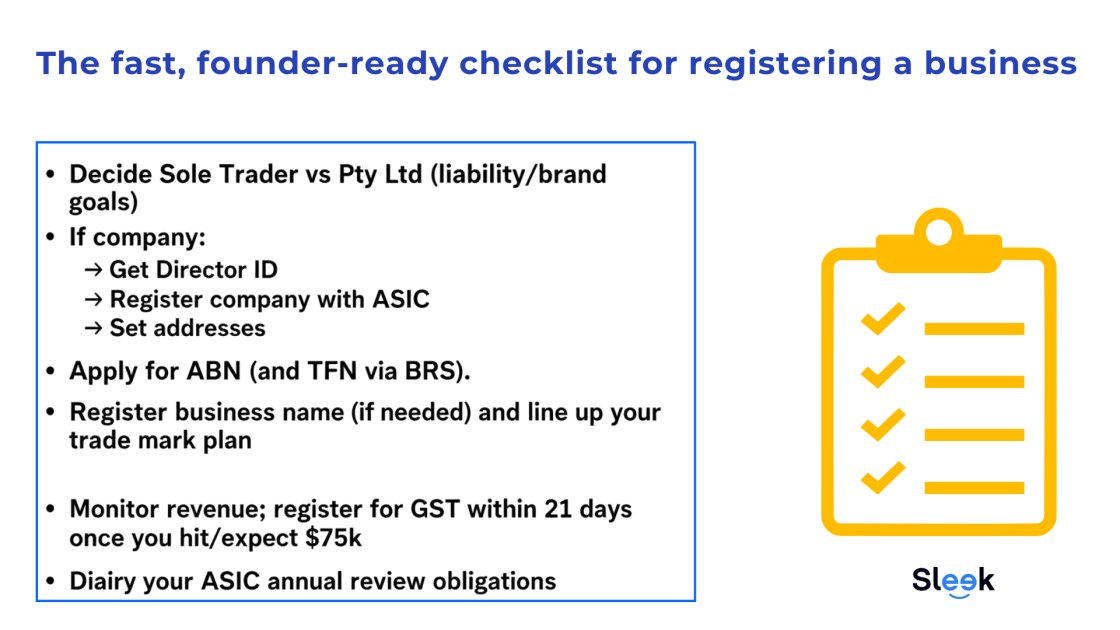
Think of this step as laying the right legal foundation so you don’t trip on compliance later. You’ll pick a structure, sort a couple of IDs, and complete a handful of registrations in the right order.
Here’s how to get started:
1. Choose a business name for your clothing brand
- Pick a name that reflects your brand identity and is easy for customers to remember.
- Before finalising it, check its availability on the ASIC (Australian Securities and Investments Commission) website. If available, you can register it directly through ASIC.
- Trade mark (optional): A business name doesn’t give exclusive rights. Consider a trade mark to protect your brand elements (name/logo) in your classes (e.g., apparel).
2. Register for an Australian Business Number (ABN)
- An ABN is essential for invoicing, claiming GST credits, and legally operating your clothing business.
- You can apply online through the Australian Business Register (ABR).
Read more: What is ABN and how to apply for it
3. Choose the right business structure
The structure you choose determines your legal obligations, tax responsibilities, and personal liability. Common business structure options include:
- Sole trader: The simplest and most affordable setup, suitable for small operations and online boutiques. However, it offers no personal liability protection.
- Partnership: Ideal for two or more people running the business together, sharing profits and responsibilities.
- Company (Pty Ltd): A separate legal entity that provides limited liability and added credibility but comes with higher compliance and reporting requirements.
If you chose a PTY LTD company, you’ll also need:
- Director ID: Every director must obtain a director identification number (apply online via ABRS). Do this first; you’ll need it to complete company set-up
- Company registration (ASIC): Register the company name (or use an ACN as name initially), set share structure, and appoint officeholders. You can register directly with ASIC or via the government’s Business Registration Service.
- Addresses: Provide a registered office and principal place of business; both must be physical street addresses in Australia (no PO Boxes). Keep these updated with ASIC if they change.
- Ongoing: Expect an annual review: pay the fee, confirm details are current, and pass a solvency resolution each year around your registration anniversary.
Read more: What is a PTY LTD company and how to set it up in Australia?
4. What licenses and permits are required for clothing brands in Australia
Most clothing businesses in Australia don’t need a specific licence to operate. However, you must register your business, get an ABN, and follow local council rules.
- If you’re opening a physical store, check with your local council for permits related to signage, waste, and shop fit-outs.
- If you’re selling at markets or pop-ups, you may need a temporary trading permit from your council.
- All online clothing stores that collect personal data (e.g., via website, email, or cookies) must have a compliant Privacy Policy under the Privacy Act 1988, even if their turnover is under $3 million.
In short: You usually don’t need a licence, but you do need the right registrations and local approvals.
5. Register for tax and GST (if applicable)
GST registration, required when your projected or actual GST turnover hits $75,000; you must register within 21 days of crossing the threshold. You’ll then lodge BAS on the ATO schedule.
TFN & other tax settings: When you apply through the Business Registration Service, you can typically request your TFN and other tax registrations alongside the ABN to save time.
Step 4: Build a strong brand
Creating a strong brand identity is crucial in Australia’s competitive fashion industry. Your clothing brand should reflect your values, aesthetics, and target audience, helping you stand out in a crowded market.
Start by:
- Designing a logo
- Choosing a colour palette that represents your brand’s personality.
- Maintain consistency across your packaging, website, and marketing materials to build recognition and trust.
When developing your product line, consider:
- Your target market’s preferences and lifestyle
- Current fashion trends and seasonal forecasts
- Sustainability and ethical production practices
- Price points that align with your brand positioning
Begin with a small, cohesive collection that highlights your unique style and craftsmanship. As your clothing business grows, you can expand your range based on customer feedback and market demand.

Step 5: Source suppliers and manufacturers for your clothing business
Reliable suppliers are the backbone of a quality clothing line. The right partner hits your specs and your deadlines.
When evaluating potential suppliers, consider:
- Production capacity: Can they handle your first run and a quick reorder if you sell out?
- Quality control: Do they check fabric, stitching, and trims during production—not just at the end?
- Ethical & sustainable: Can they show fair-labour policies or audits (not just buzzwords)?
- Minimum Order Quantities (MOQs): Are the minimums realistic for a startup, especially per colour/size?
- Pricing & terms: What’s included (labels, packaging)? Are they transparent and flexible?
Local or overseas?
- Australian makers offer faster sampling easier QC and smaller MOQs but higher unit costs
- Overseas partners can be more cost efficient at scale but require longer lead times freight and duty planning
Non-negotiables
- Always sample first, request proto size set and pre production samples, run wear and wash tests, approve production only after issues are fixed.
- Sign a clear contract, lock timelines and tolerances, include your right to third party inspections, define defect and remake terms, protect your intellectual property and patterns
If they communicate well, document everything, and hit sample deadlines, you’ve likely found a partner you can grow with.
Step 6: Set up both online and offline sales channel for your clothing brand
Your sales channels decide how your clothes reach customers, so pick a mix that fits your goals and resources.
- Online store: Use platforms like Shopify, WooCommerce, or Squarespace to launch quickly. Add crisp product photos, clear size guides, and honest, easy-to-find return policies.
- Marketplaces: Consider selling on Etsy, The Iconic Marketplace, or Amazon Australia to tap into built-in traffic and expand your reach.
- Offline: Test with pop-ups or local markets to validate fit and price, meet customers, and build local awareness.
Integrate all channels to your accounting and inventory tools so revenue, stock, and returns stay accurate and up to date.
Step 7: Set up your pricing
On the less creative side of running a clothing business, you’ll need solid strategies to manage your pricing and inventory effectively. Both directly impact your profitability, cash flow, and long-term sustainability.
How to price your clothing line
Pricing determines how your brand is perceived and how profitable it can be. When setting prices, consider:
- Production costs: Include material, labour, packaging, and manufacturing costs.
- Operational costs: Factor in marketing, shipping, and overhead expenses like rent or eCommerce fees.
- Market research: Analyse what consumers are willing to pay for similar products and brands.
- Brand value: If your label focuses on premium quality or sustainability, customers may be willing to pay more.
Common pricing strategies include:
- Cost-plus pricing: Add a margin to your total production costs to ensure steady profits.
- Value-based pricing: Set prices based on your brand’s perceived value, exclusivity, or uniqueness.
Finding the right balance between cost, value, and competition helps you stay profitable while remaining attractive to your target audience.
Step 8: Market and promote your clothing brand
Effective marketing is important for attracting customers and building brand loyalty. Develop a comprehensive marketing strategy that includes the following components.
- Social media marketing: Post consistently on Instagram, TikTok, and Pinterest, showcase products, fit videos, and behind-the-scenes moments and engage with followers.
- Influencer partnerships: Collaborate with influencers whose audience aligns with your target market. This can help increase brand visibility and credibility.
- Content marketing: Create valuable content like style guides, fashion tips, sustainability stories, and product page sections to attract and engage potential clients.
- Email and SMS: Grow your email list with regular newsletters or pop-ups featuring new products, promotions, and exclusive content.
- SEO: Optimise website, product titles, descriptions, and images, create category pages that improve your online search.
- Paid ads (Meta and Google): Test small budgets, run shopping ads and short video creatives, retarget site visitors and email subscribers.
Launching a clothing brand is a series of connected decisions, not isolated tasks. Your niche, pricing, suppliers, sales channels, and structure all affect your tax obligations, cash flow, and compliance load. Founders who treat setup as a single, end-to-end process, rather than piecemeal steps, are far more likely to scale smoothly, avoid rework, and stay compliant as their brand grows.
Step 9: Manage legal and financial aspects of the business
Starting a clothing brand is exciting but staying compliant and on top of your numbers is what keeps it alive. Use this step to lock in the essentials.
1. What are the tax obligations for a clothing business in Australia
Understanding and meeting your tax duties protects cash flow and keeps penalties away. In Australia, clothing businesses should plan for:
- GST: Register once your annual (or expected) turnover hits $75,000. You’ll need to charge GST on sales, claim credits on business expenses, and lodge your BAS according to your ATO schedule.
- Income tax: Report all your business income, track costs like COGS, packaging, freight, sampling, and platform fees, and keep detailed records for deductions.
- PAYG withholding: If you have employees, you’re required to withhold and report PAYG tax to the ATO.
- Payroll tax: This one’s state-based, you’ll need to register if your total wages across Australia exceed your state’s payroll tax threshold.
2. Build the right accounting setup
Use reliable accounting platforms to manage cash flow, payroll, and ATO compliance efficiently.
- Software: Connect your Shopify or WooCommerce into Xero or MYOB, switch on bank feeds, and let payout reconciliation match deposits for you
- Monthly close: Each month, compare revenue to returns, check COGS by SKU, sanity-check gross margin and marketing as a % of revenue, and confirm inventory on hand
- Controls: Snap receipts as you go, use an apparel-friendly chart of accounts (samples, freight, duties, packaging, returns) so costs land in the right buckets
- Reviews: Sit down monthly with your P&L and cash flow, look for margin leaks early and fix them before they snowball
Read more: Best Accounting Platforms in Australia for 2026
3. What legal contracts does a clothing company need
Essential contracts like supplier, manufacturer, and employment agreements protect your clothing business from legal risks.
- Supplier agreements: Spell out pricing, what’s included (labels, packaging), delivery terms, defect thresholds, and how disputes get resolved
- Manufacturing contracts: Reference your tech packs, set tolerances and timelines, keep QC rights (including third-party inspections), add penalties for late or failed lots, lock IP ownership and confidentiality
- Wholesale and eCommerce terms: Set MOQs, payment terms, returns/exchanges, and warranty/remedies that align with Australian Consumer Law
- Employment/contractor agreements: Define role and pay, include IP and confidentiality, outline termination and any reasonable restraint
4. Intellectual property: Protect your brand early
Secure your designs, logo, and brand name early with trademarks and IP protection to prevent imitation and misuse.
- Trade mark: Register your brand name and logo with IP Australia in the right classes
- Design registration: Consider it for unique silhouettes or prints to deter copycats
- Copyright: It’s automatic for original artwork, mark it where practical
- Digital hygiene: Lock down domains and social handles that match your brand
5. What employment laws clothing companies need to follow
Clothing companies must follow Fair Work laws covering wages, contracts, leave, and workplace safety for all employees.
- Fair Work: Pay correct award rates (e.g., Retail), follow rules on hours, breaks, leave, and payslips
- Superannuation: Pay super for eligible employees on time
- STP: Report each pay run to the ATO through Single Touch Payroll
- WHS: Put basic safety policies and incident reporting in place
6. What are the compliance requirements for a clothing brands in Australia
Clothing brands must meet key legal, tax, and labelling requirements to operate compliantly and protect their brand in Australia.
- Care labelling is mandatory: Clothing labels must comply with the Consumer Goods (Care Labelling) Information Standard 2023, which allows either English text, care symbols (ISO 3758:2012), or both.
- Children’s nightwear safety standard: If you sell children’s nightwear (or limited daywear), you must comply with the Children’s Nightwear Safety Standard 2017, which mandates fire hazard classifications and labelling.
- Consumer law and product claims: Under Australian Consumer Law, your product claims must be truthful and verifiable. You must offer consumers remedies for faulty goods and clearly state change-of-mind/refund policies.
- Privacy & marketing compliance: If you collect customer data (e.g. via website, order forms), you must adhere to the Privacy Act 1988. That includes having a public privacy policy, explicit consent for email/SMS marketing, opt-out mechanisms, and secure handling of personal data.
7. What insurance does a clothing brand need?
Public and product liability for events, markets, and product issues, workers’ compensation if you employ, cyber for eCommerce risks, transit for freight and stock in transit.
Step 10: Launch and grow your clothing brand
Once your products and systems are ready, it’s time to launch!
- Start with a soft launch to gather feedback and build early traction.
- Offer promotions or collaborations with influencers to generate buzz.
- Encourage reviews, share customer photos, and engage with your community.
- Over time, scale by expanding your collection, exploring retail partnerships, or entering online marketplaces.
How much does it cost to start a clothing brand in Australia?
Startup costs for a clothing business in Australia depend on your business model, size, and sales channels. An online clothing store typically costs between $3,000 and $10,000, while setting up a physical boutique can range from $20,000 to $50,000+.
Here’s a breakdown of common costs to plan for:
What are the business setup costs for a clothing company
| Category | Costs |
| Company incorporation and ASIC registration | $611 |
| ABN and business name registration | ABN registration is free As of 2026, ASIC’s business name registration fees are:
|
| Domain name and hosting | $20 – $200 annually |
| Business licences and permits | Varies by council or activity (e.g. $100 – $500 for market stall permits) |
| Insurance | $400 – $1,000+ per year` |
| Accounting and bookkeeping | $600-$1500 |
Product development and manufacturing
- Design and sampling: $500 – $2,000 (depending on collection size)
- Fabric and materials: $1,000 – $5,000
- Production and manufacturing: $2,000 – $10,000+
- Packaging and labelling: $300 – $1,000
Branding and online presence
- Logo and brand identity: $300 – $1,000
- Website and eCommerce setup: $500 – $2,000 (Shopify, Squarespace, or WooCommerce)
Product photography and content creation: $300 – $1,500
Marketing and launch
- Social media ads and influencer collaborations: $500 – $2,000
- SEO and website marketing: $300 – $1,000
- Launch event or promotions: $200 – $1,000
Ongoing operational costs
- Inventory management tools: $30 – $100/month
- Bookkeeping and accounting services: $100 – $300/month
- Payment gateway fees: ~2–3% per transaction
- Rent and utilities (for boutiques): $1,000 – $3,000/month
Clothing business startup costs in Australia in 2026 typically range from $3,000–$10,000 for an online brand and $20,000–$50,000+ for a physical boutique. Costs often blow out when founders choose the wrong structure, register under the wrong ABN, underestimate GST and inventory cash-flow needs, or fix compliance issues after launch. Planning upfront for ASIC registration, accounting, insurance, and manufacturing helps avoid rework, penalties, and margin erosion in the first year.
How Sleek can help opening your dream clothing business
Starting a clothing brand involves more than just designing great pieces, it also means handling registrations, compliance, accounting, and ongoing financial management. That’s where Sleek takes the load off your shoulders.
You’ll get:
- Fast, stress-free company registration: We manage your business registration, ABN, GST, and TFN setup so your clothing business is ready to trade from day one.
- Ongoing bookkeeping and accounting support: Stay on top of cash flow, track expenses, and lodge BAS or tax returns without the stress.
- Expert tax guidance: Maximise deductions for production, marketing, and operational costs while staying fully compliant with ATO rules.
- Payroll and superannuation management: Simplify staff payments and meet all Fair Work and ATO obligations.
- Simple, transparent pricing: No hidden fees, just everything you need to run your fashion brand confidently.
Whether you’re just starting out or looking to expand your label, Sleek makes business setup and compliance seamless, so you can focus on designing and selling your next collection, not the paperwork.
Ready to launch your clothing brand? Incorporate with Sleek today and start your business the smart way.
Answer a few quick questions and get a personalised recommendation.
450,000
businesses worldwide.
from 4,100+ reviews.
satisfaction rate from
16,000 surveyed clients.
Frequently Asked Questions
Do I need a licence to sell clothes in Australia?
No, there’s no specific licence required to sell clothing in Australia. However, you may need local council permits if you plan to operate a physical store, pop-up stall, or market stand. Always ensure your products meet Australian Consumer Law and labelling standards.
Do I need to register my clothing business with ASIC?
Yes, if you operate under a name other than your own or as a company (Pty Ltd), you must register your business name with ASIC. You’ll also need an ABN, and if your turnover exceeds $75,000, you must register for GST.
What legal requirements apply to clothing brands in Australia?
You must comply with Australian Consumer Law, textile labelling standards, and Fair Work requirements if hiring staff. Businesses must also follow tax and record-keeping obligations, including BAS and income tax lodgements.