




When should a sole trader actually hire an accountant?
Sole traders don’t need an accountant on day one. But there is a point where doing it yourself stops saving money and starts costing you.
You should seriously consider hiring an accountant when:
- Your income is no longer “side hustle” money, it’s a real, growing business
- You’re registered (or about to register) for GST and need regular BAS lodgements
- You’re paying contractors or staff, or thinking about it
- You’re claiming a lot of business expenses and aren’t 100% sure what’s allowed
- You’ve received an ATO notice, or you’re anxious you might trigger one
- Bookkeeping and tax are taking time away from billable work
At that stage, the question isn’t “Can I keep doing this myself?”
It’s:
“Is my time, stress and risk worth more than the cost of a good accountant?”
If the honest answer is yes, it’s time to start looking.
What makes a good sole trader accountant?
Once you’ve decided you’re done with DIY, the next step is filtering out “any accountant” from the right accountant for a sole trader.
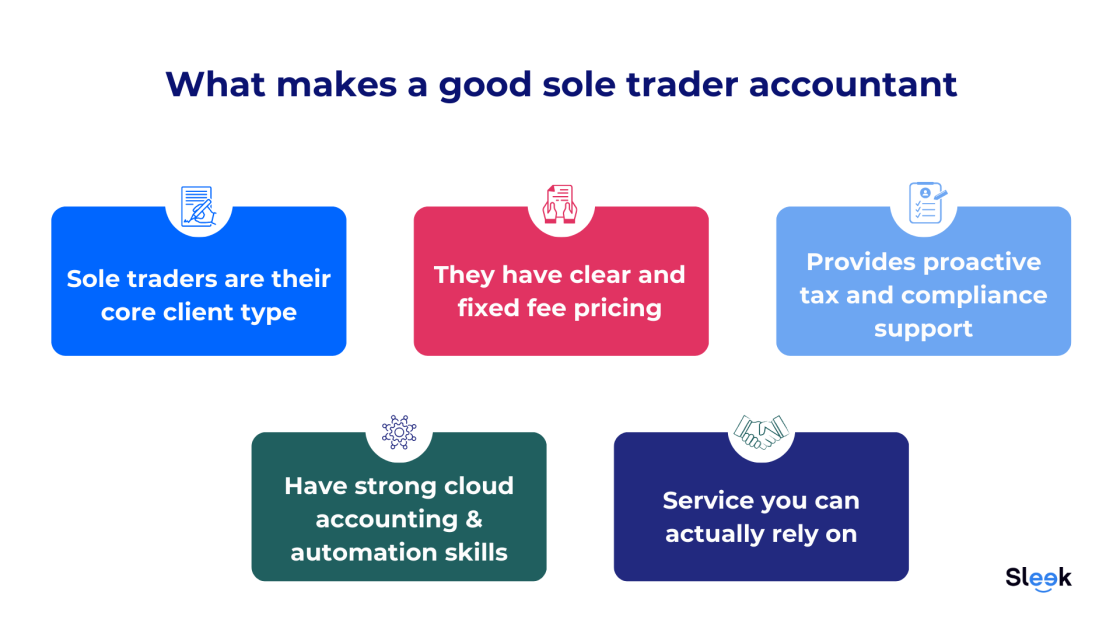
Here are the non-negotiables.
1. Sole traders are a core client type, not an afterthought
You want someone who works with sole traders every day, not just companies and bigger SMEs.
Look for:
- Services that clearly mentions sole traders, freelancers, tradies, consultants, creatives, online businesses
- Examples or case studies that sound like your situation
- Questions about how you work (income streams, tools, typical expenses), not just generic entity questions
If everything they talk about is companies, boards, and CFOs, they’re probably not the best fit.
2. Clear, fixed-fee pricing with a defined scope
For sole traders, unpredictable hourly billing is a recipe for bill shock.
A strong provider will:
- Offer fixed-fee or package pricing (monthly or annual)
- Spell out exactly what’s included: tax return, BAS, bookkeeping, advice, software
- Be upfront about what costs extra (e.g. amendments, complex advice, cleanup work)
Quick test:
Ask for a written outline of “What’s included in this fee, and what would be an additional charge?”
If the answer is vague, move on.
3. Proactive tax and compliance support (not just form-filling)
You’re not paying just to have forms lodged. You’re paying for someone to keep you compliant and help you avoid overpaying tax.
A good sole trader accountant will:
- Talk about planning ahead, not just cleaning up last year
- Explain typical deductions for your type of work (tools, home office, vehicle, software, marketing, professional fees, etc.)
- Be explicit that they stay on the right side of ATO rules, no gimmicks, no “creative” shortcuts
If all they talk about is “lodging returns”, their mindset is too narrow.
4. Strong cloud accounting and automation skills
An accountant who still relies on emailing spreadsheets back and forth will slow you down.
Look for someone who:
- Works confidently with cloud accounting software (e.g. Xero)
- Can help you set up or clean up bank feeds and rules
- Encourages tools like receipt capture rather than manual data entry
That’s how you get your evenings back instead of reconciling transactions line by line.
5. Service you can actually rely on
Technical skills are useless if you can’t get a straight answer when you need one.
Check:
- Response times: Ask, “How quickly do you usually reply to sole trader clients?”
- Point of contact: Will you have a go-to person, or a different name every time?
- Communication style: Do you feel talked down to, rushed, or genuinely supported?
What to focus on (more important than the exact number)
Instead of fixating on “Is this too expensive?”, zoom out and look at the value behind the fee.
Consideration | What to look for |
Scope | Is it tax-only, or does it include BAS, bookkeeping, software and advice? |
Predictability | Fixed-fee or package pricing vs open-ended hourly billing and surprise invoices. |
Value over 12 months | How much time, stress and risk does this realistically take off your plate? |
Fit for your situation | Does the package match where your business is now and where it’s heading? |
The goal isn’t to find the cheapest accountant.
It’s to find the one who gives you the best outcome for the fee you’re paying.
Red flags to watch when looking for a sole trader accountant
Just like there are signs you’ve found the right fit, there are also signals you should walk away.
Here are the biggest red flags to keep an eye on:
Red flag | What it looks like | Why it’s a problem |
Vague or shifting pricing | “We’ll just bill you at the end” / no clear scope in writing | You have no idea what you’ll pay until the invoice lands |
Only hourly billing, no estimate | Can’t give even a ballpark for the year | Easy for costs to blow out, hard to budget |
No clear experience with sole traders | They only talk about companies, groups, “corporate clients” | They may miss sole trader-specific issues and opportunities |
Slow or patchy communication | Takes days to reply, hard to get straight answers | You’ll be chasing them when deadlines or ATO letters hit |
Overpromising tax refunds | Lots of talk about “big refunds” before they know your situation | Suggests aggressive or risky tax behaviour |
Reluctance to use cloud tools | Pushes back on Xero or similar, wants everything emailed or on spreadsheets | More manual work, higher error risk, less visibility for you |
No mention of security or data handling | Casual about TFNs, bank data, documents over unsecured email | Puts your sensitive information at unnecessary risk |
Purely reactive mindset | “We’ll talk at tax time” and nothing about planning, check-ins or year-round help | You stay stuck in last-minute mode, not proactive with tax or cash flow |
A good sole trader accountant should make you feel:
- Clear on what you’ll pay
- Clear on what you’ll get
- Confident they know your type of business
- Comfortable asking questions
If you’re feeling the opposite, that’s your cue to keep looking.
Why is Sleek one of the best sole trader accountants in Australia?
When you’re done juggling spreadsheets and guessing what the ATO expects, Sleek gives you one place to plug everything in and switch the stress off.
- All-inclusive accounting
Get everything sorted in one place, tax returns filed, deductions correctly claimed, and compliance covered year-round so you’re never scrambling at the last minute. - BAS, done right
Never miss a deadline again. We prepare and lodge your BAS accurately and on time, no late fees, no guesswork, no ugly surprises from the ATO. - Stress-free GST
Stop second-guessing GST rules. We manage and process your GST, keep you compliant, and make sure you’re claiming what you’re entitled to, nothing more, nothing less. - Bookkeeping, always ready
Stay tax-ready every day. Your books stay clean, reconciled, and up to date with automated Xero tracking and regular reviews from our team.

If you’re ready to stop doing it all yourself and start treating your accounting like a system, not a scramble, Sleek is built for you as a sole trader.