










Expert Accounting & Year-Round Peace of Mind – now at ‎‎ 20% OFF! .
Expert Accounting & Year-Round Peace of Mind – now at ‎‎ 20% OFF! . Offer ends in:
Days
Hours
Min
Secs
United Kingdom
Singapore
Australia
Hong Kong

The Advantages of Share Capital for Limited Companies

8 mins read
Picture of Toby Denwood
Toby Denwood
Tax Manager
Toby is an experienced tax advisor who leads the UK tax team at Sleek, helping owner managed businesses stay compliant, save time, ensure efficiency, and access valuable tax incentives.
LinkedIn
Illustration of a man in a suit pointing to stacked coins, banknotes, a growth arrow with plant shoots, and a security shield, on a blue Sleek-branded background.
Rated
3.9/5
trustpilot review rating
by 3,000+ verified clients
98% client satisfaction from 16,000+ survey responses.
Key takeaways
  • Share capital lets a limited company raise money by issuing shares, with no repayments and no interest to service.
  • Issuing shares brings ownership flexibility and investor expertise, but it also means sharing control and profits.
  • A shareholder’s liability is capped at the nominal value of their shares, which is what makes limited liability work.
In this article

The main advantages of share capital are that you raise money without taking on debt, you can share ownership flexibly, and your shareholders’ liability stays capped at the value of their shares.

Only limited companies can issue shares, so this becomes an option the moment you incorporate your company. There’s no loan to repay, no interest ticking away, and no monthly pressure on your cash flow.

It’s how plenty of UK businesses fund growth and bring experienced investors on board.

Setting up your company and not sure how to structure the shares?

What is share capital?
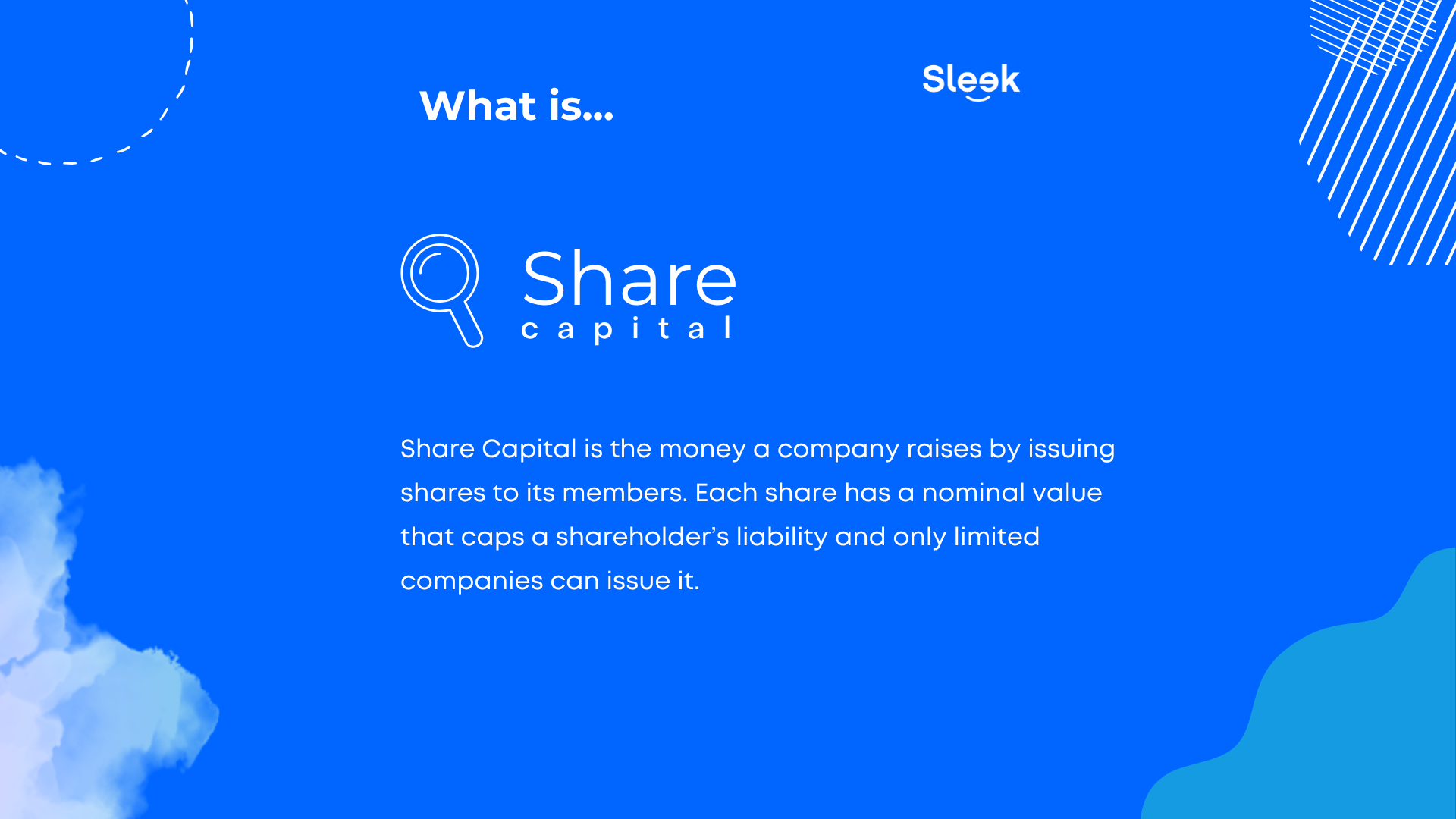
Blue Sleek-branded graphic with a magnifying glass icon defining share capital as money a company raises by issuing shares, with each share's nominal value capping shareholder liability.

Share capital is the money a company raises by issuing shares to its members. When someone buys a share, they’re buying a slice of ownership, and often a say in decisions plus a right to dividends if the company does well.

Each share has a nominal value, usually £1, though it can be as low as £0.01 or set in another currency. That nominal value is the amount the company must receive for the share, and it’s also the limit of a shareholder’s liability, the limited liability that GOV.UK confirms protects owners up to the value of their investment.

You’ll often see the phrase “issued vs authorised” share capital floating about. Here’s the thing: authorised share capital was scrapped for new companies back in October 2009 under the Companies Act 2006. So it’s worth clearing up before we go further.

Issued share capital

Issued share capital is simply the shares your company has actually allotted to shareholders. When you form a company and take, say, 100 shares at £1 each, your issued share capital is £100.

That’s the figure that matters day to day, and it’s what you set when you register your company and appears on your statement of capital at Companies House.

Authorised share capital (a legacy concept)

Authorised capital was once the maximum number of shares a company could issue. Companies formed since October 2009 don’t have it at all.

If your company was set up before then, an old cap may still sit in your articles. You can remove it with a shareholder vote if it’s getting in the way, leaving you free to issue shares without an arbitrary ceiling.

What are the advantages of share capital?

The advantages of share capital come down to funding your business without debt, keeping your liability contained, and pulling in people who can help you grow. Here’s how each one plays out.

No repayments and no interest

Money raised through shares isn’t a loan. Once an investor buys in, you don’t owe them monthly repayments and you’re not paying interest on the sum.

For a startup or a company in growth mode, that’s a serious weight off your cash flow. You can put every pound to work rather than servicing debt.

Access to larger funding

Banks can be cautious about lending, especially to younger companies. Share capital opens a different door, letting you raise meaningful sums from investors who believe in what you’re building.

That backing can fund new hires, new kit, or a push into a new market.

Limited liability that actually protects you

This is the big one, and it’s baked into how shares work. A shareholder’s liability is capped at the nominal value of the shares they hold, so if the company runs into trouble, they’re not personally on the hook beyond what they’ve agreed to pay for their shares.

Compare that with a personal loan or guarantee, where your own assets can be at risk. Getting your company share certificates issued correctly is part of making this protection watertight.


Tip

Keep your statement of capital at Companies House accurate every time you issue or transfer shares. A mismatch here is one of the most common things that trips up small companies at filing time.

Investor expertise and credibility

Bringing shareholders on board often brings more than cash. Experienced investors arrive with industry knowledge, useful contacts, and a network you couldn’t buy.

Having credible backers can also lift your reputation with lenders, suppliers, and customers. It signals that people with money and judgement have bet on you.

Shared risk

Because investors share in the outcome, good or bad, you’re not carrying all the financial risk yourself. If the company underperforms, you’re not personally repaying investors the way you’d repay a loan.

That shared exposure is one reason equity funding suits ambitious, higher-risk plans that a bank might not touch.

What are share classes and what do they enable?

Share classes let you give different shareholders different rights, which is where share capital becomes a genuine planning tool rather than just a funding method. Most small companies start with a single class, but you can create more as your needs change.

The two you’ll meet most often are ordinary and preference shares.

Share class

Voting rights

Dividend priority

Typical use

Ordinary

Yes

Standard, paid after preference

The default class for founders and most shareholders

Preference

Usually none

Paid before ordinary shares

Investors who want income priority over control

Non-voting ordinary

No

Standard

Family members or employees you want to reward without giving control

Different classes are how you’d, for example, bring a spouse in as a shareholder on dividends without handing over voting power. If you’re weighing up how many people to bring in, our guide on how many shareholders you can have walks through the practicalities.

When you issue shares above their nominal value, the extra sits in a separate account. That’s covered in our explainer on what share premium is and how it’s treated.

How much share capital should I start with?

Most private companies start with a small, fully paid amount of share capital, often just £1 to £100. There’s no legal minimum for a private limited company, so you don’t need to tie up cash you’d rather use elsewhere.

A modest figure keeps things simple and still gives you room to issue more shares later as you grow.

Keep it low and fully paid

A common setup is 100 ordinary shares at £1 each, all paid up. It’s clean, it’s easy to explain, and it covers most founders comfortably.

Starting low doesn’t limit your ambitions. You can always allot more shares later, and your original certificate of incorporation stays valid throughout.

When a higher figure makes sense

If you’re planning to raise investment soon, or you want a share structure that anticipates new backers, a slightly larger or more layered setup can help. Public limited companies are a different story, with a statutory minimum, and you can read more in our guide to the public limited company structure.

For most small UK businesses, though, keeping it simple at the start is the sensible call.

What are the trade-offs to weigh up?

The advantages of share capital come with genuine trade-offs, and it’s worth being clear-eyed about them before you issue a single share. Giving away equity is permanent in a way that repaying a loan isn’t.

  • Loss of control: the more shares you issue, the more your voting power dilutes, and shareholders can influence or block major decisions.
  • Profit-sharing: shareholders expect a return, usually through dividends, so profits you might have kept get shared out.
  • Ongoing obligations: issuing shares brings paperwork, shareholder agreements, and reporting duties you have to keep on top of.
  • Dividend tax: dividends are taxed differently from salary, and getting the mix right matters, as our guide to tax on dividends explains.

None of these are dealbreakers. They’re just the other side of the coin, and worth planning for rather than discovering later.

How Sleek helps with share capital

Getting your share structure right at the start saves a lot of untangling later. The number of shares, the classes, who holds what, and how it’s all recorded feeds straight into your filings, your dividends, and your control of the company.

Sleek sets your shares up correctly when you incorporate, keeps your statement of capital accurate, and handles the accounting that sits behind it all.

Get your share structure right from day one
From incorporation to ongoing accounts, Sleek keeps your company compliant so you can focus on growing it.
Business owners reviewing finances with online accounting software in a modern blue vector illustration

Disclaimer: The preceding information is not legal advice. This content is aimed to provide general guidance. For more formal or legal advice, contact Sleek directly.

Sleek is the preferred partner of business owners
Expertise in company incorporation, accounting, tax services, and compliance.
Trusted by over
450,000
businesses worldwide.
4.8/5
trustpilot review rating
on Trustpilot.
95%
satisfaction rate from
16,000 surveyed clients.

FAQs on share capital

Can a sole trader raise share capital?

No. Only limited companies can issue shares, so sole traders and partnerships can’t raise share capital. If you want to bring in equity investors or use shares to structure ownership, you’d need to incorporate as a limited company first. That’s a large part of why many growing sole traders make the switch to a limited company structure.

Does share capital have to be paid straight away?

Not necessarily. Shares can be issued fully paid, partly paid, or nil paid, meaning the shareholder owes the balance later. The unpaid amount stays due and can be called on by the company, or on winding up if assets don’t cover the debts. Most small companies keep it simple and issue shares fully paid from the outset.

Is share capital taxed?

No, raising share capital isn’t itself taxed as income for the company. Money received for shares at nominal value goes to share capital, and anything above that sits as share premium. Tax comes into play later, mainly through dividends paid to shareholders and any gains when shares are eventually sold.

Can I increase my share capital after incorporation?

Yes. You can allot new shares at any time after forming your company, subject to your articles and any shareholder approval needed. You then update your statement of capital at Companies House. This is the normal route for bringing in new investors or rewarding people with equity as the business grows.

What is the difference between share capital and a director’s loan?

Share capital is permanent investment in exchange for ownership, with no repayment. A director’s loan is money you lend the company that it owes back to you. Share capital dilutes ownership and carries no repayment obligation, while a loan keeps ownership intact but sits on the books as a debt the company must eventually repay.


View more

Can I have different share classes from the start?

Yes. You can set up more than one class of shares at incorporation, giving different holders different voting, dividend, or capital rights. This is useful if you want, say, a spouse on dividends without voting control. Getting the classes defined clearly in your articles from day one avoids costly restructuring later.

What happens to share capital if the company closes?

When a company is wound up, shareholders rank last for any payout, behind creditors. If anything remains after debts are settled, it’s distributed to shareholders according to their share rights. In many small company closures there’s nothing left over, which is exactly why limited liability caps a shareholder’s loss at what they paid for their shares.