









Expert Accounting & Year-Round Peace of Mind – now at ‎‎ 20% OFF! .
Expert Accounting & Year-Round Peace of Mind – now at ‎‎ 20% OFF! . Offer ends in:
Days
Hours
Min
Secs
United Kingdom
Singapore
Australia
Hong Kong

Dividend Allowance 2026/27: Rates, Thresholds and How to Pay Less Tax

Updated:

Published:

8 mins read
Picture of Ping Law
Ping Law
Financial Accountant
Ping supports Sleek clients with accounts preparation and day-to-day accounting support. With nearly 4 years experience and currently progressing through the ACA (ICAEW) qualification, Ping is recognised by clients for her dedication and support in helping businesses succeed.
Sleek blog thumbnail with text reading "What is the Dividend Allowance?" beside an illustration of a person reviewing financial documents, charts, a calculator, and a piggy bank.
Rated
3.9/5
trustpilot review rating
by 3,000+ verified clients
98% client satisfaction from 16,000+ survey responses.
Key takeaways
  • The 2026/27 dividend allowance is £500, and you pay no tax on the first £500 of dividend income regardless of your tax band.
  • Dividend tax rates rose on 6 April 2026 to 10.75% (basic), 35.75% (higher) and 39.35% (additional), so the same dividends now cost more than they did last year.
  • You can cut or remove dividend tax legally by using ISAs, spreading payments across tax years, and combining your dividend allowance with your personal allowance.
In this article

The dividend allowance for 2026/27 is £500, which means the first £500 of dividend income you receive this tax year is completely tax-free, whoever you are and whatever you earn.

Above that £500, dividends are taxed at 10.75%, 35.75% or 39.35% depending on your income tax band. Those rates rose by two percentage points on 6 April 2026, so the same dividend now costs you more than it did last year. Getting your dividend strategy right has rarely mattered more for contractors, directors and investors.

Drawing dividends and unsure how much HMRC will actually take this year?

What is the dividend allowance for 2026/27?

The dividend allowance is the amount of dividend income you can receive each tax year before any dividend tax is due, and for 2026/27 it sits at £500. You can confirm the current figure in the official tax on dividends guidance on GOV.UK.

It works as a 0% tax band rather than extra personal allowance. The first £500 of your dividends is taxed at 0%, and it does not push your other income into a higher band. Every UK taxpayer gets it, regardless of marginal rate.

The allowance has shrunk sharply over the years. It was £5,000 in 2017/18, fell to £2,000, then £1,000, and was cut to £500 from April 2024, where it remains for 2026/27. That long decline means far more people now pay dividend tax, often for the first time.

How are dividends taxed in 2026/27?

Once you have used your £500 allowance, dividends are taxed at a rate that matches your income tax band, and those rates increased on 6 April 2026.

Dividends are treated as the top slice of your income. HMRC stacks your salary and other income first, then places dividends on top, so the band your dividends fall into depends on your total income, not the dividend amount alone.

Here are the current rates and how they changed:

Tax band

Dividend tax rate 2025/26

Dividend tax rate 2026/27

Basic rate

8.75%

10.75%

Higher rate

33.75%

35.75%

Additional rate

39.35%

39.35%

The basic and higher rates rose by two points. The additional rate is unchanged. For a higher-rate taxpayer drawing £10,000 in dividends outside an ISA, that two-point rise adds roughly £190 in tax a year for doing nothing differently.

Basic rate dividend tax

If your total income keeps you within the basic rate band, up to £50,270 for 2026/27, you pay 10.75% on dividends above your allowance.

This is the rate most small company directors planning a low-salary, dividend-heavy approach will pay on the bulk of their drawings.

Higher rate dividend tax

If your total income falls between £50,271 and £125,140, dividends above the allowance are taxed at 35.75%.

Because dividends sit on top of your other income, a modest dividend can be pushed entirely into this band if your salary already fills the basic rate. Many directors misjudge this and underprovide for the bill.

Additional rate dividend tax

If your total income exceeds £125,140, you pay 39.35% on dividends above the allowance. This rate did not change in April 2026, so additional-rate taxpayers are the one group unaffected by the rise.

How to calculate your dividend tax
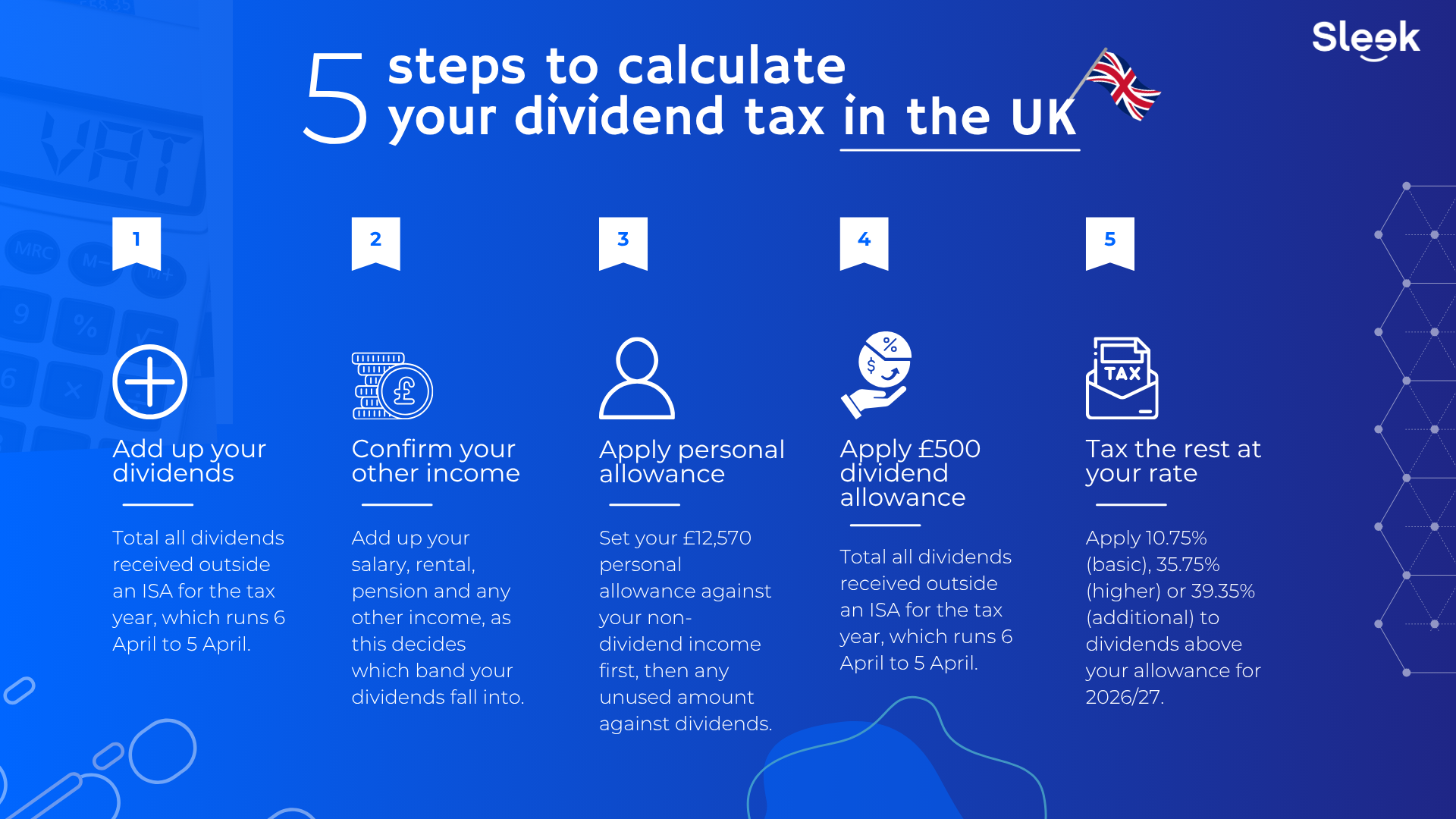
Infographic showing the 5 steps to calculate dividend tax in the UK for 2026/27: add up dividends, confirm other income, apply the £12,570 personal allowance, apply the £500 dividend allowance, then tax the rest at 10.75%, 35.75% or 39.35%.
The five steps to work out your UK dividend tax for 2026/27, from totalling your dividends to applying the £500 allowance and the correct rate for your band.

You calculate dividend tax by stacking your income in the right order, applying your allowances, then taxing what is left at the rate for each band. Here is the process step by step.

  1. Add up all dividends received outside an ISA for the tax year (6 April to 5 April).
  2. Confirm your other income, such as salary, rental and pension.
  3. Apply your personal allowance (£12,570 for most people) to your non-dividend income first.
  4. Apply the £500 dividend allowance to your dividend income.
  5. Identify which band the remaining dividends fall into and apply 10.75%, 35.75% or 39.35%.

If you would rather check your position against an official tool, GOV.UK’s dividend tax checker walks through the same calculation using your figures.

Keep your dividend vouchers from every company you hold shares in. They record each payment and date, which makes both the calculation and your Self Assessment far quicker.

As a worked example, take a director on a £12,570 salary who draws £50,000 in dividends in 2026/27. The salary is covered by the personal allowance. 

The first £500 of dividends is tax-free. The remaining £49,500 is split across the basic and higher bands, taxed at 10.75% and then 35.75%, producing a dividend tax bill of roughly £8,270. Your own figures will depend on all your income and reliefs, so treat this as illustrative.

How does the dividend allowance interact with other allowances?

The dividend allowance sits on top of your other allowances, and understanding how they combine is where most of the tax saving lives.

Your personal allowance of £12,570 is applied to your non-dividend income first, such as salary or rent. Any unused personal allowance can then be set against dividend income, so someone whose only income is dividends could receive £12,570 plus the £500 allowance before any dividend tax applies.

The dividend allowance is separate from your Personal Savings Allowance, which lets basic-rate taxpayers earn £1,000 of savings interest tax-free and higher-rate taxpayers £500. Dividends are also income, not capital, so they do not touch your Capital Gains Tax allowance at all.

How can you reduce your dividend tax legally?

You can lower or remove dividend tax by using tax-free wrappers, timing your payments, and splitting income with a spouse where appropriate. None of this is avoidance; it is simply using the allowances as intended.

  • Use a Stocks and Shares ISA. Dividends on shares held inside an ISA are completely tax-free and never count towards your £500 allowance. The annual ISA allowance is £20,000.
  • Spread dividends across tax years. If you control when your company pays, taking some dividends just before 6 April and some just after lets you use two years of allowances and can keep you in a lower band.
  • Combine allowances with a spouse. Issuing shares to a spouse in a lower tax band can use their personal and dividend allowances too, though this must be a genuine transfer of beneficial ownership.
  • Pay pension contributions. Employer pension contributions from your company are deductible and extract value without triggering dividend tax at all.

There is a clear case for sheltering as much dividend income as possible inside an ISA now that the rates have risen. 

For more on getting money out of your company efficiently, see Sleek’s guide to the most tax-efficient ways to withdraw money and the wider point of what a dividend actually is before you decide how to draw it. 

Tip

If your dividends are about to tip you into the higher rate band, check the timing before you declare them. Paying part of a dividend just before 6 April and the rest just after splits it across two tax years, giving you two £500 allowances and potentially keeping more of it at the 10.75% basic rate rather than 35.75%.

Do dividend rules differ for Scottish taxpayers?

Dividend tax rates and the £500 allowance are identical across the whole UK, including Scotland, so a Scottish taxpayer pays the same 10.75%, 35.75% or 39.35% on dividends as anyone else.

What differs in Scotland is the income tax on salary and other non-dividend income, which uses separate Scottish bands. Because those bands decide how much of your basic-rate room is already used, they can affect which band your dividends land in, even though the dividend rates themselves are UK-wide.

How do you report dividend income to HMRC?

You report dividends through Self Assessment if they exceed your allowances, and the way you do it depends on how much you receive.

If your dividends sit within the £500 allowance, you have nothing to report. Above that, you must tell HMRC. If you do not already file a return, you need to register for Self Assessment by 5 October following the end of the tax year. 

Dividend tax is then paid by 31 January, alongside the rest of your Self Assessment bill. If you are weighing dividends against salary and directors’ loans, it is worth modelling all three together rather than in isolation.

How Sleek helps with dividend tax

Dividends look simple until the rates change, your salary tips you into a higher band, or a Self Assessment deadline appears. The 2026/27 rate rise has narrowed the gap that made dividend-heavy extraction so attractive, which makes getting the salary and dividend split right more valuable than ever.

Sleek’s accountants handle the calculation, the planning and the filing together, so you draw income in the most efficient way and never face a surprise bill.

Take the guesswork out of your dividends
Let Sleek’s UK accountants plan your salary and dividend split and file it correctly, so you keep more and stress less.

Disclaimer: The preceding information is not legal advice. This content is aimed to provide general guidance. For more formal or legal advice, contact Sleek directly.

Sleek is the preferred partner of business owners
Expertise in company incorporation, accounting, tax services, and compliance.
Trusted by over
450,000
businesses worldwide.
4.8/5
trustpilot review rating
on Trustpilot.
95%
satisfaction rate from
16,000 surveyed clients.

FAQs on dividend allowance

What is the dividend allowance for 2026/27?

The dividend allowance for 2026/27 is £500. This is the amount of dividend income you can receive in the tax year before any dividend tax applies, and it is available to every UK taxpayer regardless of their income tax band. Dividends above £500 are taxed at 10.75%, 35.75% or 39.35% depending on your total income.

Did dividend tax rates go up in 2026?

Yes. From 6 April 2026 the basic rate rose from 8.75% to 10.75% and the higher rate from 33.75% to 35.75%. The additional rate stayed at 39.35%. The change means anyone drawing dividends above their allowance outside an ISA pays more tax in 2026/27 than in the previous year on the same income.

Do I pay National Insurance on dividends?

No. Dividends are not subject to National Insurance, which is one reason directors often favour them over salary. You only pay dividend tax at your marginal rate above the £500 allowance. This National Insurance saving is a key part of why a low-salary, dividend approach can still be efficient even after the 2026 rate rise.

Are ISA dividends counted in my dividend allowance?

No. Dividends from shares held inside a Stocks and Shares ISA are entirely tax-free and never count towards your £500 dividend allowance. This makes ISAs one of the most effective ways to protect dividend income, and the case for using them is stronger now that dividend tax rates have increased.

Can I carry forward an unused dividend allowance?

No. The dividend allowance is a use-it-or-lose-it benefit within each tax year. If you do not use the full £500 in a given year, it does not roll over into the next one. This is why timing dividend payments across two tax years can help you make use of two separate allowances.


View more

How much can I earn in dividends before paying tax?

If dividends are your only income, you could receive up to £13,070 before any dividend tax: your £12,570 personal allowance plus the £500 dividend allowance. If you have a salary or other income that uses your personal allowance first, only the £500 dividend allowance remains, so dividends above that are taxed.

Do I need to tell HMRC about dividends within my allowance?

No. If your total dividends fall within the £500 allowance, there is nothing to report. Once dividends exceed the allowance you must tell HMRC, either through your existing Self Assessment return or by registering for one by 5 October after the tax year ends, with payment due by 31 January.